The Supreme Court on Saturday set aside an order of the National Green Tribunal (NGT) directing Sri Sri Ravi Shankar’s Art of Living Foundation (AOL) to pay ₹5 crore in environmental compensation for restoring the Yamuna floodplains, where the World Culture Festival was held in 2016. The court pulled up the Delhi Development Authority (DDA) for granting permission to hold such an event on the ecologically sensitive Yamuna floodplains and directed the landowning agency to refund the ₹5 crore within four weeks.
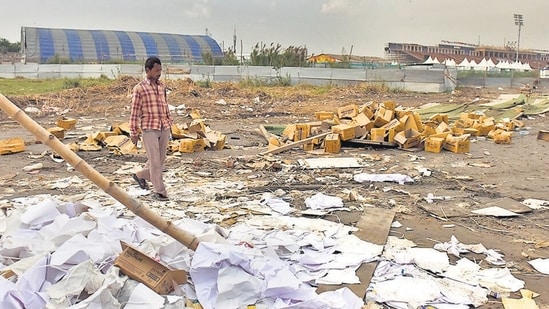
Finding serious flaws in the reasoning and conclusion of the NGT’s December 7, 2017 judgment, in a challenge by AOL’s legal entity Vyakti Vikas Kendra, India, the top court said that the tribunal “burdened” AOL with the task of developing the floodplain that it “never destroyed”.
The judgment, by a bench of justices Satish Chandra Sharma and N Kotiswar Singh, read, “The Tribunal completely altered the character of the dispute before itself and converted it into a proceeding for fresh development of the Yamuna floodplain, and in doing so, it burdened the appellant to bear the expenses of such development activity. Effectively, the Tribunal burdened the appellant with the task of developing something that it never destroyed.”
Also Read | Karnataka govt forms SIT to probe land encroachment by The Art of Living
The event was organised on 25 hectares of the floodplains, upstream of the DND Flyway, from March 11 to 13, 2016.
{{/usCountry}}The event was organised on 25 hectares of the floodplains, upstream of the DND Flyway, from March 11 to 13, 2016.
{{/usCountry}}While permitting DDA to continue with the rehabilitation of the floodplain as ordered by the NGT from time to time, the bench held, “The manner in which permission was granted by DDA to hold the event on an active floodplain of the river cannot be approved. It was not only avoidable, but was also not consistent with the precautionary principle and doctrine of public trust. The authority failed to act in accordance with its duties towards the public at large.”
However, it refrained from passing any order as the grant of permission was not under challenge.
Court questions findings on floodplain damage
The counsel for AOL argued before the top court that the NGT required the organisation to deposit a sum of ₹5 crore prior to the event based on a conclusion that the floodplain was damaged. Pursuant to the event, the tribunal relied on reports prepared by the expert committee, whose findings were under doubt, given that in one report, the committee reported extensive damage and in a subsequent report, admitted it was not possible “to determine the state of ecosystem to which restoration has to be carried out”.
Also Read | Art of Living should not be allowed to get away with damaging the Yamuna
Terming this as a “flip” by the committee, the bench said, “We are afraid, the Tribunal got swayed by the expert committee’s report that massive preparatory work is going on at the site and went on to conclude that by undertaking such work, the appellant has severely damaged the floodplain.”
The court held that such a conclusion was reached without the tribunal noticing that in December 2015, AOL wrote to DDA about construction debris scattered at the site in question, which DDA admitted and allowed AOL to clean it up. The court found further flaws in the committee’s findings based on unverified Google imagery showing the event site as a “green vista” prior to the event, when there were reports as old as 2015 indicating how the pre-event state of the floodplain did not present a “happy picture”.
“The Tribunal ought to have questioned as to how the satellite image presented a flowery picture of the floodplain; however, it did not,” the bench said.
The court cited the NGT Act and said that the task entrusted to the tribunal was for restoration, which is distinct from rehabilitation. “Rehabilitation of the floodplain was never the issue before the committee or the Tribunal. Evidently, the committee not only exceeded its mandate but also brought its earlier opinions on the issue under scanner,” the top court held.
SC flags flaws in NGT’s approach to restoration
Later, when AOL sought to question the committee’s findings by presenting alternative evidence, the tribunal discarded the same. The NGT then called for a fresh report from government experts, who conducted a site inspection and effectively nullified the allegations of damage. This report was rejected by the tribunal on the ground that the committee was not supposed to report on damage, but to propose an action plan.
The bench held, “We cannot approve of the approach adopted by the Tribunal. As a neutral fact-finding body, the Tribunal ought to have taken all relevant material into consideration for deciding the liability of the appellant.”
Reiterating that the responsibility of private persons gets triggered when environmental damage or degradation is attributable to them, the judgment said, “We feel constrained to note the manner in which the principle of no-fault liability has been invoked by the Tribunal in this matter.”
Frequently Asked Questions
What did the Supreme Court decide regarding the environmental compensation ordered by NGT?
What was the court's view on the Delhi Development Authority's approval for the event?
What significant flaws did the court find in the NGT's reasoning?
What issues were raised about the expert committee's reports?
Stay updated with all top Cities including, Bengaluru, Delhi, Mumbai and more across India. Stay informed on the latest happenings in World News along with Delhi Election 2025 and Delhi Election Result 2025 Live, New Delhi Election Result Live, Kalkaji Election Result Live at Hindustan Times.
Stay updated with all top Cities including, Bengaluru, Delhi, Mumbai and more across India. Stay informed on the latest happenings in World News along with Delhi Election 2025 and Delhi Election Result 2025 Live, New Delhi Election Result Live, Kalkaji Election Result Live at Hindustan Times.