Preliminary investigation by police and district authorities finding that demolition work in the adjacent building could have triggered the collapse of the Seemapuri five-storey building, which claimed at least four lives, has brought to light the demolition process used in the Delhi-NCR.
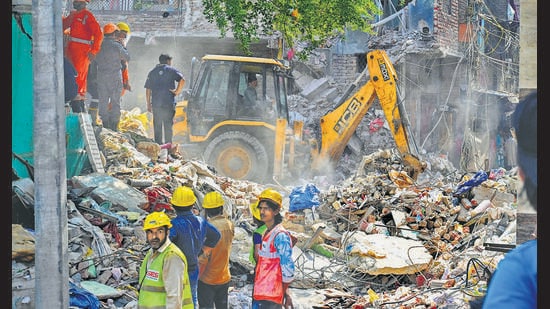
Ajay Kumar, District Magistrate (DM) of northeast Delhi, told HT that the owner of the adjacent building allegedly carried out illegal construction, over which a police complaint was filed about a fortnight ago.
“The police informed the Municipal Corporation of Delhi (MCD) about the same and the civic agency warned the owner that it will demolish the entire building if he did not remove the illegally constructed portion,” the DM said.
Also Read | Delhi Seemapuri building owner’s daughter among dead; toll rises to 4
Under the rules, once the MCD issues a demolition notice for illegal construction on private property, owners have two choices: demolish it themselves or opt for MCD demolition, which comes with hefty charges.
{{/usCountry}}Under the rules, once the MCD issues a demolition notice for illegal construction on private property, owners have two choices: demolish it themselves or opt for MCD demolition, which comes with hefty charges.
{{/usCountry}}A senior MCD official explained that demolition of unauthorised construction on private land falls under Section 343 (demolition or stoppage of unauthorised construction) of the Delhi Municipal Corporation Act. “Once the property is booked, the owners are asked to demolish the portion or regularise it, if law permits. If not permitted, the action is to write to discoms to cut the electricity supply, seal, and finally demolish. A 15-day notice is provided during which the owner can demolish the property on their own, while demolition charges are levied if MCD takes up the demolition after the deadline,” the official said.
The official said the demolition charges of up to ₹13,000- ₹14,000 per hour can be levied depending on the area and resources deployed.
Also Read | MCD, DUSIB trade blame over Seemapuri building collapse
A second set of demolition notices is for dangerous and dilapidated buildings, for which a three-day notice is issued. For instance, in the case of the Satya Niketan building collapse, the nearby structures were issued notices under section 348 of the Delhi Municipal Corporation Act, which empowers the Municipal Commissioner to order the owner or occupier to demolish, secure, or repair the building that is in a ruinous condition, likely to fall, or dangerous to people.
A second municipal official said that private parties’ demolition is not a regulated activity. “They should not damage the nearby properties, but there are no legal regulations regarding the demolition. They can hire labourers and demolish the structure. Disputes also arise while carrying out basement work in planned areas. Perhaps the government should amend regulations to ensure a more careful demolition process,” the official added.
Stay updated with all top Cities including, Bengaluru, Delhi, Mumbai and more across India. Stay informed on the latest happenings in World News along with Delhi Election 2025 and Delhi Election Result 2025 Live, New Delhi Election Result Live, Kalkaji Election Result Live at Hindustan Times.
Stay updated with all top Cities including, Bengaluru, Delhi, Mumbai and more across India. Stay informed on the latest happenings in World News along with Delhi Election 2025 and Delhi Election Result 2025 Live, New Delhi Election Result Live, Kalkaji Election Result Live at Hindustan Times.