
 E-Paper



Single-pillar Metro stations in Delhi to save space and hassle
Metro officials said such stations will come up on Janakpuri West to RK Ashram Marg corridor and Maujpur to Majlis Park line

 Prefer HTon Google


The Delhi Metro Rail Corporation (DMRC) will construct at least 16 elevated stations planned as part of the phase-4 expansion of the transit network on a single pier, as opposed to the current three, to be able to build structures in congested areas, as well as minimise road diversions and damage during the work, DMRC officials said.
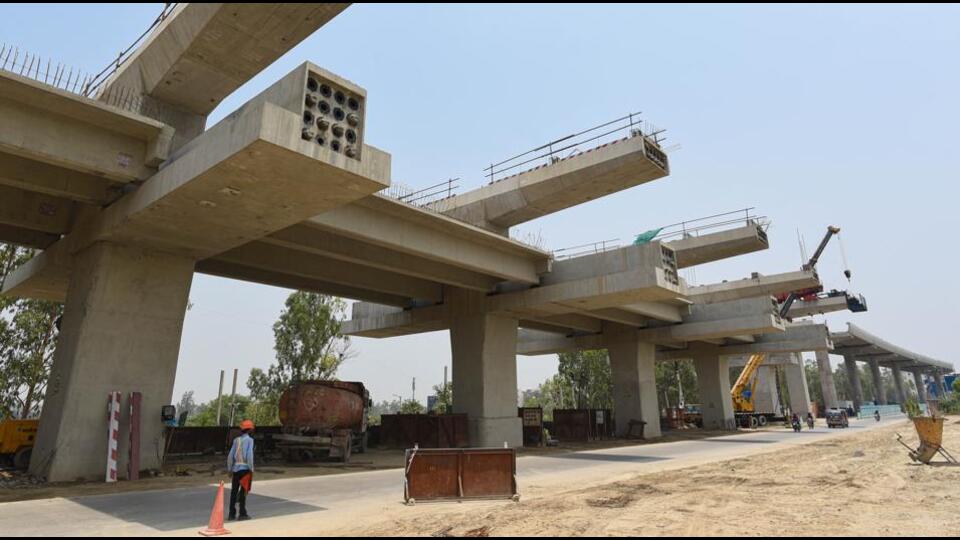
The officials said such stations will come up on Janakpuri West to RK Ashram Marg corridor and Maujpur to Majlis Park line. Since these corridors are coming up in the congested west and north-west parts of the Capital where finding enough space to build a station is a major challenge, they said.
So far, the DMRC has been using three piers -- one on the road median and one each on either side of the road to build elevated stations, though a single pier was used for laying the track. The officials said though they have used the same construction technique for making stations on the Dilshad Garden-Shaheed Sthal Line in Ghaziabad, they have not used it in Delhi so far.
“In Phase 4, several Delhi Metro’s elevated stations will occupy lesser road space and the construction process will also involve minimum activity on the site. This will help in smoother management of traffic near the construction sites and ensure a greater amount of safety,” said Anuj Dayal, principal executive director, corporate communications, DMRC.
He added that 16 elevated stations have been chosen so far, which will be constructed on a single pier, owing to congestion in the area.
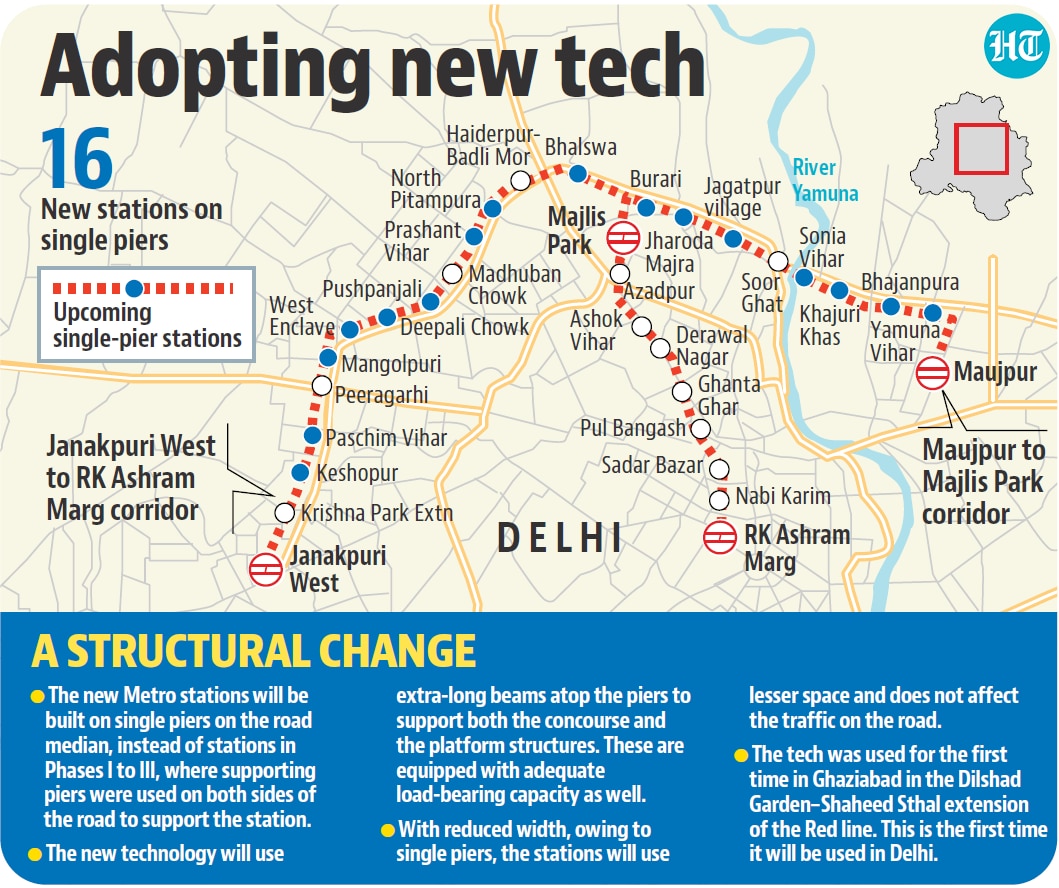
“Like the rest of the viaduct, the stations will also rest on single piers on the road median. In the conventionally designed stations, apart from the piers on the median, supporting piers are also constructed to support the station structure on both sides of the road. With this new technique, extra-long beams are being installed atop the piers to support both the concourse and the platform structures. These are equipped with adequate load-bearing capacity as well,” Dayal explained.
So far, there are nine such stations planned to be built on a single pier on the Janakpuri West to R.K Ashram Marg corridor, which is an extension of the Magenta Line. The stations include Keshopur, Pashchim Vihar, Mangolpuri, West Enclave, Pushpanjali, Deepali Chowk, Prashant Vihar, North Pitampura, and Bhalswa. And, seven such stations are under-construction on single piers on the Maujpur to Majlis Park corridor – an extension of the Pink Line, which will such elevated stations at Yamuna Vihar, Bhajanpura, Khajuri Khas, Sonia Vihar, Jagatpur village, Jharoda Majra and Burari.
Dayal says this process also reduces the time spent on-site, with a number of components planned to be shifted to the working site after casting is carried out at the casting yard, instead of being done on-site. “This has significantly reduced on-site activity which is a major benefit while working in a congested city like Delhi. Traffic is also not being disrupted,” he added.
Construction work is currently going on 27 elevated stations of the total 45 planned as part of the phase 4 expansion. The Delhi Metro currently operates on a network of 391 kilometres with 286 stations.
So far, three corridors have been approved in Phase IV, which also includes a new ‘Silver’ Line, which will connect Tughlakabad to Aerocity.



