


 Live Score
 Cricket Teams
 Cricket Players
Devdutt Padikkal’s 167 powers India past 460, but Sri Lanka fight back as seven wickets fall on rain-hit Day 2
India reach 460/9 in their first innings after home bowlers claim seven scalps on Day 2 of the first Test

 Prefer HTon Google


The sun played hide and seek as rain came and went at Galle on Sunday, teasing both teams before scuppering the chance of a full day’s play. When the light finally faded on the second day of the first Test against Sri Lanka, India were 460/9, a substantial total although it would not have felt as big as it would have at the start of the day.
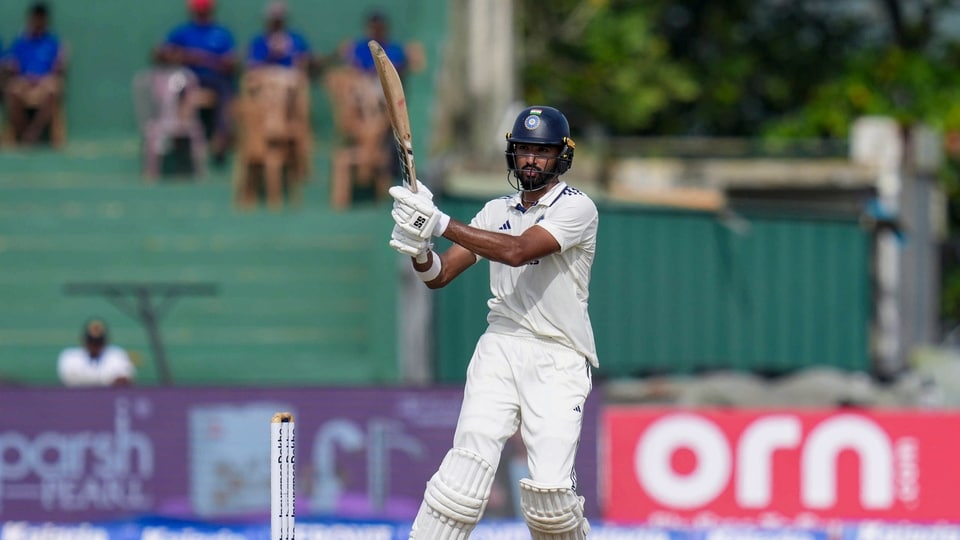
The reason was Sri Lanka’s response. After being put under sustained pressure on the opening day, their bowlers discovered discipline, length and, increasingly, a method. India added 172 runs from the 43 overs available, but lost seven wickets in the process. The scoreboard tells a story of accumulation, but the day itself was about resistance. And Devdutt Padikkal was at the centre of both narratives.
The left-hander resumed on 131, a century already secured overnight, and spent much of the second session – no play was possible until into the post-lunch session – looking as though he might make Sri Lanka pay for allowing him to settle. His 167 from 230 balls was not merely a large score but an assured performance against spin, built on an understanding of when to go forward and when to stay back.
Deep Dive

Statistics say Padikkal played almost half his deliveries against spin off the front foot and half from the back. That was a remarkable approach on a Galle pitch where the traditional response to spin is to smother the ball by getting well forward. Padikkal instead trusted his judgement of length, allowing him to score off the back foot without surrendering control.
“When you have that clarity in terms of what you want to do, I think that brings that confidence in your footwork as well,” Padikkal told the broadcaster after the day’s play. “I was just looking to make sure that I commit to whatever I do 100%. Even if it’s a defensive shot, I want to make sure that I really commit to playing that, so that made my footwork better.”
It was, therefore, fitting that his dismissal came from the opposite approach. Left-arm spinner Prabath Jayasuriya, returning to bowl with the second new ball, saw Padikkal advancing and pushed one through flatter and quicker. Padikkal committed himself, missed and was stumped. The wicket was less a consequence of sustained pressure than a reminder of the narrow margin that separates dominance from error in Test cricket. Padikkal had been in complete control, till he wasn’t.
Sri Lanka deserved credit for recognising the opportunity. Jayasuriya was the most important bowler on the field, finishing with 4/109 from 39 overs. The figures don’t convey the improvement in his bowling as the day progressed. He bowled patiently, varied his pace and, crucially, resisted the temptation to search for extravagant turn. On a surface where accuracy was often more valuable than mystery, he kept India working.
Debutant Keshara Nuwantha, the off-spinner, offered something different. A spinner trusted with the second new ball is unusual enough, a debutant finishing with three wickets against an Indian top order more so. His 39 overs cost 175 runs, but the wickets of Rishabh Pant, KL Rahul and Ravindra Jadeja were worth considerably more than what his economy suggests.
Pant’s dismissal was especially revealing. He had already shown the instinct that makes him such a dangerous Test batter, advancing to attack Nuwantha. But the shot lacked shape and elevation, and he miscued to mid-off for 39.
Rahul’s dismissal was more instructive. Returning after retiring hurt due to cramp on Saturday, he had negotiated 175 balls for 82, constructing another of those innings in which patience is itself a form of aggression. Nuwantha eventually found a delivery that turned sharply from outside off, cramped Rahul and induced a flick straight to short leg. From 305/2, India were suddenly 319/4.
Padikkal’s departure at 357/5 accelerated the collapse. Ravindra Jadeja was trapped leg-before by Nuwantha for 13 before Dhruv Jurel — he was on a valuable 51 — became Jayasuriya’s fourth victim. India slipped from 377/5 to 432/6 and then lost three wickets for only 28 runs. Manav Suthar made a useful 24 before lofting Jayasuriya to long on, while Mohammed Siraj’s brief 11 included a towering six before he fell to Asitha Fernando’s pace.
However, India remain favourites from this position. Their spin attack should eventually become a major factor, and the psychological advantage of crossing 450 after losing only one wicket for much of the opening day remains significant. The weather may ultimately prove to be as important as the pitch though. India have the runs, Sri Lanka have some momentum. What neither side has in abundance is time.


