E-Paper



Six more dengue deaths in Delhi take annual toll to 23, highest since 2015
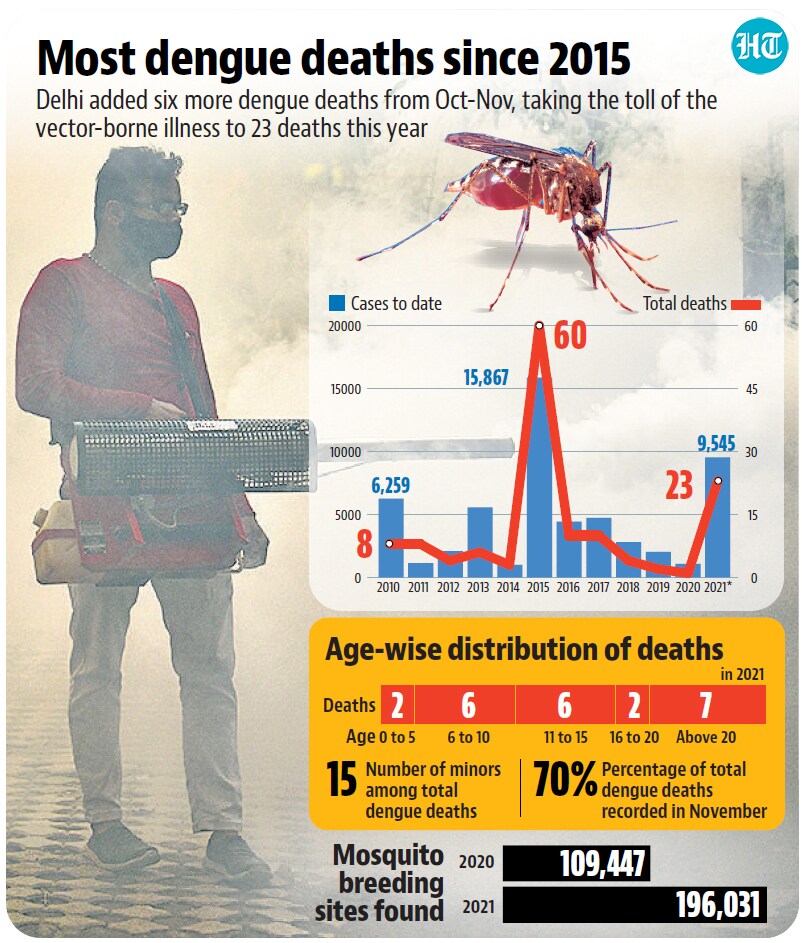
Delhi witnessed just one death in 2020, two in 2019, four in 2018 and 10 deaths each in 2017 and 2016. Of the 23 persons who died this year, 15 were minors

 Prefer HTon Google


Delhi added six more dengue deaths that took place between October and November, taking the toll due to the mosquito borne disease to 23 this year -- the most fatalities since 2015 when 60 people succumbed to the disease, according to the weekly report compiled by the three municipal corporations.
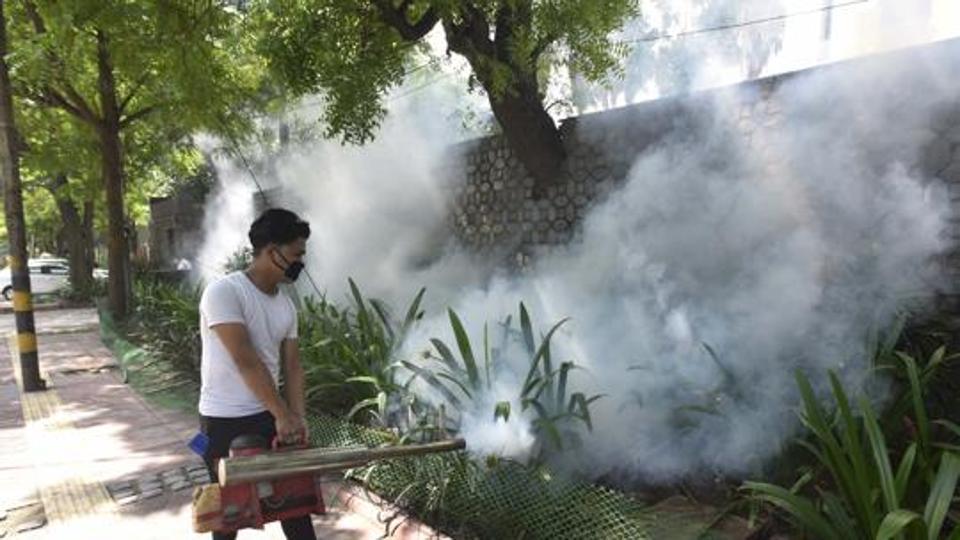
According to the latest report released on Monday, all six fatalities were those under 15 years, including an 8-month-old from Kirari in northwest Delhi who died in early November. The latest report also added 131 new dengue cases to the tally during the last week. The annual dengue case count in the Capital now stands at 9,545.
Officials said though no dengue death was reported last week, the latest fatalities were added to the weekly report after the municipal death audit committee confirmed dengue as the cause of death in the six cases.
Delhi reported the maximum fatalities and cases of the disease in 2015, when 60 people died of dengue and 15,687 got infected. Last year, the city reported only one dengue death, two in 2019, four in 2018 and 10 each in 2017 and 2016, according to the municipal data.
This was the last weekly dengue report of the year, that is released every Monday. According to the data compiled this year, of the 23 fatalities in 2021, 15 were minors. Of these, six were in the 11-15 age group and eight were under 10 years. “The youngest was an 8-month-old boy from Kirari who succumbed to dengue in Chacha Nehru Bal Chikitsalaya Hospital on November 3,” a municipal official said.
Dr Rommel Tickoo, director, internal medicine at Max Saket, said the city witnessed erratic rain during 2021, which proved to be a major factor in the increased number of cases. “Moreover, type-2 of dengue was circulating in Delhi as well as Uttar Pradesh, which is more virulent,” he added.
According to health experts, there are four dengue strains—type-1, type-2, type-3 and type-4. Type-2 and type-4 are more virulent strains while type-1 and type-3 are milder. Type-2 leads to haemorrhagic fever and shock.
Civic officials said that all the cases brought before the death audit committee so far have been processed. Once a dengue or malaria-related death is reported by a hospital, a nine-member expert committee audits all documents to check whether it was indeed an infection-related death and whether the origin of the case was in Delhi.
The committee also takes a look at other aspects such as co-morbidities, before attributing the death to a vector-borne disease. If a patient is severely ill due to other diseases and the main cause of death is not dengue, then the death is not attributed to the mosquito-borne disease, an official explained.
The vector-borne disease data between 2010 and 2021 shows that this is only the fourth instance when the number of infections has crossed 5,000-mark. A bulk of this year’s unusually high number of dengue infections was reported in November, which logged 6,739 cases. Trends from previous years show that the number of dengue cases in the city usually peak in October; officials attributed the delayed peak of infection this year to the delayed monsoon and the slow arrival of winter. Civic bodies also attributed the high number of cases to the government making a dengue a notifiable disease in mid-October.
“Before the notification, 36 hospitals would share weekly data with the malaria headquarters under the ‘sentinel surveillance system’. But now, corporations are getting data from 180 healthcare facilities,” an official overseeing the data compilations in the anti-malaria headquarters said.
Reacting to the record high number of dengue cases this year, the Delhi high court on Friday directed local bodies, including the three municipal corporations, to constitute task forces to monitor and control the mosquito infestation in the city. The court also asked the government to increase the fine imposed on owners of premises where mosquitogenic conditions are found. “Currently, a fine of just ₹500 is imposed, which is not a deterrent. We will soon send a proposal to raise it to ₹5000 per offence,” an official added.
Dr SP Byotra, senior consultant and chairman of the department of medicine at Sir Gangaram Hospital, said while the very high number of infections can be attributed to the delayed monsoon, there were lapses on the part of people as well as authorities. “Why do we wake up so late when the infection has already crossed a limit? The dengue control programme should be run all round the year. We should start the drives from March next year. Vector-borne diseases are bound to arise, and like other countries we should have institutional mechanisms that function all 365 days to deal with them,” he added.
The weekly report released on Monday said that of the reported 9,545 dengue cases, 2,645 were logged in the jurisdiction of north MCD, 2,570 under SDMC and 1,129 under EDMC. During this year, domestic breeding checkers of the three civic bodies detected 196,000 cases of mosquito larvae in houses across Delhi and issued 150,000 legal notices for mosquitogenic conditions. The corresponding number of houses in which mosquito breeding was detected was 109,000 in 2020 and 179,000 in 2019.