The best time to see Kamla Nagar is when the market is shut, an early morning walk in September, reveals the architecture behind the flex and signage of a crowded commercial area. As the monsoon sky still lingers, the sweet, dramatic sky during the rains sets off the terrazzo in these houses.
The buildings, built between 1950 and 1955, are streamliner deco clustered around the Gol Chakkar, combining Art Deco with colonial neo-classicism, indigenous traditions, and haveli architecture. Broken down, these influences produce a consistent set of features: a central courtyard that connects the mansion internally with light and community, a street-facing concrete verandah that filters the transition into the house while keeping it tied to one of the city’s early commercial hamlets, and climatic shading through windows and concrete grills.
The terrazzo is the dominant material in most of these houses, used for flooring, for fireplace facades, and for staircases, often in vibrant colours and maximalist patterns, with large columned galleries and ornamental grilles adding drama to the stairwells. Entrances were designed to be grand, with a heavy deco gateway bearing the mansion’s name embedded in terrazzo, sometimes alongside a date.
While photographing the neighbourhood one morning, we saw a young man leave one of these houses. After we explained what we were doing, he said he was dropping his wife off and would return; five minutes later, having checked with her, he invited us inside.
{{/usCountry}}While photographing the neighbourhood one morning, we saw a young man leave one of these houses. After we explained what we were doing, he said he was dropping his wife off and would return; five minutes later, having checked with her, he invited us inside.
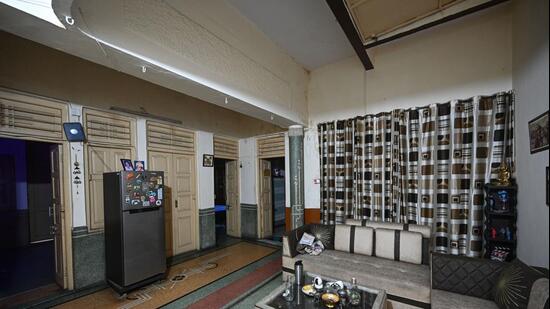
{{/usCountry}}This was the most elaborate deco house in the neighbourhood, bright yellow, with a curved balconied facade around the stairwell. A sleek staircase led to a first-floor apartment, its middle landing marked by a short door to a storeroom called a myani. The apartment belongs to Sahil Bandwal and his wife Divya Ujwal, who live in a reclaimed section of a larger family mansion, created by enclosing part of the courtyard. Inside, remnants of the original courtyard verandah remain visible, including the concrete jaali parapet. The apartment is largely unaltered: the floors, mouldings, parapet, and fireplace are all original to the 1950s, apart from a new front door and a bathroom door that once opened outside the bedroom area.
Houses of this kind maximised storage through built-in cupboards in many ways, a unique way to build storage was a loft on the kitchen roof, almost like the present day false ceiling but one with more purpose than just ornamental. Bandwal and Ujwal’s flat has two bedrooms, a puja ghar, a kitchen, a living room, and one bathroom with its myani outside, which has been sufficient for them so far, though they too plan to move out eventually. Asked why, they cited the noise and clutter of the street, which they said penetrates even the thick walls, and the impossibility of keeping curtains open without inviting the attention of neighbours. The family has lived in the house since the 1950s, when they were merchants, and like others in the area, they want to leave for a quieter, less cluttered part of the city.
This house is one of many mansions in a dense deco district. Kamla Nagar took shape after Independence, when wealthy merchants who could no longer live in overcrowded Old Delhi and were not given preference in Lutyens’ Delhi, reserved for the British and colonial staff, settled instead in West Delhi, close to both civil lines and the old city. These mansions were built to display wealth through architecture, producing the version of Delhi Deco recognisable today. As south Delhi developed, Kamla Nagar, once a major commercial hub where merchant families ran businesses from the ground floors of their homes, fell into neglect as the city’s attention moved elsewhere.
Today this deco district, part of a wider stretch across west Delhi, needs urgent attention. Much of it stands on the brink of demolition for newer construction, threatening to erase Delhi Deco before it has even been properly documented.
Anica Mann works on archaeology and contemporary art in Delhi. The views expressed are personal
Stay updated with all top Cities including, Bengaluru, Delhi, Mumbai and more across India. Stay informed on the latest happenings in World News along with Delhi Election 2025 and Delhi Election Result 2025 Live, New Delhi Election Result Live, Kalkaji Election Result Live at Hindustan Times.
Stay updated with all top Cities including, Bengaluru, Delhi, Mumbai and more across India. Stay informed on the latest happenings in World News along with Delhi Election 2025 and Delhi Election Result 2025 Live, New Delhi Election Result Live, Kalkaji Election Result Live at Hindustan Times.