E-Paper



Yamuna may hit danger mark in Delhi, central agency warns of floods
The forecast by CWC suggests that the water level is likely to touch 205.70 metre at 8pm on Monday and 206 metre by 2am on Tuesday.

 Prefer HTon Google


The hourly discharge of Yamuna water in Haryana’s Hathnikund barrage crossed the 100,000 cusecs threshold on Sunday, for the first time this season. The Central Water Commission (CWC) has therefore warned that a significant rise in the water level is likely till Tuesday.
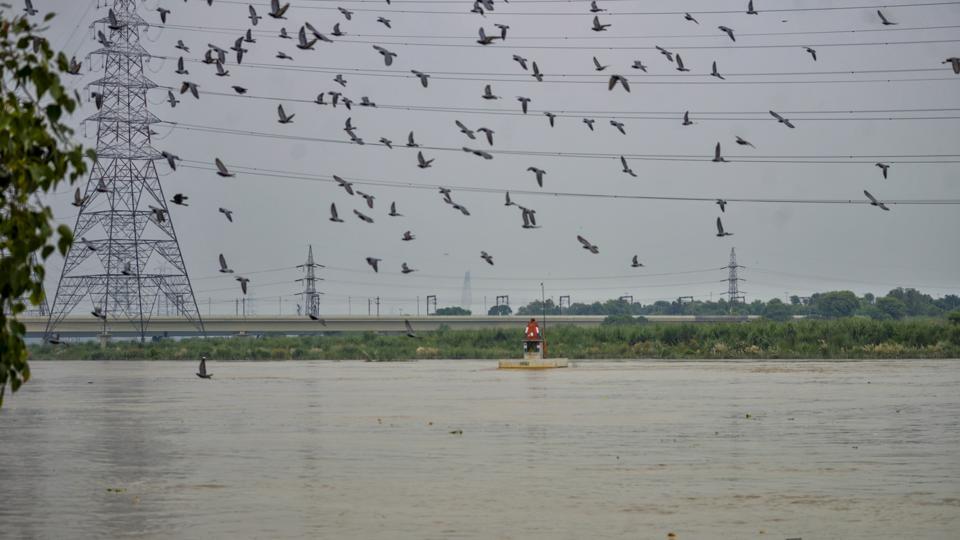
The forecast by CWC suggests that the water level is likely to touch 205.70 metre at 8pm on Monday and 206 metre by 2am on Tuesday. “The above forecast may further be affected with the releases from Wazirabad and Okhla barrages,” CWC said in a flood advisory issued on Sunday.
The Yamuna River in Delhi was flowing above the “warning” level of 204.5 metre on Sunday and is likely to cross the “danger” level of 205.33 metre in the next two days.
Prior to Sunday, the highest hourly discharge this season was 65,861 cusecs reported on Thursday. On Sunday, it touched a peak of 67,333 cusecs at 11am and continued to rise. At noon, it was over 70,965 cusecs and crossed 100,000 cusecs at 1pm, when 109,029 cusecs was released. The hourly discharge continued to increase and touched a peak of 178,996 cusecs at 4pm - so far the highest this season. At 7pm, the hourly discharge stood at 127,030 cusecs.
“This is by far the season’s highest discharge at Hathnikund, nearly triple the previous peak recorded on August 14. With this spell, the water level should cross the danger level in the next 36 hours,” said Bhim Singh Rawat, associate coordinator at the South Asia Network on Dams, Rivers and People (SANDRP).
The Yamuna was flowing at 204.60 metre at 7pm. It had touched a season-high of 205.28 metre at 3am on Saturday, before beginning to marginally dip.
In 2023, the Yamuna swelled to its highest-ever water level of 208.66m on July 11 following a record discharge of 359,760 cusecs from Hathnikund. On the other hand, last year’s peak was 204.38m on September 26 — below the “warning” level. The peak discharge last year was 87,018 cusecs, data from the Irrigation and Flood Control department showed.
As per Delhi’s I&FC department, evacuation from low-lying areas will commence when the water reaches 206 metre, however, announcements in such regions are regularly being made asking people to vacate and move to higher grounds. “A warning in particular is given when the discharge crosses 100,000 cusecs,” an official said.