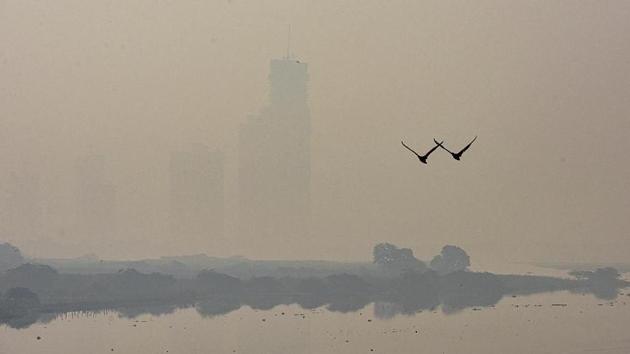
Delhi breathed the most polluted air of the season on Monday, the worst since February 26, with the air quality index (AQI) slumping to 261, in the ‘poor’ category -- which indicates breathing problems over prolonged exposure --- with low wind speed, no change in wind direction and increase in the number of farm fires in Punjab and Haryana.
The AQI on February 26 was recorded at 274.
According to the CPCB bulletin, particulate matter (PM 2.5 and PM10) was the primary pollutant in the city air on Monday. PM2.5 and PM10, dangerous microfine particles that cause a variety of cardiovascular and respiratory problems, are triggered by road dust, industrial emissions and crop residue burning.
Also read: Delhi air quality remains poor for fifth consecutive day on Sunday
Scientists at the India Meteorological Department (IMD) said that the accumulation of pollutants was a result of low wind speeds over the city coupled with an increase in the incidents of stubble burning in the neighbouring states of Punjab and Haryana.
According to the Central Pollution Control Board (CPCB) recordings, the AQI on Monday rose sharply to 261 from 216 on Sunday.
{{/usCountry}}According to the Central Pollution Control Board (CPCB) recordings, the AQI on Monday rose sharply to 261 from 216 on Sunday.
{{/usCountry}}An AQI between 0 and 50 is considered ‘good’, 51 and 100 ‘satisfactory’, 101 and 200 ‘moderate’, 201 and 300 ‘poor’, 301 and 400 ‘very poor’, and 401 and 500 ‘severe’.
The early warning system of the Union ministry of earth sciences had on Sunday predicted that the air quality would improve to land in the ‘moderate’ zone on Monday and Tuesday because of a change in the wind direction. According to the forecast, Delhi will receive wind from the southeast direction, which will limit the impact of stubble burning to a minimum. There was also a forecast of wind speed of up to 12kmph, enough to disperse the accumulation of pollutants.
Contrary to the forecast, the average hourly AQI started rising since early Monday morning. At 6am, the hourly average AQI was 232. It progressively increased and touched 248 at 10am and by 2pm the pollution levels had peaked to 258.
Also read: Delhi pollution levels likely to dip today, reach moderate level
The levels of PM 2.5 (ultra-fine particulate matter with diametre less than 2.5 micrometres) and PM 10 (particles with diametre less than 10 micrometres) also showed an upward trend through the day.
The levels of PM 2.5 rose from 91ug/M3 at 2pm to 119ug/m3 at 8pm. The level of PM 10 peaked to reach 258.3ug/m3 at 6pm. The prescribed safe standards for PM2.5 is 60ug/m3 and 100ug/m3 for PM10.
Scientists at the IMD said that Delhi on Monday was “victim to several unfavourable factors”, including a delayed change in the wind direction, low wind speed and farm fires in Punjab and Haryana. The air quality is expected to improve only “marginally” on Tuesday, scientists said.
“Delhi continued to receive north-westerly winds on Monday and the surface wind speed was as low as 8kmph during the day, which was not strong enough to disperse the polluting particles. We are expecting the wind to blow from southeast direction by late Monday, which would bring some respite but the effect will only be marginal,” said a senior IMD scientist.
Satellite imagery recorded by the National Aeronautics and Space Administration (Nasa) reported the most number of farm fires in parts of Punjab and Haryana on Monday, since the harvest season began this season.
Till Monday, Haryana reported 111 stubble burning cases and Punjab witnessed 700 such incidents.
Pawan Gupta, research scientist at the Goddard Earth Sciences Technology and Research (GESTAR), Universities Space Research Association, said on Monday farm fires were more widespread in parts of Haryana, Punjab, Uttar Pradesh and also in parts of border areas in Pakistan.
“On Monday, the crop fires were more widespread in India as well as in Pakistan. You can see hazy skies over the Indo-Gangetic plains and parts of central India. The PM 2.5 levels were also high in Delhi, Indore, Bhopal, Kanpur and Agra,” said Gupta.
Delhi environment minister Gopal Rai said the government has started “micro monitoring” of all 13 pollution hot spots in the city and will soon deploy environment marshals to check violations of norms.
Rai said all construction and demolition sites, irrespective of their size, will have to compulsorily take five steps – covering the area with a 10-metre-high tin shed and the construction and demolition waste with a green shade net, covering the vehicles carrying building material and water sprinkling.
He said nine deputy commissioners of municipal bodies have been appointed as nodal officers to keep an eye on the situation at the hot spots.
Rai also said that Delhi chief minister Arvind Kejriwal will launch spraying of “Pusa bio-decomposer” solution at Hiranki village in Narela on Tuesday. The solution that decomposes crop residue has been manufactured to control stubble burning.
Stay updated with all top Cities including, Bengaluru, Delhi, Mumbai and more across India. Stay informed on the latest happenings in World News along with Delhi Election 2025 and Delhi Election Result 2025 Live, New Delhi Election Result Live, Kalkaji Election Result Live at Hindustan Times.
Stay updated with all top Cities including, Bengaluru, Delhi, Mumbai and more across India. Stay informed on the latest happenings in World News along with Delhi Election 2025 and Delhi Election Result 2025 Live, New Delhi Election Result Live, Kalkaji Election Result Live at Hindustan Times.