A steady downpour on Monday yet again brought Gurugram to its knees. By evening, the town looked less like India’s Millennium City, and more like an endless parking lot. Hours of rain turned roads – arterial, highways, and residential streets alike – into stagnant pools and its traffic into an unbroken snarl.
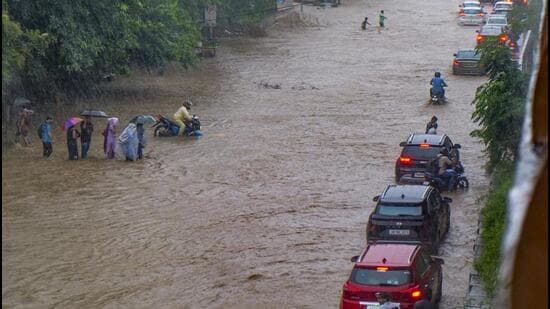
Cars stood motionless, autorickshaws sputtered and died in knee-deep water, and commuters found themselves in a situation that brought back memories of a repeat of the infamous “Gurujam” of 2017 – when thousands of commuters were forced to abandon their vehicles and walk home.
Most were confronted with a grim choice: spend the night at the office or risk being trapped for hours, if not longer, on impassable roads.
By evening, the District Disaster Management Authority (DDMA), alarmed at the scale of disruption, issued an advisory directing corporate offices to allow employees to work from home on Tuesday. Schools were asked to conduct classes online to avoid another day of paralysis.
The downpour began innocuously enough in the afternoon. But by the time office-goers began heading home, the city was already buckling. Entire stretches of NH-48 were submerged near Hero Honda Chowk, Shankar Chowk, IFFCO Chowk, and Rajiv Chowk. Gridlock snaked through Golf Course Road, Sohna Road, Southern Peripheral Road (SPR), and even Old Gurugram’s narrow arteries. By evening, the chaos evoked memories of the infamous “Gurujam” of 2017, when tens of thousands were stranded in similar circumstances.
Commuters stranded
{{/usCountry}}Commuters stranded
{{/usCountry}}For many, the only option was retreat.
Ashu Singh, who works in Sector 67, said he set out for his home in Dwarka at 5.30pm but never made it past Vatika Chowk. “I spent almost four hours just trying to cover a short stretch,” he said. “By the time I reached close to the Dwarka Expressway, I realised I would be stuck for the night. I turned back, and it was 9pm when I finally reached my office again. With no other option left, I will now sleep in office till 4-5am, and then see if it’s possible to go home... if things get better.”
Others endured long, maddening slogs across tiny distances. Raj Mehra, bound for Hardoi, said he left his Sector 12 home at 4pm and was still crawling six hours later. “It usually takes me 40 minutes to Bhondsi. Today, by 10pm, I was still inching past the toll plaza,” he said.
For Ashwani Virk of Sector 48, the experience bordered on surreal. “I started from Panchsheel Park at 5pm, thinking I’d be home by dinner. At 9.45pm, I was barely at Signature Tower. Half the journey, four and a half hours gone. The city feels paralysed — bumper to bumper, no end in sight.”
The paralysis forced many professionals to simply abandon the idea of getting home. At offices in Udyog Vihar, Cyber City, and along Golf Course Road, employees huddled by glowing screens long after working hours, watching traffic updates on their phones and hearing horror stories from colleagues stuck on the road.
“It’s pointless to step out,” said Geetika Sangwan, who works in Udyog Vihar but lives in Delhi’s GK-2. “People who left at 7pm are still stuck. I’ve decided to wait it out. But it’s exhausting – we’re in limbo, not knowing when it will be possible to move.”
Some commuters simply parked by the roadside and gave up.
Others sat grimly in their vehicles, headlights glowing in the floodwaters. The sheer volume of water compounded everything. According to district officials, some parts of the city recorded 116mm of rainfall by 6pm, with nearly 80mm of that arriving in just two hours between 3pm and 5pm.
On the ground, the picture was the same everywhere.
In Sector 46, resident Aanya Bhardwaj said her 25-minute commute stretched into a two-and-a-half-hour ordeal. “Autorickshaws broke down mid-way, cars stalled, and waterlogging made entire stretches impassable. Knee-deep water in some patches… it was chaos.”
At Galleria Crossing, Rekha Sharma said she spent nearly two hours without moving an inch. “Rainwater pooled all over the road. I counted at least three vehicles that broke down in front of me. Nobody was moving.”
For many residents, the gridlock was not simply about the weather, but the city’s chronic inability to plan for it.
“Every time it rains, Gurugram collapses,” said Gaur Sarin, founder of citizen collective Making Model Gurugram. “We’ve heard about action plans, emergency helplines, and drainage projects. But when the crunch comes, where is the preparation? Why isn’t more traffic police deployed? Why are citizens left to fend for themselves?”
The frustration was widespread online, too, where hashtags about the “Gurujam” trended late into the night as commuters vented about journeys that lasted five to six hours or ended in retreat.
Officials, however, insisted on putting up a brave front, saying they were not caught unprepared.
DCP (traffic) Rajesh Kumar Mohan said that a traffic jam at Iffco Chowk in which both the lanes of the Delhi-Jaipur Expressway (NH-48) were packed for several kilometres, was caused by private security guards.
“Private guards of these offices slowed down the moving traffic which resulted in such a jam. Waterlogging on service lanes further aggravated the scenario. A team under ACP Satyapal was deployed especially for clearing this jam,” he said. “The jam at Rajiv chowk resulted from breakdown of four automatic cars on the service lane at Subhash Chowk due to waterlogging,” he said.
If Monday was bad, the forecast offers little relief.
The India Meteorological Department (IMD) has predicted more showers through Tuesday, warning of localised heavy downpours. “The monsoon trough is close to Delhi, moisture is feeding in from the Arabian Sea, and a low-pressure system is active,” an IMD official explained. “All these factors combined to cause the intense rain. The pattern will persist.”
IMD has issued an orange alert for several districts of Haryana for Tuesday, followed by a yellow alert for Wednesday. Gurugram, already reeling, may have to brace for more. The Haryana government, anticipating the strain, cancelled all official leave on Monday evening, directing personnel to remain available for emergency response.
The statistics underline the human stories. Over 116mm of rainfall in a few hours, miles-long tailbacks on every major road, commuters forced into extreme choices. For many, the most jarring aspect was not the rain itself but the complete collapse of the city’s civic fabric.
As the clock ticked past midnight, the gridlock was still unravelling. Some roads eased, but many remained choked. For those who had chosen to stay back in offices, the hope was for clearer skies and emptier roads at dawn. For those still inching home, it was simply the longest Monday of the year.
Stay updated with all the Breaking News and Latest News from Mumbai. Click here for comprehensive coverage of top Cities including Bengaluru, Delhi, Hyderabad, and more across India along with Stay informed on the latest happenings in World News.
Stay updated with all the Breaking News and Latest News from Mumbai. Click here for comprehensive coverage of top Cities including Bengaluru, Delhi, Hyderabad, and more across India along with Stay informed on the latest happenings in World News.