
 E-Paper



Ward 12: Dwarka Expressway residents have world-class societies but poor civic infrastructure
While high-rise buildings and modern amenities dominate the landscape, lack of proper civic infrastructure has made life difficult for residents

 Prefer HTon Google


The Dwarka Expressway area, widely regarded for its world-class residential societies, presents a glaring paradox. The area, part of Ward 12 comprising Sectors 100, 101, 102, Tekchand Nagar, Basai village, and other surrounding areas, has a population of 250,000 of which 61,807 are registered voters. While high-rise buildings and modern amenities dominate the landscape, offering the promise of luxurious living, the lack of proper infrastructure—dilapidated roads, erratic water supply, encroachments, and ineffective waste management — has made life difficult for the residents.
Water mafia
Although many residential societies here boast state-of-the-art facilities, they are heavily reliant on water tankers, often supplied by local water mafias. This has not only made access to water unreliable but also put a heavy financial burden on residents. The failure of municipal authorities to ensure regular water supply has turned a fundamental right into a commodity controlled by private suppliers.
“We are paying exorbitant prices for water every month, yet the local government has done nothing to improve the supply,” said Sunil Sareen, a resident of Imperial Garden in Sector 102 and deputy convenor of the Dwarka Expressway Group Development Authority (DXPGDA), an umbrella organisation of resident welfare associations (RWAs). “We have raised the issue multiple times, but the situation has only worsened. The government must take action to install a proper water supply system,” he added.
Gurugram Metropolitan Development Authority (GMDA) officials said that the water mafia has damaged infrastructure and then charged residents exorbitant sums for water tankers and packaged water. GMDA officials said that the issue of leakage or tampering is in the water supply connection of the developer and not on the GMDA master water supply pipeline. “The developer is responsible for the maintenance of their own pipeline infrastructure laid by them. Any illegal connections when detected on the water supply pipeline of GMDA is disconnected by the GMDA team,” said Abhinav Verma, executive engineer, GMDA.
Frequent accidents
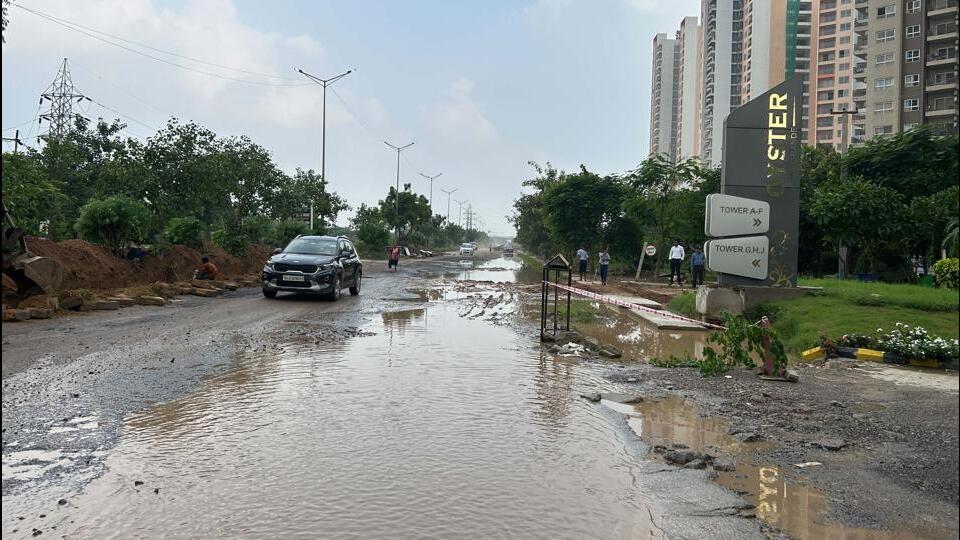
The 60-metre road near the Oyster Grande residential complex in Sector 102 is potholed and uneven and has been the scene of at least 50 accidents this year alone, and four major ones over the years, according to police.
“It is shocking that the authorities have not taken action despite repeated requests from residents,” said Colonel Hari Bhagwan (retired), president of the Oyster Grande RWA in Sector 102/102A. He added that Oyster Grande is also one of the polling booths for the upcoming assembly elections, and if the road repairs are not carried out soon, many voters may not be able to reach the polling station on election day.
Although the Gurugram Metropolitan Development Authority (GMDA) has allocated ₹15 crore for the repair and re-laying of roads in Sectors 102 and 102A, the pace of work has been slow.
Delayed road, power infra projects
The long-promised Dhanwapur Railway Underpass, which is critical for improving connectivity in Ward 12, remains unfinished five years after construction began because of pending tenders. “This underpass is vital for connecting our area with the rest of the city, yet it remains incomplete after years of work. We are suffering because of the delays, and it is unacceptable,” said Mukesh Singla, a social activist from Surat Nagar.
The electrical infrastructure for Sector 104 is poor, and power outages and voltage fluctuations are common due to the failure to implement the promised 33kV electrical infrastructure. The work on smart grid is pending and yet to be upgraded. “We face frequent power cuts and unreliable voltage, which not only disrupts our daily life but causes damage to our electrical appliances,” said Navdeep Singh, president of the ATS Triumph RWA in Sector 104.
Encroachment on public spaces
Scrap dealers, liquor shop owners, and construction material suppliers have occupied large sections of green belts and public areas in Ward 12. “The encroachments have taken over our green belts which were supposed to be reserved for parks and public use. These areas are now occupied by unauthorised vendors and heaps of construction debris,” said Ritu Sharma, a Sector 103 resident.
Garbage piles and waterlogging
Heaps of uncollected garbage are a common sight in neighbourhoods in this ward, with the issue becoming particularly severe during the monsoon when streets are often waterlogged and the accumulated waste turns roads into sewers.
“The waste management system here is broken. There is no regular collection and garbage piles on the streets are common. They become a breeding ground for diseases, especially during the rainy season. The authorities have done little to improve the situation despite repeated complaints from residents,” Sharma added.
Waterlogging is particularly severe in Tekchand Nagar, Basai, and Surat Nagar Phase 1. The drains are often blocked or overflowing, and short spells of rain fill up roads with water up to three or four feet. “Even after a minor downpour, we find ourselves living in knee-deep water. The sewers are so poorly maintained that the rainwater has nowhere to go, and it takes days for the water to recede. We’re essentially living in slum-like conditions due to the terrible drainage system,” said Mukesh Singla.
Sector 104 also faces severe waste management issues, with garbage littering the streets and untreated sewage posing health risks. “The waste management here is abysmal. We have raised these issues repeatedly, but there has been little action from the authorities. We need better waste segregation and disposal systems in place,” said Navdeep Singh.
Lack of street lighting and public transport
Streets in Sector 37D, 100, 101, 102, 103 and 104 are poorly lit due to missing poles and dysfunctional lights, while those in internal lanes in these areas have no streetlights “There have been cases of accidents and even petty crimes due to the lack of streetlights,” said Aditi Singh, a Tekchand Nagar resident.
Public transport options in the ward are severely limited, forcing most residents to rely on private vehicles or taxis for daily commutes. “We have no bus services or local transport options,” Singh added. “This means more cars on the road, leading to traffic jams, increased pollution, and higher transportation costs. We need a reliable public transport system to ease the daily commute,” Singh said.
Hope for change
As Ward 12 gears up for the upcoming assembly elections, residents are hopeful that their long-neglected issues will finally get attention. With more than 61,000 registered voters, the ward holds significant electoral importance. Residents are making it clear that they expect concrete action from the incoming MLA to address their concerns, which include fixing the water supply, improving road conditions, and enhancing waste management and public services.
“We have world-class residential societies but are living in horrible conditions due to the lack of basic amenities. The incoming MLA needs to prioritize these issues and work toward improving the quality of life for all residents in Ward 12,” said Sareen.
The inadequate electrical infrastructure, especially in Sector 104, remains a significant point of frustration for residents. Rekha Menon, a resident of Indiabulls Centrum Park, Sector 103, wants more public transport options in her area. “We are dependent on private vehicles because there is no reliable public transport. This is a growing area, and the government needs to ensure that we have basic services like buses or local transport,” she said.
The road ahead for Ward 12
While the Dwarka Expressway area was envisioned as a premium residential hub, its development has been marred by poor civic infrastructure. As elections approach, residents are calling for a more proactive approach from the authorities to fix the broken roads, water shortage, waste management failures, and lack of transport services.
“We’ve been waiting for years, but our problems only seem to get worse. This time we hope the new MLA will take our concerns seriously and deliver on their promises,” said Navdeep Singh.
Taking note of the residents’ concerns, Nishant Kumar Yadav, deputy commissioner of Gurugram, said the government was committed to addressing the water, road, and waste management issues. “We are aware of the infrastructural challenges in Ward 12. Steps are being taken to expedite ongoing projects and improve the overall quality of services in the ward,” he said/
“The Municipal Corporation of Gurugram has been working on a detailed plan to enhance road conditions and waste management systems in the area. We are in talks with relevant authorities to ensure the timely execution of these projects,” said MCG commissioner Narhari Singh Bangar.


