The health department on Saturday brought out a set of standard operating procedures (SOPs) for teams taking up surveillance activities across 327 containment zones in the district. Officials said the idea behind introducing SOPs for containment zones was to make surveillance more effective as several symptomatic patients in recent times have escaped the surveillance cover in recent times. Officials said one of the vital aspects of the SOPs is to involve the local police in case people do not cooperate with the teams conducting door-to-door surveys.
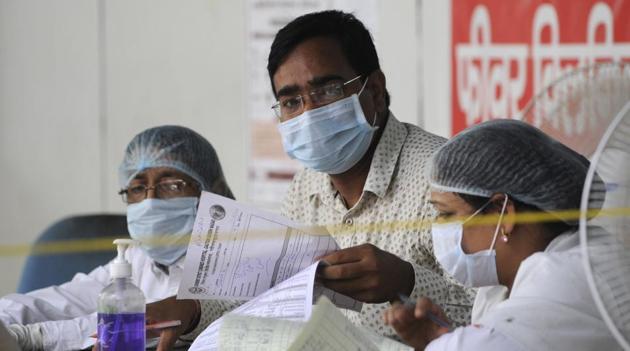
At present, surveillance activities are being taken up by 862 teams in the district who visit the containment areas to trace suspected patients, such as people suffering from influenza-like illnesses, those having symptoms of severe acute respiratory illness (SARI) and people having co-morbid conditions.
“People often refuse to cooperate with the teams and do not pass on the correct information. This leads to suspected cases slipping out of the surveillance cover. Now, as part of the SOPs, our teams have been asked to make inquiries from the nearby households or influential local people about suspected cases if they refuse to cooperate,” said Dr NK Gupta, chief medical officer (CMO).
“In case the teams find any suspicious information, they have been asked to pass it on to the local police. Every suspected case can turn out to be a potential Covid-19 case. Further, there is also a possibility that suspected patients might develop severe health complications later. As such, involving the local police will strengthen our surveillance mechanism,” he added.
Out of the 862 teams, comprising of two members each, specified teams are sent to the containment zones once the cases are reported. After a special drive was conducted between July 2 to July 12 on the directions of the UP government, the containment activities were beefed up after July 13.
{{/usCountry}}Out of the 862 teams, comprising of two members each, specified teams are sent to the containment zones once the cases are reported. After a special drive was conducted between July 2 to July 12 on the directions of the UP government, the containment activities were beefed up after July 13.
{{/usCountry}}According to official records, about 5,860 teams have been deployed so far who have taken up surveys of 4,76,559 houses, covering a population of 18,89,405. They have detected 500 symptomatic cases so far. Out of them, 451 have been tested. A total of 53 persons have turned out to be positive, while test results are awaited for the rest.
“As part of the SOPs, each team has been given a written set of instructions about the question they will ask during household visits. For people in home isolation, they teams will check if the sticker pasted on the house is intact or not. Apart from general inquiry of the immediate neighbours, the teams will also inquire from other locals about the patients in home isolation,” said Dr Rakesh Gupta, nodal officer (Covid), state health department.
According to official records, till August 15 about 563 symptomatic patients have been allowed permission for home isolation and 306 of these have already completed a period of 10 days. At present, the district has 1,026 Covid positive patients, of whom 257 patients are in home isolation. A total of 25 persons in home isolation so far have been warned for not following home isolation rules.
“Under the new rules, the surveillance teams can also approach registered and unregistered clinics in residential areas to find out the names of the patients who have come to these clinics complaining of symptoms. They have also been asked to approach local chemist shops to find out who all are buying medicines related to cough, cold or fever, etc. The idea is that no suspected case should be left out of the surveillance cover,” Dr Gupta added.
Recently, several cases were reported in which patients who could not be traced by surveillance teams developed complications later on. For instance,a 37-year-old man who was running high fever was admitted to an L3 hospital in the district but succumbed to his medical conditions on August 9 after five days of treatment.
In another case, a 30-year-old woman, who was having health complications for about 10 days, had come to district women hospital after having delivered at her home. She died on night of August 10 after she was referred to a hospital in Meerut, where she tested positive for Covid-19. Both the cases went undetected by teams of the health department carrying out surveillance.
Stay updated with all the Breaking News and Latest News from Mumbai. Click here for comprehensive coverage of top Cities including Bengaluru, Delhi, Hyderabad, and more across India along with Stay informed on the latest happenings in World News.
Stay updated with all the Breaking News and Latest News from Mumbai. Click here for comprehensive coverage of top Cities including Bengaluru, Delhi, Hyderabad, and more across India along with Stay informed on the latest happenings in World News.