
 E-Paper



Increasing big cat population at Ranthambore Tiger Reserve a concern
CM Gehlot has directed the officials to form a panel of experts to suggest shifting tigers.

 Prefer HTon Google


The increasing tiger population at Ranthambore Tiger Reserve (RTR) in Sawai Madhopur district has become a concern for the Rajasthan government with territorial fights and man-animal conflict due to dispersal out of the Reserve area, officials said.
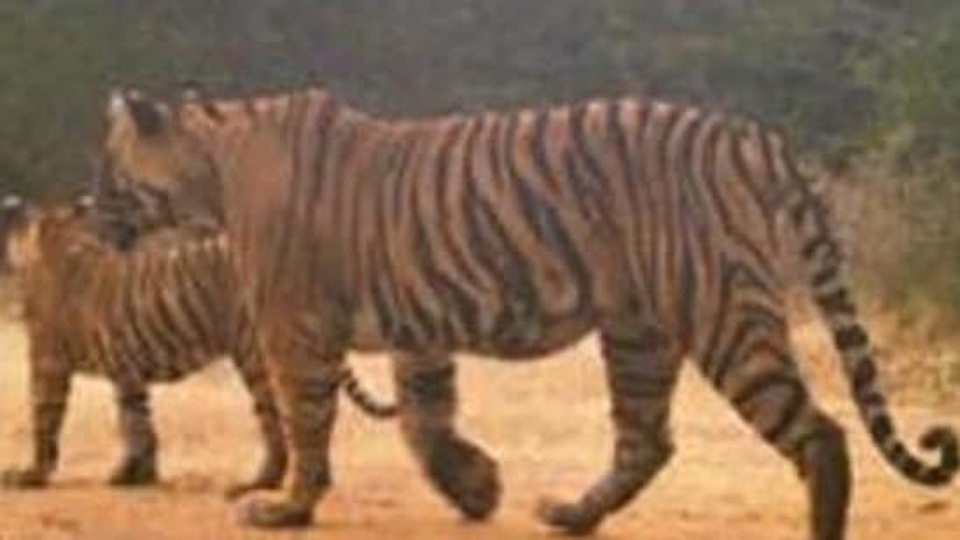
Two days back, tigress Arrrowhead (T-84) was spotted with three cubs. The big cat population in RTR’s has reached 79, including 28 cubs and sub-adults living in an area of 1,334 square kilometres, making it the third most congested habitats of felines in India after the Corbett National Park in Uttarakhand and Kaziranga National Park in Assam.
The state has three tiger reserves with over 103 big cats – 79 at RTR , 23 at Sariska Tiger Reserve (STR) in Alwar, and one left at Mukundra Hills Tiger Reserve (MHTR) in Kota.
In a recent development, after the National Tiger Conservation Authority (NTCA) and the Ministry of Environment, Forest and Climate Change get the permission, tigress Ridhi will be relocated to Sariska Tiger Reserve as she and her sister Siddhi have injured each other number of times claiming a territory. Five months back in January, two-and-half-year-old tigress Ridhi had received 14 stitches on the tongue after getting injured in a territorial fight with her sibling Siddhi.
In wake of the growing population and infights, the CM has directed the officials to form a panel of experts to suggest shifting tigers.
Chief minister Ashok Gehlot in the meeting of the State Wildlife Board held on Thursday, directed the officials to form a panel of experts. The panel will suggest shifting the increasing number of tigers to other sanctuary areas; and ways to develop Mukundra Hills Tiger Reserve and the newly formed Ramgarh Vishdhari Tiger Reserve in Bundi, said an official release.
Gehlot said that the state government is working on a plan to develop new tiger reserves in the state to provide safe shelter to the tigers in line with their increasing population in the state. “It is a matter of happiness that the Ramgarh Wildlife Sanctuary in Bundi region has recently been approved by the NTCA as a Tiger Reserve. Now, it is our endeavour to promote the conservation of tigers and other wildlife in Kumbhalgarh Sanctuary and other forest areas,” he said.
RTR Field Director TC Verma said, “The big cat population is rising in the Reserve and they need space. Not just one but we have asked to permit to shift more.”
RTR is the source area to re-populate other Reserves in the state, since the inception of project tiger in 1973, then the Reserve had 11 tigers.
In the last five years, five tigers were relocated from RTR – four to Mukundra Hills Tiger Reserve in 2018 and one to Sariska Tiger Reserve in 2019.
Of the five relocated, MT-4 is the lone survivor at MHTR as the rest, MT-2 and MT-3, along with their two cubs, died last year in the month of July and August; while MT-1 cannot be traced. Similarly, 7-year-old ST-16 which was shifted to Sariska Tiger Reserve, Alwar in April 2019, died two months after the shifting allegedly by an overdose of tranquillizer injected to treat a wound.
Retired IFS, Sunayan Sharma said looking to the increasing population relocation of tigers should be the priority, or else territorial fights and man-animal conflict will continue. “The kind of management done here is not scientific management as carrying capacity should is the guiding principle. Relocation and habitat improvement of tigers should be done simultaneously,” he said.
He said tigers were relocated in past, some died but that does not mean that the relocation process should be stopped. Tigers should be sent again to MHTR, and people should be held accountable. If relocation is stopped the population will continue to increase, he said.
Sharma said old tiger habitats should be revived and developed such as Ramgarh Vishdhari, MHTR, and Raoli Todgarh in Udaipur – this will help in tiger and environment conservation.


