
 E-Paper



Villages in WB’s Alipurduar gasp for air as pollution from Bhutan takes toll
Pasakha Industrial Estate (PIE) has been the epicentre of the growing pollution levels in the adjacent areas of the West Bengal district

 Prefer HTon Google


A bottle of cough syrup and a few strips of medicines, packed in a polythene packet, were kept on a table next to the cot, on which 54-year-old Chameli Singh Bathyal was taking a nap.
A resident of Rangamati, a small village at Kalchini in West Bengal’s Alipurduar district tucked amidst tea gardens and forests, crisscrossed by rivers and streams, has been suffering from recurring cough and breathlessness over the past four years.
“You see that? That’s the Pasakha Industrial Estate (PIE) in Bhutan. The smoke and polluted water they release are taking a heavy toll on villagers living on this side of the border. I’m suffering from cough and breathlessness over the past four years at least. Now it is getting more frequent and intense. Acidity and diarrhea occur frequently and my body aches,” she said, sitting up on the cot and pointing to the door.
Also Read:India and Bhutan: Time for nimble and agile diplomacy
PIE is Bhutan’s first major industrial town and is located in a valley surrounded by hills on three sides. Because of its close proximity to the Indian border, availability of minerals such as quartz, dolomite and limestone, good road connectivity with Phuentsholing, PIE has become a major attraction.
There are around 40 industries, including silicon-carbide plant, ferro-silicon factories, cement, steel and alloy industries.
Delhi-based Centre for Science and Environment (CSE), in a report for the Bhutan government, said in some places inside the PIE, the PM10 level reached a maximum of 466 micrograms per metre cube, at least four times above the daily permissible limit in India.
The level of PM 2.5 was also hovering around 4–5 times above the daily permissible limit according to Indian standards.
“There are substantial uncontrolled fugitive emissions of dust particles along with gases from the industries,” the report said, attributing the high emissions to burning of fossil fuels and air polluting industries in the area.
Chameli’s room faces the PIE at Phuentsholling in Bhutan, right across the Indo-Bhutan border.
A small rivulet, locally known as ‘Singhi jhora’, follows adjacent to the industrial estate.
Singhi with Bhalu jhora and Basra, all originating in Bhutan and polluted – meet a few kilometres downstream and form the Kaljani river, which flows into Jaldapara National Park and Buxa Tiger Reserve.
The stretch of the Kaljani river from Bitala to Alipurduar was tagged as unfit for bathing by the central pollution control board but was delisted in 2022 as the water quality claimed to have improved.
While the winding and downhill village road leads to the Singhi rivulet a few metres below, the PIE is just a stone’s throw from the Bathyal’s house and one can even see the smoke billowing out of the chimneys.
“The smoke is less now. Come in the evening and you will get the true picture, because that’s the time when they release the smoke in full throttle. We need to close the doors and windows,” said Dhiraj Singh Bathyal (62), her husband, who also complained of breathlessness and frequent cough.
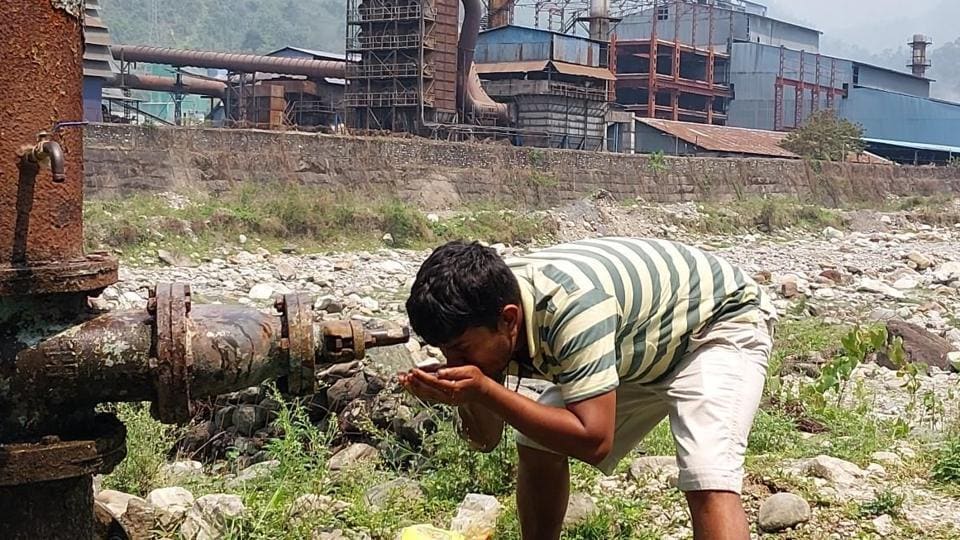
Mohan Subba, a local youth, who works in the pump-station on the bank of the Singhi jhora, said that he frequently suffers from diarrhea and other gastro-intestinal problems including acidity.
“We all drink the same water knowing well that it is not clean. We also catch small fishes that are found in these waters. The water is pumped out from the Singhi jhora stream and supplied to the villages. We have no other option. The industrial estate dumps their waste water into the stream,” said Subba.
Locals said that there are around 11 villages close of the Indo-Bhutan border in Kalchini block in which at least 22,000–25,000 people, mostly tea garden workers, live with many suffering from lung ailments, gastro-intestinal problems and skin-diseases.
“Almost every other villager you come across in this part of Kalchini would tell you the same story and the same problems. The industrial pollution, soot and dust from the PIE have made life miserable here,” said Jairaj Lama, a resident of central Dooars.
Locals like Lama and Subba even claimed that such is the pollution level, that if it doesn’t rain for a few days, the leaves of the trees get brown and wrinkled.
The tin-roof of the village huts gets rusty and corroded after every six months.
“The trees, the tea plantations and the grass all get covered with a layer of dust and soot if it doesn’t rain. And, when it rains, the PIE releases more smoke as the pollution gets subdued,” said Minati Thapa, a local resident and a tea garden worker.
Kalchini block in Alipurduar has around 21 tea estates of which the Central Dooars Tea Estate in Rangamati is just one.
Most of the people are tea garden workers earning around ₹2,500 to ₹4,000 per month.
While locals have been complaining about the problems over the past few years, the Cooch Behar Himalayan Nature Development Society, an NGO working on this issue since 2014, moved a PIL in the Supreme Court in May 2019.
As the pollution was coming from across the border, the union environment ministry, ministry of external affairs, the state pollution control board, the central pollution control board and the Alipurduar civic body were all made parties.
“Before filing the PIL, we had written letters to everyone including the Prime Minister’s Office (PMO), ministry of external affairs and union environment ministry among others. But everyone has been passing the buck,” said Mahendra Thapa, general secretary of the NGO.
But, till date, nothing has been done and the villagers of Rangamati and its adjoining areas continue to suffer.
“The division bench of Justice SA Bobde and Justice BR Gavai heard the case once in July 2019. But that’s it. The matter was never heard again. It is still pending,” said Sukriti Kashyap, environment lawyer and the petitioner’s counsel.
Locals continued to rue the fact that not much has been done in this regard by both political leaders and the administration.
“I am not aware of the issue. No one informed me, if they approach me, I will definitely take it up and pursue it,” said John Barla, union minister of state for minority affairs and a BJP MP from Alipurduar.
“This doesn’t come under the purview of the CPCB. It is an international matter. The matter was referred to the MoEF&CC,” said a senior official of the CPCB.
Senior officials of the state pollution control board and the local district administration refused to comment saying the matter was sub judice.


