Permission norms for felling, pruning and cutting trees in the Taj Trapezium Zone (TTZ) have been simplified after Supreme Court relief in 2025 for areas beyond 5 km of the Taj Mahal.
Following these directions, the social forestry wing of the forest department has issued fresh guidelines to streamline the process and promote agroforestry.
According to a press statement issued by the District Information Office in Agra, the revised norms apply to areas beyond a 5-km aerial radius of the Taj Mahal. In these areas, permission to fell, trim or cut specified tree species will be granted by the divisional director or a forest officer.
“The government of India and the Uttar Pradesh government have been making efforts to promote social forestry and simplify procedures for tree felling and pruning within the TTZ,” the office of the divisional director, social forestry, said.
Rajesh Kumar, divisional director (social forestry), forest department, Agra, termed the move a major achievement, saying it relaxes the permission process at least for areas beyond 5 km of the Taj Mahal.
“This SOP will simplify the process of seeking permission, save time and promote agroforestry in the region,” he told HT on Sunday. He added that the exercise would also help build a database to be presented before the Supreme Court in the future to seek further relaxation of norms.
{{/usCountry}}“This SOP will simplify the process of seeking permission, save time and promote agroforestry in the region,” he told HT on Sunday. He added that the exercise would also help build a database to be presented before the Supreme Court in the future to seek further relaxation of norms.
{{/usCountry}}It may be recalled that a blanket ban on felling, cutting or trimming of any tree within the TTZ was imposed following the Supreme Court’s May 8, 2015 order in the MC Mehta vs Union of India case. Any such activity required prior approval from the apex court.
Subsequently, the centre and the state government sought relaxations, following which a series of orders were issued in 2025. On March 25, 2025, the Supreme Court permitted trimming, pruning and lopping of trees obstructing electricity poles, high-tension lines and other power infrastructure, the statement said.
On May 1, 2025, the court allowed felling of specified species — eucalyptus, poplar and melia dubia (Malabar neem) — to promote social forestry. It also permitted removal of trees to prevent damage to property, safeguard human life and facilitate traffic management.
Further, an order dated May 13, 2025 fixed penalties for illegal felling of trees on agricultural, private and forest land.
The divisional director said that on March 25, 2026, the Central Empowered Committee (CEC) issued a standard operating procedure (SOP) to regulate tree felling, pruning and cutting within the TTZ.
Under the SOP, farmers located beyond the 5-km aerial radius of the Taj Mahal can obtain permission from the divisional director or a forest officer to fell between one and 49 trees of eucalyptus, poplar and melia dubia. For felling more than 50 trees, approval will be required from the CEC in New Delhi.
For non-farmers, permission to fell up to 49 such trees will be granted by the CEC, while cases involving more than 50 trees will require approval from the Supreme Court.
In emergency situations, such as to prevent damage to property, protect human life or ease traffic, permission for tree felling may be granted by the divisional director or a forest officer.
Permission for trimming or pruning trees for laying electricity poles or high-tension lines will be granted by the divisional director or forest officer. However, in the case of dry trees, approval will be given only after inspection by the CEC, the statement said.
It was clarified that within a 5-km aerial radius of the Taj Mahal, permission for any pruning, cutting or felling will continue to be granted only by the Supreme Court.
The department has urged residents to comply with the new guidelines and cooperate in safeguarding the environment.
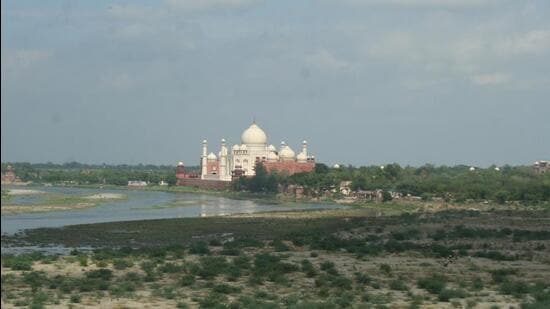
The TTZ was created following the Supreme Court’s 1996 judgement in the MC Mehta vs Union of India case, which raised concerns over industrial pollution affecting the Taj Mahal. It is a defined area of 10,400 square kilometres. Shaped like a trapezoid around the Taj Mahal, the TTZ covers areas across Agra, Firozabad, Mathura, Hathras, and Etah districts in Uttar Pradesh, and Bharatpur district in Rajasthan.
Activist reacts
However, the move does not seem to have gone down well with activists. Brij Khandelwal, an environmentalist and president of the Braj Mandal Heritage Conservation Society, expressed reservations about the relaxation, terming it a “dilution of control”.
“Past experience shows that whenever such initiatives are handed over to a committee or commission, the process gets diluted and the sense of urgency weakens. The very objective is pushed into cold storage,” Khandelwal said.
He added that the functioning of such committees is often questionable and not foolproof, cautioning that any dilution is detrimental to environmental protection.