The Mahakumbh, a grand spectacle of faith and devotion that has set many benchmarks in infrastructure development and crowd and traffic management, has already drawn 64 crore pilgrims to the Sangam banks even as authorities prepare for its grand conclusion on Mahashivratri on Wednesday.
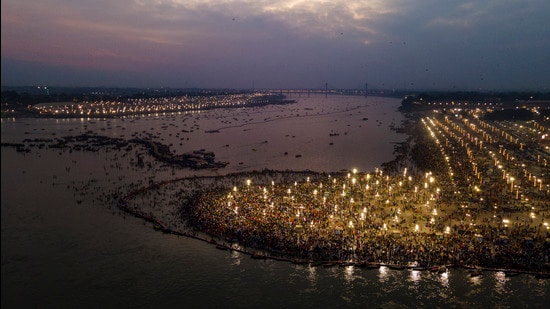
While the pilgrims’ footfall has already breached the earlier anticipated 50-crore mark, all signs indicate that the total count may easily surpass the revised official estimate of 66 crore before the 45-day mega fair, which began on January 13, ends.
The scale of this achievement can be gauged from the fact that the 55-day-long Kumbh of 2019 drew around 24 crore devotees. The Mahakumbh of 2025 fair has already witnessed footfalls more than 2.5 times of that figure despite its shorter duration.
A day before it ended, the 2019 edition of the Mela had hosted 22.95 crore pilgrims.
While five of the six bathing festivals brought a total of 17 crore pilgrims to Prayagraj, the bathers’ daily count stayed above 1.5 crore on a dozen other days of the Mahakumbh. On seven occasions, the figure even crossed 2 crore.
‘Pradosh Vrat’, a significant day of fasting and prayers dedicated to Lord Shiva and Goddess Parvati, caused a huge gathering of devotees at the bathing ghats in the Mela area on Tuesday.
{{/usCountry}}‘Pradosh Vrat’, a significant day of fasting and prayers dedicated to Lord Shiva and Goddess Parvati, caused a huge gathering of devotees at the bathing ghats in the Mela area on Tuesday.
{{/usCountry}}Meanwhile, chief minister Yogi Adityanath has instructed top officials in charge of health and security to remain alert at all times so that devotees can take the holy bath and perform rituals without any hindrance.
1.5 lakh tents, 40k security personnel, AI surveillance
Among the many firsts, the Mahakumbh Mela area accommodated a temporary tent city spanning 4,000 hectares against 3,200 hectares in the Kumbh of 2019. The tent city, this time, featured 1,50,000 tents, enhanced sanitation facilities, and improved transportation services. Security measures involved deploying 40,000 police officers and AI-powered surveillance systems to ensure the safety of pilgrims. Artificial Intelligence was used to guide devotees to parking, food courts and hospitals. Accurate mapping of the Mela area was also done. QR codes were used to help the public access toilets, exhibitions, and lost and found centres. Banking, public water ATMs, events, attractions, and transport information were provided instantly to the public with proper tech support.