
 E-Paper



“Aye Mohabbat…”: Begum Akhtar’s ghazal wafts again, as admirers visit grave to pay tribute
Pasandbagh, where she rests in peace and which was once her orchard, is shrinking today due to the inevitable pressures of the modern times, including city sprawl


LUCKNOW: The mellifluous strains of “Aye Mohabbat Tere Anjam Pe Rona Aaya” floated in the air as admirers visited the grave of the nonpareil light classical singer, Malika-e-Ghazal Begum Akhtar, in Pasandbagh cemetery in the old city on her 109th birth anniversary on Saturday. “Aye Mohabbat...” was one of the most popular ghazals sung by Begum Akhtar, who was synonymous with ghazals and whose voice, even after her death, refuses to be conquered by new trends, genres and voices.
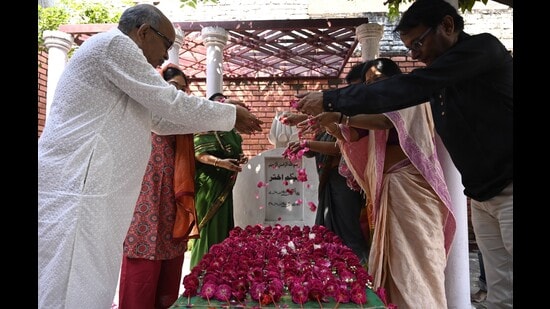
The ghazal queen’s mausoleum, which was once in a shambles, is beautifully preserved now. Her grave has marble inlay work and is surrounded by a red brick enclosure. It is situated next to her mother Mushtari Bai’s grave.
The two white sandstone graves situated in an area of less than 700 square ft area were decked up beautifully with rose petals and chadar (cloth) by a team of professors of Bhatkhande University who visited the place to pay tributes and remember the nearly half a century musical career of the ghazal queen.
The team from Bhatkhande University rendered some popular compositions of Begum Akhtar, including “Aye Mohabbat Tere Anjam Pe Rona Aaya” and Ranjana Dwivedi, who led the song, said, “She will always be in our hearts.” The professors led by vice-chancellor Professor Mandavi Singh said, “We’re proud to say that such a legend was a part of our university. It gives us immense pleasure to come and remember her on her birth anniversary. We have also organised a musical evening dedicated to her so that the younger generation can take inspiration from her.”
Pasandbagh sinking in oblivion due to city sprawl
The grave site is in an old part of Lucknow in Pasandbagh, on a plot of land that belonged to Akhtar and was much larger before it was divided among her descendants. It was restored in 2014, her birth centenary year.
“The grave was cemented, with wild grass growing around it. It was regularly desecrated by people nearby,” said Guddu, the caretaker who lives with his family near the site.
“She is buried next to her mother Mushtari Sahiba as she always wanted to rest in peace next to her mother when she died. So when she died on October 30, 1974 in Ahmedabad, she was brought to Lucknow and buried here,” he said, adding that many of her relatives once lived in Pasandbagh but later most of them sold their properties. Only her adopted child’s family lives here.
“Her tomb was a mango orchard within her home, ‘Pasand Bagh’. However, over the years, much of the garden was lost to the growing city, except the tomb,” he said.
‘Traces of Begum Akhtar can be
found everywhere in Lucknow’
Begum Akhtar lived through a turbulent time in India’s history. “Traces of this history can be found everywhere in Lucknow, as though she was born in Faizabad she spent most of her time here,” said Himanshu Bajpai, a dastango and Lucknow-based author who also penned a book on her 100th birth anniversary.
Bajpai informed that the singer was married to barrister Ahmad Abbasi and her home was in Lucknow. She was also associated with All India Radio for a long time and recorded her music with them.
Begum’s life journey in short
Begum Akhtar, earlier known as Akhtari Bai Faizabadi, was born to courtesan Mushtari Bai in Faizabad in 1914.
According to a plaque at the tomb, as a child, she moved with her mother to Gaya and then to Calcutta (now Kolkata) where she recorded her first disc and began acting on stage. She later moved to Bombay where she acted in films. She settled in Lucknow in 1939. She learnt music from Ustad Imdad Khan, Ata Mohmmad Khan and Waheed Khan and became one of the leading performers of thumri and ghazal.
Begum Akhtar married Ishtiaq Ahmad Abbasi in 1944.


