
 E-Paper



‘Bad air’ season: Are 4 sprinkling vehicles enough to settle the dust?
Lucknow’s air quality index stood at 149 placing it in the ‘moderate’ category with PM2.5 as the dominant pollutant: Central Pollution Control Board report

 Prefer HTon Google


LUCKNOW Authorities’ promises to combat air pollution in Lucknow have yielded negligible results as Lucknow’s air remains bad enough to give breathing discomfort and the water sprinkling drives being limited to areas where air quality monitoring stations are situated.
According to Friday’s report by the Central Pollution Control Board (CPCB), Lucknow’s air quality index (AQI) stood at 149, placing it in the ‘moderate’ category with PM2.5 as the dominant pollutant.
PM 2.5 refers to the fine particulate matter with a diameter of 2.5 micrometers or less. Due to its microscopic size, it can be inhaled deep into the lungs and even enter the bloodstream, leading to health conditions. PM2.5 can make people with lung and heart diseases suffer.
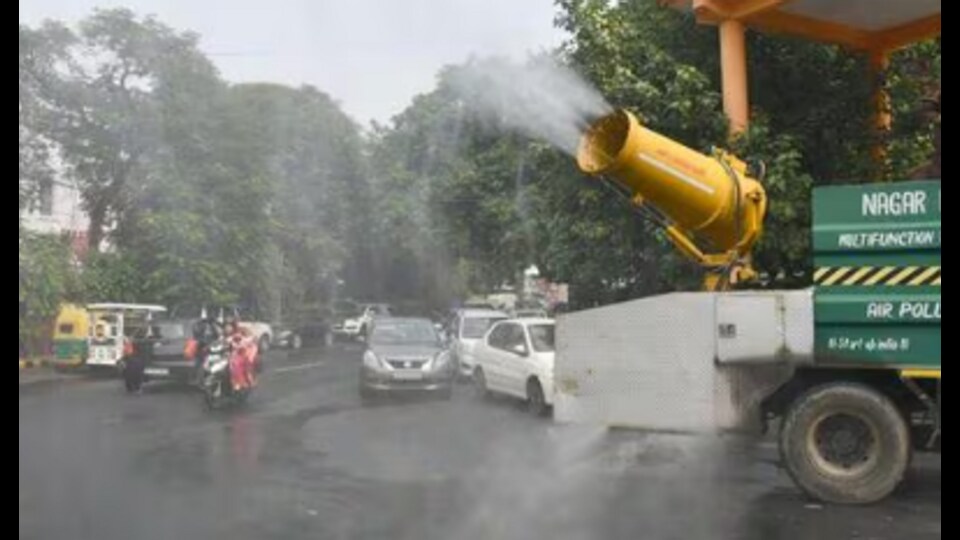
Officials said the Lucknow Municipal Corporation (LMC) has intensified water sprinkling drives, focussing on localities witnessing heavy dust emission due to construction and industrial activity.
However, only four of the LMC’s six sprinkling vehicles are operational, exposing the civic body’s limited preparedness to tackle worsening air quality.
“The number of sprinklers pressed into service now should at least be doubled. If the trial is successful, the same should be expanded to get immediate relief from the rising air pollution,” said, Pradeep Kumar Srivastava, retired CDRI Scientist.
The municipal corporation has deployed its four water sprinkler vehicles in Gomti Nagar, Talkatora, Lalbagh and Aliganj, which are among the most dust-prone and high-traffic zones of the city. These areas also house continuous ambient air quality monitoring stations (CAAQMS), which provide real-time pollution data.
LMC environmental Engineer Sanjeev Pradhan said the sprinkling activity runs from morning till evening to minimize suspended dust particles. “We are focusing near monitoring stations and sites with loose soil. The drive aims to reduce particulate matter that contributes to the rising AQI levels,” he added.
“The machines are primarily operating in prime and industrial areas. The Aishbagh industrial belt is already covered and Transport Nagar will be added soon due to heavy truck movement and dust generation,” said LMC chief engineer (mechanical and electrical) Manoj Prabhat, admitting that only four of the six vehicles available for water sprinkling are being used.
Officials said the LMC has also directed junior engineers (JEs) and executive engineers (EEs) across all zones to monitor construction sites regularly. Builders have been asked to install protective nets around under-construction buildings to prevent soil from dispersing into the air.
“Strict action is being taken against those burning garbage or violating pollution control measures. Notices have been issued to erring construction sites,” Pradhan added.
The Uttar Pradesh Pollution Control Board (UPPCB) earlier carried out manual monitoring at seven locations, including Aliganj, Chowk, Mahanagar, Hazratganj, Talkatora, Ansal Technical Campus, and Gomti Nagar. With the winter season approaching, experts warn that air quality may worsen further if stringent dust and emission control measures are not implemented.


