
 E-Paper



Gomti’s future tense: Will Lucknow’s lifeline become a river on ‘life support’?
The state capital may need to manage nearly 1,500 MLD sewage, almost double the current treatment capacity, say planners

 Prefer HTon Google


LUCKNOW As Lucknow rapidly transforms into a modern metropolis, environment experts and citizens are concerned over the future of Lucknow’s lifeline - the Gomti, which is battling a host of urbanisation challenges —declining oxygen levels, rising fecal coliform, and an overwhelming burden of untreated sewage.
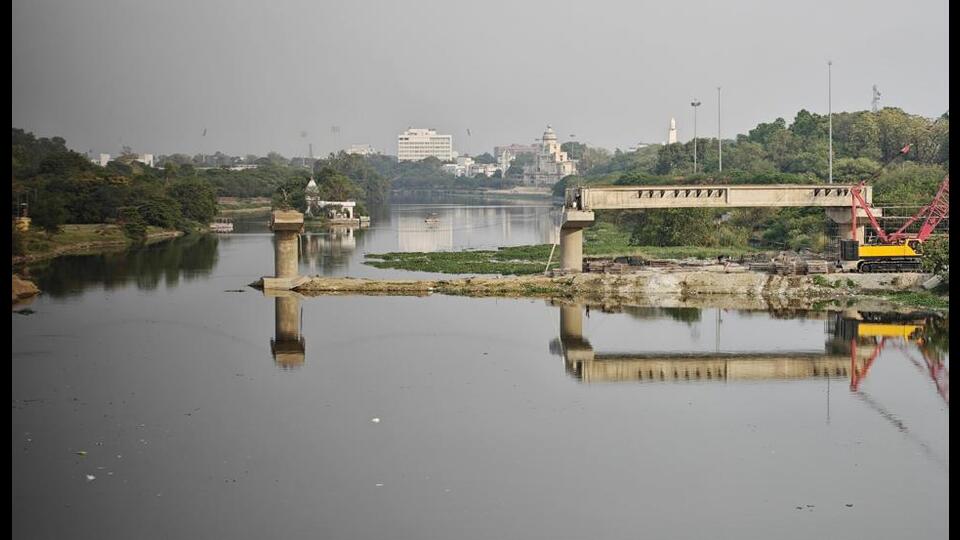
Will Gomti remain a viable, life-supporting river in the next 10 years...or will it be choked by massive urban expansion is the looming question.
Increasing population and rapid urbanisation pose a serious threat to the health of the river in Lucknow. Gomti, the 960-km long tributary of the Ganga, starts from Madho Tanda in Lakhimpur Kheri and culminates into the Ganga at Kaithi in Ghazipur. It is faces serious challenges of dipping oxygen levels, increasing fecal coliform in Lucknow.
1,500 MLD SEWAGE LOAD BY 2035
According to estimates of Lucknow Municipal Corporation, the city’s population is projected to reach 70 lakh by 2035 — including migratory inflow linked to the upcoming State Capital Region (SCR)— and the volume of sewage is also expected to surge dramatically. Urban planners estimate the city will need to manage nearly 1,500 million litres per day (MLD) of sewage, which is almost double the current treatment capacity.
Despite multiple proposed sewage treatment plants (STPs), implementation has lagged. Without timely upgrades, large volumes of untreated waste could continue flowing directly into the river.
CURRENT FACILITY
Officials say 345 MLD Bharwara STP is the largest in the city at present while there are two Daulatganj STPs with capacities of 42 MLD and 14 MLD, respectively. Additionally, Vrindavan Yojna in Sector 10 houses a 37.5 MLD STP, along with a 6.5 MLD unit.
Meanwhile, major expansion is underway. A 39 MLD STP is under construction at Daulatganj, and a 120 MLD plant is being developed along the GH Canal. These projects aim to significantly boost treatment capacity in the coming years. But in next 10 years more such STPs would be required.
Major Kanwardeep Nagi of the Environment Task Force said: “Currently, around 280 MLD of untreated sewage is directly discharged into the river, raising constant concerns about water quality. The city’s existing sewage treatment infrastructure is insufficient, treating only 450 MLD against the present need of 730 MLD. Experts warn that without urgent corrective measures, the situation will worsen significantly.”
If necessary infrastructure upgrades are not implemented by 2035, the condition of the Gomti will deteriorate further, posing environmental and public health risks. Immediate and long-term interventions are essential to prevent irreversible damage to this vital water body and ensure sustainable urban development in the region.
MEGA TOWNSHIPS UNDERWAY
The Lucknow Development Authority (LDA) is spearheading the city’s expansion with four upcoming mega township projects: Wellness City, IT City, Educational City, and Prabandhnagar,
In addition, the LDA is also working on other key projects such as the Anant Nagar scheme on Mohaan Road and development of Aero City near Amausi Airport, which is expected to become a major hub due to its proximity to the airport and upcoming infrastructure. These projects are strategically located along major corridors like Sultanpur Road, Mohaan Road, Sitapur road, Hardoi Road, Kanpur road and IIM Road.
Each township aims to provide modern housing, commercial hubs, and institutional spaces, in line with the Lucknow Master Plan. This means more populations, more drainage, more STPs and more culmination into Gomti.
URBAN GROWTH STRAINS RESOURCES
It remains to be seen how officials plan for STPs, green energy, spaces, reuse of water and major nullah network is prepared in a scientific way for these colonies.
‘STILL TIME TO ACT’
Environment expert Prof Venkatesh Dutta from BBAU’s School of Earth Sciences warned that Gomti’s survival hangs in the balance. “The river’s future is uncertain, but not beyond hope. With proactive governance, infrastructure investment, and stronger public awareness, the river can still serve the city,” he said.
“As Lucknow inches closer to becoming a mega metropolitan hub, the choices it makes today will determine the health and survival of the Gomti. The river is not just a water body — it is a cultural, ecological, and economic asset. If neglected, Gomti could soon become a toxic drain, unable to support the very city that depends on it,” he added.
HEALTH HAZARD
One of the most alarming trends is the spike in faecal coliform bacteria in Gomti’s waters and reduction of oxygen level in the river. This poses serious public health risks and threatens aquatic biodiversity.
Director, urban local bodies, Anuj Jha said: “The Jal Nigam has to plan for the STPs in the city. For the upcoming areas, authorities like Housing Board and LDA plan all these things for upcoming areas.”
Jal Nigam chief engineer said: “Authorities have planned everything like drainage, STPs for upcoming areas of city and urban planning is much better now. In the past, all nullahs were dropping directly into the river. Now most of them are tapped...but yes, more needs to be done.”


