
 E-Paper



SC order on Taj Mahal: Businesses on wait-and-watch mode as ADA orders survey
The SC order will impact business establishments spread across the Tajganj locality, mainly on the Taj Mahal’s southern side, which is a densely-populated area originally inhabited by families of those who were involved in the building of the monument. Presently, a sizeable Muslim population lives there.


Agra
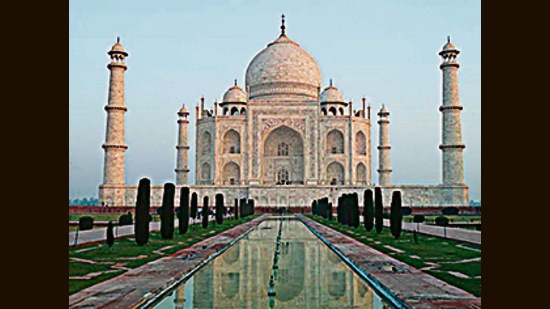
The Supreme Court directing Agra Development Authority (ADA) to immediately stop all business activities within 500 metres of the iconic Taj Mahal, has created a wave of uncertainty in the Tajganj locality, where about 150 small- and medium-category hotels, emporiums and 500-odd shops are located.
Hotel Taj Khema, owned by the U.P. State Tourism Development Corporation, is located barely a few meters away from the eastern gate of the Taj Mahal. Former US president Bill Clinton had addressed an environment conference from the hotel. One of the suits there is named after Clinton’s daughter Chelsea, who had praised the location for providing a clear view of the Taj Mahal.
The prestigious ‘Amar Vilas’ Hotel, where then president General Pervez Musharraf had stayed during the Indo-Pak Summit, is just beyond the 500-meter mark. On the western side lies government-owned Taj Restaurant and a market owned by ADA.
ADA officials, however, are tight-lipped over the action they would be taking to comply with the SC order. Vice-chairman Charchit Gaur said: “Teams have been constituted to conduct a survey within the 500-meter periphery of the Taj Mahal to find out what type of business activities are going on in the area and how many of them are there. We will compile a report, after which further course of action in compliance with the Supreme Court order will be taken.”
The SC order will impact business establishments spread across the Tajganj locality, mainly on the Taj Mahal’s southern side, which is a densely-populated area originally inhabited by families of those who were involved in the building of the monument. Presently, a sizeable Muslim population lives there.
A few years ago, the monument’s southern gate was closed for visitors’ entry on security grounds. Now, only exit is allowed through the gate, which leads to shops on both sides. On the north of the Taj Mahal flows the Yamuna.
The official vehicle parking spot is located near the eastern and western gates, but it is beyond 500 metres of the mausoleum. As vehicular movement is prohibited in the area, even VVIPs have to take battery-operated golf carts from ADA to reach the eastern gate.
In an order released on Monday, the top court allowed a plea which had sought a directive to the authorities concerned for prohibiting commercial activities in the 500-meter periphery of the 17th-century monument.
“We allow the prayer that reads -- Direct the Agra Development Authority to remove all business activities within 500 meters from the boundary/peripheral wall of the monument Taj Mahal which shall be in tune with Article 14 of the Constitution of India,” the bench of justices Sanjay Kishan Kaul and AS Oka.
Sandeep Arora, a business owner near the southern gate, said if ADA acted arbitrarily then legal recourse might be sought before the apex court.
“There had been orders on similar lines in the past. Agra Development authority needs to implement the order in the true sense because prima facie the matter relates to shops on the western side of the Taj Mahal, where ADA owns a market. A majority of shop owners had earlier gone for litigation as they were allotted shops outside the 500-meter radius,” he observed.
The Supreme Court’s order was in response to an application moved by 71 shopkeepers, who had alleged that they were removed from near the western gate in 1993 even as other commercial activities continued there.
“We have full trust in the court and the government, and thus expect a humanitarian approach because thousands of families relying on these commercial activities will be affected. In case we are asked to close our shops then an alternate arrangement must be made for us,” said Tahiruddin Tahir, an 80-year-old who runs a shop near the southern gate and is the head of the craftsman association of southern gate shops.
Munawwar Ali, who owns a hotel on the western side, said he has complete trust in the judiciary.
The bench had taken on record the submissions of senior advocate ADN Rao, who is assisting the court as an amicus curiae, that it would be in the interest of the protected monument to issue directions for barring all commercial activities near the Taj Mahal. Rao pointed out that the top court issued a similar order in May 2000 but it is only appropriate to reiterate the direction in view of the long passage of time.


