
 E-Paper





Umesh Raghuvanshi is an award-winning journalist with nearly four decades of demonstrated experience in the profession. He is the author of Ayodhya: The Gods Are Liberated. He is skilled in storytelling and newswriting, and writes on politics, governance, legislature, finance, environment, and social issues. He is based in Lucknow, is well-travelled, and has covered several national and international events, as well as all assembly and parliament elections in Uttar Pradesh since 1984. He has been a visiting scholar at the Graduate School of Journalism, University of California, Berkeley, USA, and a Metcalf Fellow at the Metcalf Institute of Marine and Environmental Reporting, University of Rhode Island, USA. He is a science graduate from DBS College, Dehradun, and holds an MA in Political Science from DAV (PG) College, Dehradun. He won the KC Kulish International Merit Award for excellence in journalism (2015) and received it in New Delhi in 2017. He also won a competition organised by the United Nations Environment Programme DTIE OzonAction Programme in 2009 that assessed coverage of the interlinkages between ozone and climate change. He was awarded in Beijing, China, in 2010. He started his career with a Dehradun-based English daily in the early 1980s and later worked with The Pioneer too.
Uttar Pradesh budget: Performance, prudence pave way for long-term goals
A close scrutiny of the state government’s own analysis, circulated with the annual budget, claims that UP’s GSDP (nominal), which is estimated to reach ₹31 lakh crore by March 31, 2026, will go up further to reach ₹39.75 lakh crore by March 31, 2027.


The Yogi Adityanath government’s 10th budget speaks of its performance and financial prudence for now amid the challenge of taking Uttar Pradesh ahead on the path of development even as it paves the way for long-term goals without short-term freebies.
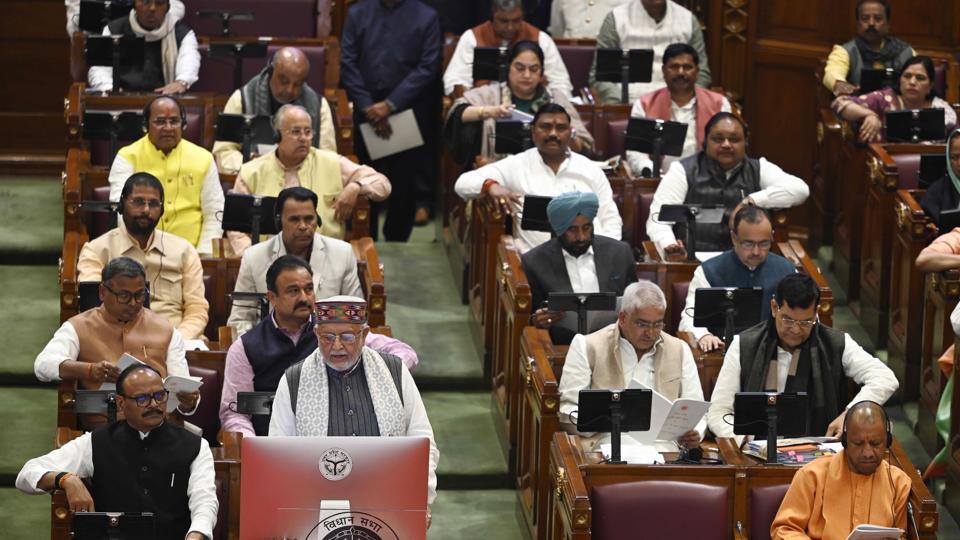
Finance minister Suresh Khanna acknowledged his government’s focus on performance in his budget speech with the couplet “kabile tarif hai andaaz ek ek kaam ka, ga raha hai geet UP Yogi ji ke naam ka” (His style of work is praiseworthy, a song is being sung in the name of Yogiji).
The Yogi government, which presented the first ever pre-poll economic analysis in the house on Monday, has been able to push the development agenda aiming at making UP a trillion-dollar economy in the next few years and Viksit UP by 2047.
A close scrutiny of the state government’s own analysis, circulated with the annual budget, claims that UP’s GSDP (nominal), which is estimated to reach ₹31 lakh crore by March 31, 2026, will go up further to reach ₹39.75 lakh crore by March 31, 2027. Khanna, who presented the seventh of Yogi government’s 10 budgets with a deficit of ₹64,463.17 crore, said the GSDP (nominal) was ₹30.25 lakh crore in 2024-2025 and has grown 13.4% vis-a-vis the previous year. Those aware of the development say the GSDP growth may be about 14% in 2025-26 and is projected to be about 15% in 2026-27. His budget speech does not indicate measures that may be initiated to bring down the deficit.
The state government’s analysis also claims that the state’s debt to GSDP ratio would come down from an estimated 29.4% to 27.6% by March 31, 2026 and 23.1% by March 31, 2027. The state’s fiscal deficit is also expected to remain ₹1,18,480.59 crore, which is within permissible limits at 2.98% of GSDP. The state government proposes to bring down the expenditure on debt servicing from an estimated 17.6% of revenue receipts in 2025-26 to 16.6% in 2026-27.
With regard to the financial situation, the state government’s analysis indicates that it hopes to get ₹1,08,310.02 crore from its own taxes, showing an estimated increase of about 47.89% in 2026-27. It hopes to get ₹3,92,317.06 crore as its share in central taxes, subsidy and loans from the Centre in 2026-27. It estimates total receipts of ₹8,48,233.18 crore in 2026-2027. Its total receipts in 2025-2026 may, however, remain about ₹6,86,393.73 crore only against estimates of receiving ₹7,79,242.65. The state government’s total estimated receipts include revenue receipts of ₹5,79,842.01 crore and capital receipts of ₹1,06,551.72 crore. The state government’s expenditure on the capital account, which was projected to be ₹2,25,561.49 crore, may remain ₹2,10,737.05 crore as per the revised estimates indicating a shortfall of about ₹15,388.91 crore. The state government’s share in central taxes is expected to come down by about ₹5,287.21 crore from the estimated ₹2,49,885.00 crore in 2025-26.


