Flooding and waterlogging during monsoon in Punjab is a tale as old as time. This year, with the state government and district authorities busy tackling the Covid-19 pandemic and as such late to start preparing for the rains, Hindustan Times surveys how prepared major cities of Jalandhar, Ludhiana, Bathinda, Amritsar and Patiala are for the rains scheduled to hit Punjab from Thursday.
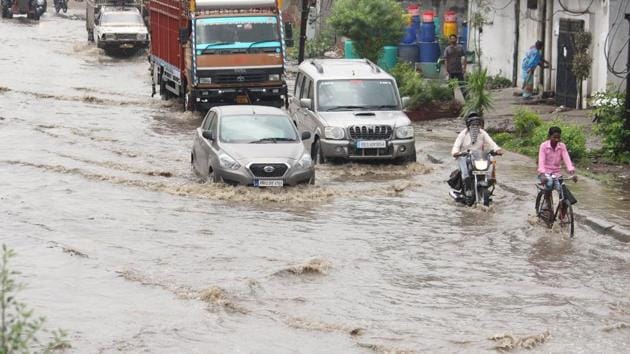
CASH-STRAPPED JALANDHAR MC YET TO START DRAIN CLEANING DRIVE
The cash-strapped municipal corporation in Jalandhar seems unprepared for the monsoons as the cleaning of sewer and main drains has yet to begin.
Sewer pipelines choked with plastic and waste led to flooding in most of the roads and low-lying areas in the city last year.
The Congress-ruled MC House, say sources, does not have a plan to tackle waterlogging despite being included in the Centre’s smart city list in September 2016.
As no revenues have been generated in the last few months because of the Covid-19 lockdown, the MC deferred plans to buy new machines or install new pipelines to manage storm water drainage.
Only drains in the city will be cleaned as of now, but work on that too will begin once contractors manage to get labourers, which is difficult as most of them have left for their home states after the corona outbreak, says a senior MC officer.
Lovedeep Singh Nagra, a resident of Shaheed Babu Labh Singh Nagar, says most of the roads in the city have developed potholes due to rain early this month, but no repair has been carried out. As a result, the risk of mishaps has increased.
{{/usCountry}}Lovedeep Singh Nagra, a resident of Shaheed Babu Labh Singh Nagar, says most of the roads in the city have developed potholes due to rain early this month, but no repair has been carried out. As a result, the risk of mishaps has increased.
{{/usCountry}}Besides Covid-19, the risk of other disease outbreaks is high as the MC has not started its fogging drive.
The MC has managed to cover only 8% area with storm water drainage, while sewage pipes don’t have the capacity to handle the heavy flow of water.
Even as the civic body has been using sewage cleaning machines to clear the choked pipes for over a year, waterlogging has been reported.
The MC in the last financial year spent about Rs 50 lakh on cleanliness and maintenance of the sewerage and water supply systems in the city.
MC commissioner Karnesh Sharma says there are enough cleaning machines and there are plans to hire more for a cleaning drive of the drains and pipelines ahead of the monsoon. – Jatinder Mahal
AMRITSAR HOPES TO STEER CLEAR OF WATERLOGGING
Amritsar’s sewer lines are being cleaned manually and mechanically at a cost of ₹8 crore, as the municipal corporation gears up to face the monsoon this season.
“The city has a 200-km main sewer line that runs through 85 wards. It used to be badly choked and filled beyond capacity, leading to submerging of most parts of the city every year, but this time, our new mechanised sewage cleaning machines will be used to clean the drains,” said mayor Karamjit Singh Rintu.
Desilting, which started in every constituency, is expected to be completed before the monsoon begins. The machines will be used at most of the places, “so once cleaned, the drains won’t cause waterlogging at Heritage Street at the Golden Temple,” Rintu said.
“Apart from the ₹8 crore sewer line cleaning project, a ₹5.5-crore project to clean the main sewerage drain, Ganda Nullah, in the city had been initiated in October last year and the desilting has been completed,” said Komal Mittal, MC commissioner.
Though Mittal said she was confident that there would be no waterlogging in the city, two control rooms would be set up by MC, at Lahori Gate and Company Bagh, to tackle choked drains, where MC employees will work from July to September. “We will advertise the helpline numbers soon,” she said.
Urging the MC to be better prepared, Kulwant Singh, social worker, said, “During pre-monsoon rain last year, a portion of Mall Road caved three months after it had been repaired. Waterlogging on Heritage Street, at the city bus stand and in the walled city remains a concern. During the lockdown, the MC should have recarpeted city roads.” Mandeep Kaur Narula
LAND ACQUISITION FOR SULLAGE LINE UNDERWAY IN BATHINDA
It is likely that Bathinda will face a flood-like situation in some pockets of the city this year too. The district does not have a storm water drainage network and sewage lines are being used to drain rainwater.
Last year, it was decided that a 12-km sullage line will be installed to drain excess rainwater from Power House Road locality, which is one of the worst-hit areas. However, only 4km of the pipeline has been laid as land acquisition for the remaining area is still underway.
The local body is racing against time as the monsoons are knocking on the door.
The MC has taken 10-acre land on lease from the Waqf Board to dig a pond to drain rainwater. Workers started digging the 10-ft pond on June 18 and the work is expected to be over by July 7.
Low-lying areas at the risk of flooding include localities around the district administrative complex that houses the official residences of the Bathinda deputy commissioner (DC), inspector general of police (IGP) and judicial officials, Sirki Bazaar, Mall Road, Power House Road, Parasram Nagar, Ganesha Basti and Vir Colony.
Vijay Kumar Sharma, a resident of Parasram Nagar and a former municipal councillor, blames poor planning for the sad state. “A single spell of showers in March exposed the unpreparedness of the authorities. Though Parasram Nagar is prone to waterlogging, the MC has still not cleaned sewer lines,” he said.
Public health activist Dr Vitull K Gupta blames haphazard urbanisation and poor planning. “Waterlogging cuts people’s access to different areas, including hospitals. Years of unplanned development and encroachment of old ponds is responsible,” he said.
Sirki Bazaar Traders’ Association general secretary Satpal said, “Stagnant water, rising up to four feet, collects in the streets after each shower but no effort has been made to find a solution.”
Municipal commissioner Bikram Shergill said they had lost April and May to the Covid-19 outbreak. “Additional pump sets have been sourced to drain water from low-lying areas,” he said.
“Natural depression zones near Sanjay Nagar and DAV College are being de-silted and the water-holding capacity of ponds is being increased. Work to clean drains is underway and residents will not face much trouble this time,” said Shergill. Vishal Joshi
PATIALA MC, DRAINAGE DEPT BEHIND SCHEDULE
Cleaning and de-silting of water bodies and drains in Patiala are running behind schedule due to the pandemic. It will take authorities two to three weeks to complete the process.
Drainage department superintending engineer Devinder Singh said de-silting is on in full swing. “Men and machines are working round-the-clock to complete the work,” he said.
“This year, work was delayed due to the coronavirus pandemic. Everything from deciding to tap the main drains to arranging machines and manpower was delayed due to the lockdown,” Singh said, adding since health is a priority for the state government, the department is working with limited resources.
“We received Rs 1.5 crore to clean the main drains in Patiala city and other parts of the district. We are expected to complete the work by June 30,” he said.
Last year, a flood-like situation had persisted in Patiala city after Badi Naddi, the main rivulet, overflowed. The administration had to evacuate around 250 families after the water entered colonies in low-lying areas. The Ghaggar river also brought devastation. Around 10,000 acres was submerged in Patran, Sanour and Samana.
Singh said the department was conducting a survey of the main rivulets, including Badi Nadi and Chhoti Nadi, to ensure their openings were not blocked.
Krishan Kumar, a resident of Gopal Colony that had flooded last year, said, “People had to live in a temporary relief camp last year after water entered their residences. Authorities must ensure that we do not face such an experience this year. Moreover, instead of cleaning drains before the monsoon, authorities should make it a routine affair,” he said.
Patiala MC commissioner Poonamdeep Kaur said the sewerage department had been directed to ensure de-silting of the eastern drain and the 30-km sewer lines and gullies before monsoon.
The district administration has set up seven control rooms at sub-division levels to deal with flood-like situations. Deputy commissioner Kumar Amit said, “Senior officials have been instructed to ensure that there are no man-made obstructions to restrict the natural flow of water and remove encroachments on drains.”
Model Town, portions of Lehal Colony, interiors of the walled city, Khalsa Mohalla, colonies situated in Tripari area and low-lying areas in the vicinity of Badi Nadi and Chhoti Nadi are prone to flooding. – Navrajdeep Singh
OLD SEWERS, CHOKED GULLIES SPELL TROUBLE IN LUDHIANA
Every year, Ludhiana city has trouble due to waterlogging yet the municipal corporation (MC) officials do not plan to install storm water drains in the city.
The district is sorely in need of such drains because old sewer lines are not able to keep up with the pressure due to low capacity.
Most city areas are prone to water-logging, especially portions of the old city areas and the outskirts of the city.
Posh areas of the city such as the Model Town extension, and Sarabha Nagar are not immune to waterlogging.
In a first, the MC is getting the city’s main drain, Buddha Nullah, desilted by a private firm and residents living near the area have flagged anomalies in the process.
The nullah overflows at few points, including New Kundanpuri area, Upkar Nagar and Shivpuri, almost every year during the monsoon.
Former BJP councillor Narinder Malhi said, “Desilting is not being done properly and silt is not being removed from the centre. The silt that is being pulled out of the nullah is also being dumped on the banks. It will re-enter the nullah when it rains.”
Authorities are also working on increasing the capacity of Talab Bazaar drain. However, residents have criticised the MC for not cleaning road gullies.
A resident of Bishan Enclave, Sahil Khurana, said, “New sewer lines were installed in the area in November but the road gullies have already become choked. The MC staff had cleaned the lines a few days ago but the problem persists.”
MC commissioner Pardeep Sabharwal said, “Work to clean Buddha Nullah and the road gullies is on in full swing. The MC is also getting the drain passing through the old city cleaned. The drain had been blocked for years. I have inspected the work and the staff at the sewerage treatment plants have been asked to ensure rain water does not get accumulated.”
“A control room will soon be established in the coming days to deal with waterlogging woes,” he added. -Harsimran Singh Batra