
 E-Paper



Decoding the Maratha-Kunbi reservation row
Three panels had already studied the issue and offered specific steps to confirm the backwardness of the Maratha community. Yet, the agitation continues

 Prefer HTon Google


A committee led by retired justice of Bombay high court (HC) Sandeep Shinde held its first meeting in the Mantralaya on Monday. The committee, constituted to decide the methodology on the basis of which Kunbi certificates can be issued to members of the Maratha community has been handed over documents that run to more than four million pages. However, this is not the first committee that has been tasked with the important job of resolving the Kunbi-Maratha political crisis.
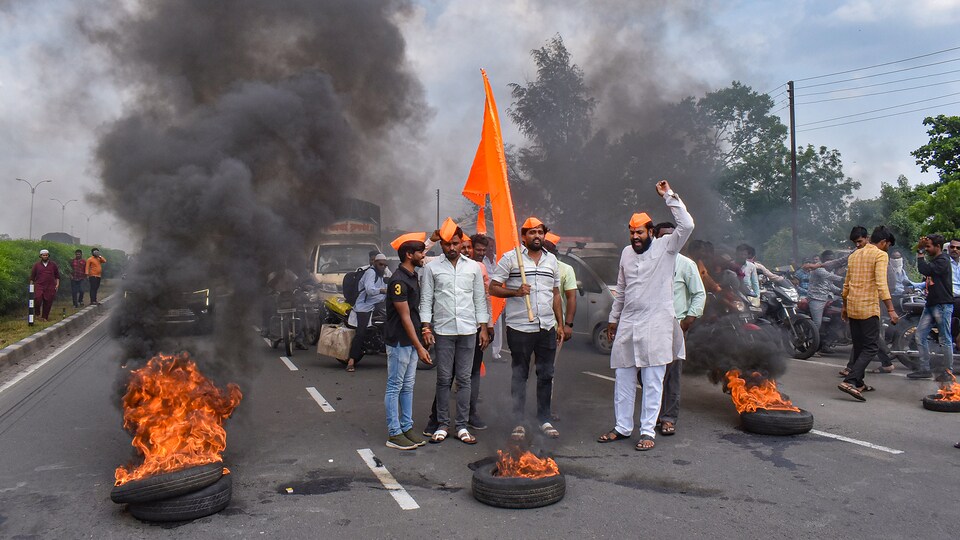
As the Maratha community raises its demands for reservation again, this time in the crucial pre-Lok Sabha election year, the Bharatiya Janata Party-Shiv Sena-Nationalist Congress Party (Ajit Pawar faction) coalition government in Maharashtra must tread carefully. Since the past decade, three committees have already looked into the matter and suggested varying amounts of reservation for the community; the government has implemented the quota for various years; and constitutional courts have either modified or struck down the reservation.
The same coalition, after coming to power in 2014, had passed a law according 12% and 13% quotas to Marathas in education and jobs, respectively, in 2018. However, the law was challenged by advocate Jayashri Patil in the Supreme Court, who quashed the reservation in May 2021 when the Maharashtra Vikas Aghadi (MVA) government was in power.
In 2021, a committee was formed under former chief justice of Allahabad high court Dilip Bhosale to recommend steps that could be taken to restore reservation to the Maratha communities. The committee recommended that the state should file a review petition in the apex court and that a fresh commission should collect data to ascertain the backwardness of the community — on the basis of this, the quantum of reservation could be decided.
The 2018 reservation was based on data provided by the Maharashtra State Commissioner for Backward Classes (MSCBC) which was headed by Justice MG Gaikwad at the time. The Fadnavis government had initially offered reservations of 16% for both jobs and education. While upholding it in 2019, the Bombay high court brought it down to 12% in education and 13% in jobs. However, a five-judge bench of the Supreme Court deemed the reservation unconstitutional on May 5, 2021.
The issue dates back a little further: The process to accord reservation started in 2014 when the then Congress-led government gave 16% reservation to Marathas and 5% to Muslims. The Prithviraj Chavan government issued the Educationally and Socially Backward Category (ESBC) Ordinance in September 2014 to bring the quota into force.
However, the reservation was stayed by the Bombay high court in November that year. The quantum was decided by a committee of ministers headed by Narayan Rane, who was a minister in the Prithviraj Chavan-led government at the time. The Rane committee had recommended a 20% quota, but the cabinet decided to keep it to 16%.
After the assembly elections held that year --- and the Bombay HC had by then stayed the ordinance --- the newly-formed BJP-Sena government headed by Devendra Fadnavis moved a bill in the state legislature in December 2014 and it was passed unanimously.
Here’s a look at what the previous commissions did:
Rane Committee: 2013
The Rane committee which submitted its report in March 2014, recommended 20% reservation to the Marathas in the state. Following this, the state cabinet in 2015 recommended 16% reservation to the Marathas and 5% to Muslims in jobs and education.
The Rane committee, which was formed in 2013, surveyed 5.5 lakh families and 18 lakh people from the community to establish its backwardness.
Its report was submitted to the Maharashtra State Commissioner for Backward Classes for approval, but was denied approval.
Gaikwad commission: 2018
The Maharashtra State Commissioner for Backward Classes (MSCBC), headed by Justice MG Gaikwad, submitted a report running to more than 1,000 pages in November 2018. It made a case for exceptional circumstances in the state that would allow the Maratha community to fall within the exception carved out in the Supreme Court’s benchmark Indra Sawhney judgement, which put a 50% ceiling on the reservation. The report also endorsed the backwardness of Marathas in social, educational and financial parameters.
The 40-point questionnaire set for the survey of 43,629 families in more than 175 tehsils across the state included 10 points allotted to social backwardness, 8 to ascertain educational and 7 to ascertain economic backwardness. Not all families surveyed belonged to the Maratha community.
The parameters to establish social backwardness included customs and traditions, types of jobs that the community men and women are into, the percentage of the population that does dignified work, and the proportion that does menial work, among other factors. To measure economic backwardness, questions pertained to land holdings, annual income, and Below Poverty Line families. Enrolment figures in higher and technical education helped ascertain the backwardness of the community in the educational sector.
The Maratha community reportedly scored 21 points in all (out of 25), which established the backwardness required for reservation.
Historical documents from the Chhatrapati Shivaji era, including scriptures were produced to show the backwardness of the community. In some documents, Shivaji Maharaj has been referred to as Kunbi. Groups and organisations representing the community also submitted material as evidence to prove to the commission that it was traditionally backward. Of the 43,629 families surveyed across the castes, more than 60% agreed that Marathas should get reservation in education and jobs and, of those surveyed, 70% lived in semi-pucca houses. While 37 % families were BPL, 62% families held marginal land holding, the report stated. It also stated that deaths by suicide were reported in 345 of families surveyed; 277 of them belonged to the Maratha community.
The committee suggested 16% reservation to the community.
Bhosale committee: 2021
Soon after the SC struck down the Maratha reservation in 2021, the MVA government constituted an eight-member committee to decide the future course of action. The Bhosale committee recommended setting up a new commission if the government’s review petition was dismissed by the Supreme Court. A fresh study was needed to collect appropriate material and to statistically demonstrate the correct percentage of every class of the population, and comprehend the real deprivation of the Maratha community. The study could also collate information about educational backwardness, and in doing so, overcome the criticism of the SC regarding breaching the 50% ceiling on all reservations.
The committee also recommended the terms of reference for the fresh commission, and recommended exploring the possibilities of providing ancillary benefits to the Maratha community, including hostels, fee reimbursement, and credit facilities as well as skill development training for youth.
The commission recommended that the state government collaborate with other states and approach the Central government to ask for a constitutional amendment in Articles 15 (4) and 16 (4) to dilute the effect of the 50% cap. The commission made these recommendations after studying the SC judgement of May 2021, the Gaikwad Commission report as well as the SC’s observations on the Gaikwad Commission report.


