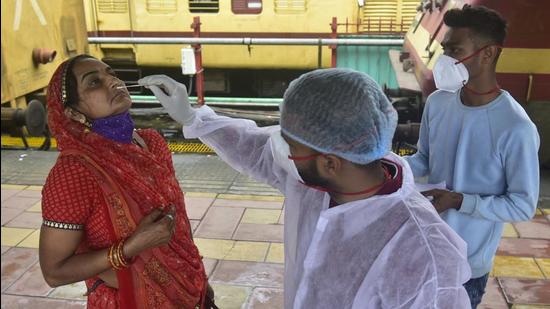
Apart from battling the novel coronavirus, healthcare workers (HCWs) attending to patients are facing another challenge – stigma. This often forces the caregivers to hide their identity in order ‘to prevent any social harassment’. This has been revealed in a pan-India study conducted by the Indian Council of Medical Research (ICMR) across 10 cities. The study has also revealed various other reasons that are affecting the mental health of the HCWs.
The ICMR has conducted the study of 967 participants from the 10 cities —Bhubaneswar (Odisha), Mumbai (Maharashtra), Ahmedabad (Gujarat), Noida (Uttar Pradesh), south Delhi, Pathanamthitta (Kerala), Kasaragod (Kerala), Chennai (Tamil Nadu), Jabalpur (Madhya Pradesh), Kamrup (Assam) and East Khasi Hills (Meghalaya). Among the respondents, 56% were females, while 46% were males who were primarily in the age group between 20 and 40 years (84%).
Stigmatisation of HCWs
Till August 28, around 87,000 HCWs in India have been infected with Covid-19 on their line of duty. Six states—Maharashtra, Karnataka, Tamil Nadu, Delhi, West Bengal and Gujarat recorded almost 74% of the total cases. In Maharashtra, around 158,000 HCWs were tested for Covid-19, of which, around 24,500 were identified with novel coronavirus— the highest in India, as per the data from the Union health ministry.
Since the outbreak of the pandemic, the overwhelmed HCWs have been working round the clock in taking care of the patients and vaccination. Despite this, in repeated instances, they are being subjected to stigmatisation and harassment.
{{/usCountry}}Since the outbreak of the pandemic, the overwhelmed HCWs have been working round the clock in taking care of the patients and vaccination. Despite this, in repeated instances, they are being subjected to stigmatisation and harassment.
{{/usCountry}}Citing a particular instance, the study has published an interview of a 55-year-old male ambulance driver who was responsible for ferrying patients to hospitals. Sharing his experience, he said, “When people see me, they say “here comes Corona!.” They (neighbours) would close their doors and windows if they saw me coming from a distance. At marketplaces, people cover their faces when they see me. They would cross me or supersede me very fast by accelerating their vehicles. Even my relatives walk away when they see me and do not want to be face to face with me. There seems to be so much hatred in their minds.”
This is not the only instance where HCWs in service for Covid-19 patients were humiliated. In April 2020, HT reported how a marriage proposal for Dr Reshma Shinde, a resident doctor in pathology department at King Edward Memorial (KEM) Hospital, Parel did not work out as she was stationed in the Covid-19 ward.
The study has found out that the neighbours, friends and relatives of the HCWs made them feel they were the spreaders of the infection and avoided them, made hurtful remarks and also showed reluctance to interact with them. “Some HCWs reported that they also had to conceal their identities to prevent any social harassment as captured in the statement below. There were also some who reported stigma from their own families,” reads the study. “This attitude was mainly because they were considered as vectors for transmission of the virus and not perceived as those whose primary service was to prevent infection and help those infected,” it further reads.
Dr Beena E Thomas from the department of social and behavioural research, National Institute for Research in Tuberculosis, Chennai who is the main correspondent of the study said that there is a need to sensitise the public. “The stigmatisation adds to the mental health of the already exhausted and burn out HCWs. More focus should be paid on educating people,” she added.
HCWs need a psychological support system
HCWs are already suffering from burnout. As HT reported earlier, many of them are taking psychiatric help to deal with the trauma in Mumbai. National Institute of Mental Health and Neurosciences (NIMHANS) conducted a survey among 3,083 HCWs across India. They published their findings in April in the Asian Journal of Psychiatry, which revealed that 26.6% and 23.8% of the respondents had anxiety and depression respectively.
Against this backdrop, ICMR conducted his study to find out the main reasons for the mental health crisis among the HCWs and make recommendations to the central government.
“I am not able to take care of my two-year-old baby and leaving her was difficult for me. My kids are angry with me, and now whenever I call my daughter, she does not talk to me. They are angry because I have to leave them again and again. My elder daughter is studying in Class 9, and as a mother, I should provide her more time in this growing up stage and I should help her with her studies, but I am unable to provide time for her. I am unable to provide them good food in these growing up years and I am unable to take care of them,” a 43-year-old nurse was quoted in the study.
Along with the pressure of separation from the family, the researchers also found out that the excessive workload, erratic working hours, challenges of working personal protective equipment (PPE) for hours, fear of infection, sleep deprivation, disruption in eating habits are also contributing to the mental trauma of the HCWs.
“Recent reports indicate that health personnel struggled with higher workloads and a swiftly changing workspace milieu that differed greatly from the familiar day-to-day reality while dealing with the social changes and emotional stressors of Covid-19. The longer working hours with erratic timings reported in the present study resulted in sleep deprivation as well as unhealthy eating patterns, which could have long-term consequences,” reads the study.
In fact, the researchers have found out that female caregivers are more affected than male counterparts as along with workload, they also have the responsibility at home. “As the triple burden of being caregivers in the hospital, at home and balancing these dual roles which took a toll on their mental well-being…(sic),” reads the study.
ICMR has suggested improving the working environment for HCWs, allowing them breathing space, filling the staff crunch and providing them more time with facilities.
“There is a need for a more holistic approach by focusing on community engagement and support groups in each organisational structure,” said Dr Thomas.
Stay updated with all the Breaking News and Latest News from Mumbai. Click here for comprehensive coverage of top Cities including Bengaluru, Delhi, Hyderabad, and more across India along with Stay informed on the latest happenings in World News.
Stay updated with all the Breaking News and Latest News from Mumbai. Click here for comprehensive coverage of top Cities including Bengaluru, Delhi, Hyderabad, and more across India along with Stay informed on the latest happenings in World News.