
 E-Paper



HC refuses to stay govt resolution granting Kunbi status to Marathas
A division bench of chief justice Shree Chandrashekhar and justice Gautam Ankhad refused to stay a government resolution (GR) issued on September 2

 Prefer HTon Google


MUMBAI: The Bombay High Court on Tuesday refused to grant an interim stay on the Maharashtra government’s recent decision to allow eligible members of the Maratha community to get Kunbi caste certificates, which would enable them to get reservation benefits under the Other Backward Classes (OBC) category.
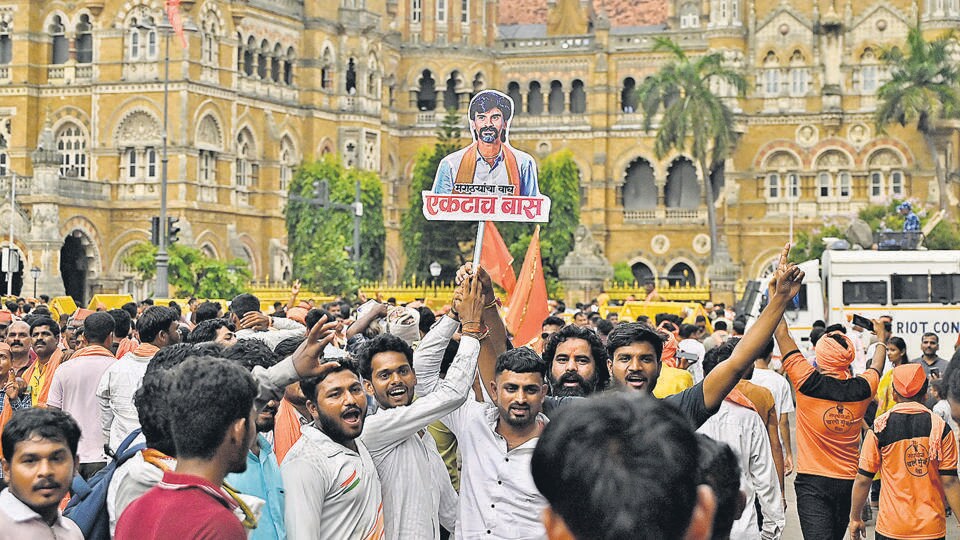
A division bench of chief justice Shree Chandrashekhar and justice Gautam Ankhad refused to stay a government resolution (GR) issued on September 2, saying the matter needed a detailed hearing. The bench has now directed the state’s social justice department to reply to a batch of petitions filed by various OBC groups challenging the GR.
The September 2 GR allows Marathas who can prove their Kunbi ancestry through historical records to receive Kunbi caste certificates. To establish eligibility, the GR provides for the use of the 1918 Hyderabad gazetteer, which documented Marathas as Kunbis during the Nizam’s rule. Kunbis get reservation under the OBC category.
The decision was taken following a five-day agitation by Maratha quota activist Manoj Jarange and his supporters in Mumbai, who have been demanding OBC status for the community. The decision was based on recommendations by the government-appointed justice (retired) Sandeep Shinde committee, which examined revenue and historical records, particularly from the Marathwada region, to identify people of Maratha origin who may have Kunbi lineage. The GR effectively extended the verification process across the entire state, enabling applicants to rely on old records or family documents to claim OBC status.
Senior advocate Venkatesh Dhond, appearing for the petitioners, argued that the GR was unconstitutional as it sought to alter a process already governed by a statutory mechanism under the Maharashtra Scheduled Castes, Scheduled Tribes, De-notified Tribes (Vimukta Jatis), Nomadic Tribes, Other Backward Classes and Special Backward Category (Regulation of Issuance and Verification of) Caste Certificate Act, 2000.
“The GR is worded in such a manner that it will open a backdoor for ineligible people, such as Maratha, Maratha Kunbi or Kunbi Maratha,” Dhond submitted, adding that “the question of caste and any benefit is already a subject of state legislation”.
Dhond argued that the 2000 Act already provides for a detailed two-tier system for issuance and verification of caste certificates, and that the government could not bypass this procedure by invoking executive powers under article 162 of the Constitution. “When the process for issuance of caste certificates is prescribed under the rules, you cannot issue a GR under article 162. The intention is to avoid going before the legislature,” he said.
Dhond also cited reports of expert bodies like the Kaka Kelkar commission, the VD Deshmukh committee, and the Mandal commission, all of which, he said, drew a clear distinction between Marathas and Kunbis. “Marathas as a community are not OBCs. The Mandal commission also separated Kunbis and Marathas,” he added.
Tracing the legislative history, Dhond referred to the Narayan Rane committee, which had recommended a separate quota for Marathas, following which the state government promulgated two ordinances granting 16% reservation for the community, independent of the OBC category. These ordinances later became the Socially and Educationally Backward Class (SEBC) Act, which was eventually struck down as unconstitutional by the Supreme Court in 2021.
“Because Marathas are not in the OBC bucket, and cannot claim reservation as SEBC, there is now an attempt to squeeze them in through a backdoor entry,” Dhond argued. “The Shinde committee considered only documents from Marathwada, where there might be genuine applicants, but it was later expanded to all of Maharashtra. This creates an avenue for infiltration of persons otherwise not eligible.”
The senior advocate pointed out that the impugned GR was issued following the Maratha agitation in August, and said the phrase “eligible Maratha”, which earlier restricted benefits to a narrower group, had now been dropped.
Dhond also raised concerns about a provision allowing individuals to secure caste certificates based merely on affidavits from people in their village claiming ancestral OBC lineage. “This means anyone can make such claims and even contest elections,” he said.
Senior advocate Anil Anturkar, representing some other petitioners, said the government’s decision violated mandatory constitutional safeguards. “The National Backward Classes Commission, which must be consulted in such cases, was never consulted. The Supreme Court in Jayashri Patil’s case has laid down that such consultation is mandatory,” he submitted.
Advocate general Birendra Saraf, on the other hand, submitted that the petitioners had no locus standi (right to be heard) to challenge the resolutions. “They are not aggrieved. They cannot lay a challenge to the GRs, and their petitions should not be entertained,” he told the court.
The division bench, while recording the submissions, said it was “not inclined” to grant interim relief at this stage. The judges observed that “whether consultation was necessary or whether the resolutions are ultra vires needs to be examined after a full-fledged hearing.”
The bench also refrained from commenting on the government’s exercise of powers under article 162, saying, “We are reluctant to say anything because it shouldn’t come from us. We need to hear what the government has to say first.”
The court added that while the petitioners’ apprehensions may be genuine, any clarification on the government’s intent must come through an affidavit. It directed the social justice department to file its affidavit in reply to the petitions and posted the matter for further hearing after the Diwali vacation.
Stay updated with all the Breaking News and Latest News from Mumbai. Click here for comprehensive coverage of top Cities including Bengaluru, Delhi, Hyderabad, and more across India along with Stay informed on the latest happenings in World News.


