
 E-Paper



Malad – Marve road widening: HC restrains BMC from removing Parochial House in St Anthony’s Church
The court was hearing a petition filed by the church through its sole trustee, Father Agnelo Fernandes, after the civic body issued notices for the removal of the structure, claiming that it was in the middle of the planned DP (Development Plan) road line and is therefore required to be removed


MUMBAI: The widening of congested Malad Marve road is likely to be delayed as the Bombay high court (HC) on Friday restrained the Brihanmumbai Municipal Corporation (BMC) from removing the Parochial House or the Father’s Bungalow in St Anthony’s Church that has held up the work.
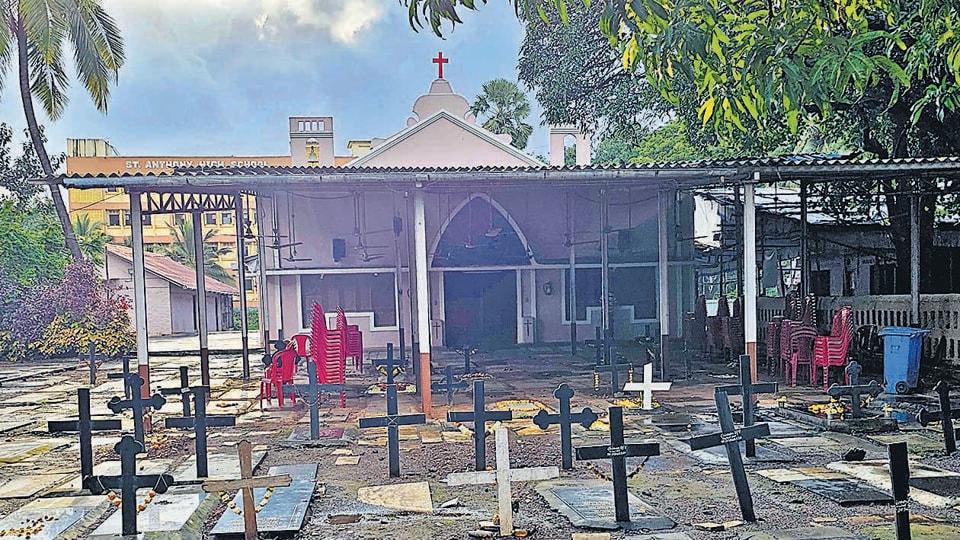
The division bench of justice Gautam Patel and justice Kamal Khata passed the restraining order after noticing that though the church was willing to relocate the bungalow for the road widening project, the civic body had failed to come up with an acceptable solution to the landowner’s demand for appropriate compensation for loss of the land.
The court was hearing a petition filed by the church through its sole trustee, Father Agnelo Fernandes, after the civic body issued notices for the removal of the structure, claiming that it was in the middle of the planned DP (Development Plan) road line and is therefore required to be removed.
Though the Father’s Bungalow was listed as a heritage structure, the church had in September this year expressed its willingness to relocate the bungalow to some other location in the church complex after receiving a communication from the BMC in November 2020 stating that the Mumbai Heritage Conservation Committee (MHCC) was of the view that the structure was not of significant heritage value and had accordingly granted permission for widening of the road to the extent of the DP road line by removing the bungalow.
On Friday, advocate Sean Wassoodew, who represented the church, pointed out that though they were willing to relocate the structure, the civic body was unwilling to appropriately compensate them. He pointed out that though the structure had a built-up area of 410 sq mtr, the civic body was maintaining that under their prevailing policy compensation could be granted for maximum 120 sq mtr only.
The bench agreed with his apprehension. “Mr Wassoodew has pointed out, and we believe he is correct, that in a situation such as this, and especially since the structure in question has probably been in existence longer than the Municipal Corporation of Greater Mumbai (MCGM) itself, there is no question of applying some artificial cap or upper limit on the area that can be reckoned for the purposes of compensation,” the judges said.
“It does not matter what policy is being invoked by the MCGM. If the Petitioners’ structure is today of 410 sq mts, we do not see how compensation can take into account only 120 sq mts,” the judges added and restrained BMC from removing the structure till the next date of hearing on the petition – January 5.
After the advocate representing the church pointed out that the compound wall around the Parochial House had been pulled down, the court allowed the church to put up a temporary protective fence to prevent encroachers from entering into the property.
Stay updated with all the Breaking News and Latest News from Mumbai. Click here for comprehensive coverage of top Cities including Bengaluru, Delhi, Hyderabad, and more across India along with Stay informed on the latest happenings in World News.


