Mumbai: “It was like building a house with no windows,” said Ashwini Bhide, the driving force behind Mumbai’s first underground metro, Metro 3, or the Aqua Line. Which is why, when phase one of the metro opened on Monday, the tough-talking Indian Administrative Service officer felt a “big sense of satisfaction, relief and confidence”.
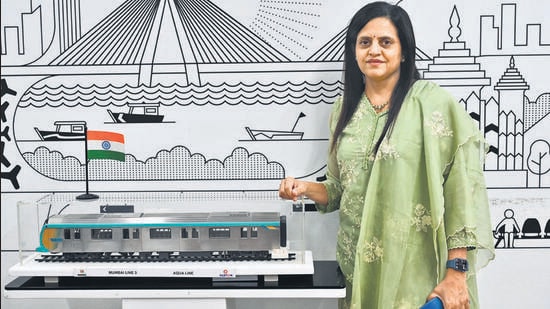
Bhide, Managing Director of the Mumbai Metro Rail Corporation Limited (MMRC), is a no-nonsense officer who is not afraid to speak her mind. She said that, for her, Metro 3 has been the most challenging infrastructure project to date.
Not new to execute big-ticket projects, Bhide has spearheaded the Eastern Freeway, Mumbai Monorail and Sahar Elevated Road. However, Mumbai Metro 3 was unique, given the multitude of challenges, some of them never encountered in other infrastructure projects. “The magnitude of this project was humongous. In fact, this one was all of them put together in one project.”
With the Aqua Line rolling, and gathering momentum among Mumbai’s commuting public, Bhide spoke to Hindustan Times about the highs and lows during the construction phase, and how MMRC navigated the unique challenges it presented. Excerpts:
PLANNING
{{/usCountry}}PLANNING
{{/usCountry}}The biggest challenge was its design and construction as crews had to tunnel under some of the city’s most congested neighbourhoods, which house old, dilapidated heritage buildings. Elsewhere, they had to bore under high-rises, swanky new buildings, and vital installations such as the airport and active railway lines.
Besides, the project was split into a dozen packages and planning was divided into different baskets – from finance, loans from the Japan International Cooperation Agency, identification of land parcels from various government agencies, acquisition from private owners and rehabilitation of project affected people (PAPs). “Getting environment approvals from the state and Centre was a challenge because certain sections passed through the Coastal Regulatory Zone area, in addition to approvals from the railways, airport and airports authority,” said Bhide.
SOCIAL ENGINEERING
Nearly 2,950 families – 2,200 in slums and about 750 in buildings – were impacted by the project. “These were not typical PAPs who had to be rehabilitated. They were legal tenants who had the right to in-situ rehabilitation. We temporarily shifted them to rented premises and carved out some land parcels for in-situ redevelopment. That took a while,” said Bhide. “We have incurred the burden of their rental payments for 5-6 years and it may take another 2-3 years for construction to be complete. These issues were different from earlier projects.”
RIGHT OF WAY
It’s not easy to cut into Mumbai’s underbelly. Two tunnels for the 33.5-km corridor (Colaba to Aarey), totalling 55 km, were carved out, using 17 Tunnel Boring Machines (TBMs). Certain sections of the route had to be cut open to build the tunnels 25mt underground. The route has 27 stations, only one is at ground level.
“The first 6mt beneath any road is full of utilities. So, we had to undertake utility management, space management, traffic management, in addition to managing transportation of the construction material, especially the excavated earth,” Bhide reveals.
LOGISTICS
Building an underground metro is very different from constructing one above ground. It requires high precision in design and implementation, while ensuring safety all around. “It’s like building a house without any windows,” she says.
A whopping 15 lakh sq mt of built-up space was created underground. Imagine transporting and then moving into place, with utter precision, heavy electrical machinery, escalators, fans and everything else that has been fitted in the underground metro. Everything had to be placed exactly where it needed to be installed, at different levels, before the slab was closed. And then there was the Mumbai monsoon and associated waterlogging to deal with. Crews worked incessantly to keep the construction area dry.
“There were complaints of dust, noise pollution and other issues we had to resolve. As a result, the initial phase saw a lot of litigation and many organisations were up in arms against the project,” revealed Bhide.
LITIGATION
The project faced stiff resistance from environmentalists. Over 90 petitions were filed in various courts as MMRC and environmentalists failed to see eye to eye on the loss of green cover in Mumbai, in Aarey in particular. Eventually, the Bombay High Court appointed a committee to oversee tree planting initiatives that would compensate.
“Environmentalists selected trees at nurseries we had tied up with. We nurtured these trees for four years, till they attained a certain girth and height. They are being planted wherever we have rebuilt the road. Over 600 trees have been planted and are growing well,” said Bhide.
The Girgaum-Kalbadevi area saw huge protests between 2015 and 2019. An effigy of MMRC was burnt. “I conducted 50-60 meetings with locals. We also had a dedicated team who were in conversation with them for two years,” said Bhide. “As a result, we didn’t face a single lawsuit on rehabilitation issues.”
HERITAGE BUILDINGS
Making sure heritage buildings in South Mumbai were not damaged was not easy, and the civic Heritage Committee had to be convinced that these structures would not be impacted.
In the Hutatma Chowk heritage area, the road was narrower than required. So we designed that metro station to suit a partially Cut-And-Cover and New Austrian Tunnelling Method, which involves conventional tunnelling.
“Our ‘building condition survey’ mapped and documented roughly 2,500 buildings throughout the alignment, including the heritage area. Then we shared the details with the building owners. This was done twice, by MMRC and then the contractors,” Bhide revealed.
“We placed instruments at the site and on various buildings, to measure the impact of the construction activity on the structures. There were displacement markers, crack markers, vibration meters, and many other instruments. These were monitored 24x7. It took a long time to build the Hutatma Chowk station but we made sure not a single building was affected,” she said.
RELIGIOUS FAITH
There are two Parsi fire temples in the Dhobi Talao-Kalbadevi area. One of the tunnels passes very close to the boundary of one of them and 25mt beneath the other. The Kalbadevi station was just next to that temple. The Parsi community did not want tunnels to pass beneath their holy fire as it would amount to desecration.
“We wanted to determine the exact path of the tunnel in relation to the fire temple. Since only Parsis are allowed inside the fire temples, we arranged for a Parsi engineer to assist in the task,” recounted Bhide. “We realised that the tunnel would not pass beneath the holy fire, it would pass under the corridor used for cleaning one’s feet,” Bhide says. “Still, we were requested to shift the tunnel and we honoured that request as best we could.”
At some point in this process, the community also moved court and pressed for relief. “It became a constitutional petition that invoked the Right to Religion and the Right to Minority Welfare under Article 25 and 26. After 6-7 months, the court ruled in favour of MMRC but it cost us time as tunnelling activity had come to a standstill,” said Bhide.
SPORTS
The project disrupted sporting activity, particularly in South Mumbai. Some parts of Oval Maidan and a sizeable portion of Azad Maidan fell in the construction zone. Some pitches were also disturbed. Even cricket pitches at Shivaji Park had to be temporarily shifted. While the other grounds have been restored, the land at Azad Maidan will soon be restored.
Stay updated with all the Breaking News and Latest News from Mumbai. Click here for comprehensive coverage of top Cities including Bengaluru, Delhi, Hyderabad, and more across India along with Stay informed on the latest happenings in World News.
Stay updated with all the Breaking News and Latest News from Mumbai. Click here for comprehensive coverage of top Cities including Bengaluru, Delhi, Hyderabad, and more across India along with Stay informed on the latest happenings in World News.