
 E-Paper



New glossary offers vibrant vocabulary to appreciate city’s colonial buildings
The book was inspired by archaeologists who, despite knowing history of buildings, sometimes lack vocabulary to describe architectural details, technicalities

 Prefer HTon Google


MUMBAI: Very few books about Mumbai will make you look at a building and observe its tiny details: the slatted ventilators of a timber-framed bungalow, the different columns that support a Neo-Classical structure, or the inner ribbed dome decorating the historic CSMT. It may all seem like architectural jargon at first, but architect-educator couple Mustansir and Smita Dalvi’s new book, ‘Glossary of the Architecture of Bombay’, attempts to both demystify and simplify it, helping articulate the built heritage of the city. Supplemented with meticulous illustrations by architect-graphic designer Shah Faisal and photographs, the book is second in a two-part series, published by the CSMVS—the first, titled ‘Glossary of Indian Islamic Architecture’—that draws from the couple’s expertise on the subject.
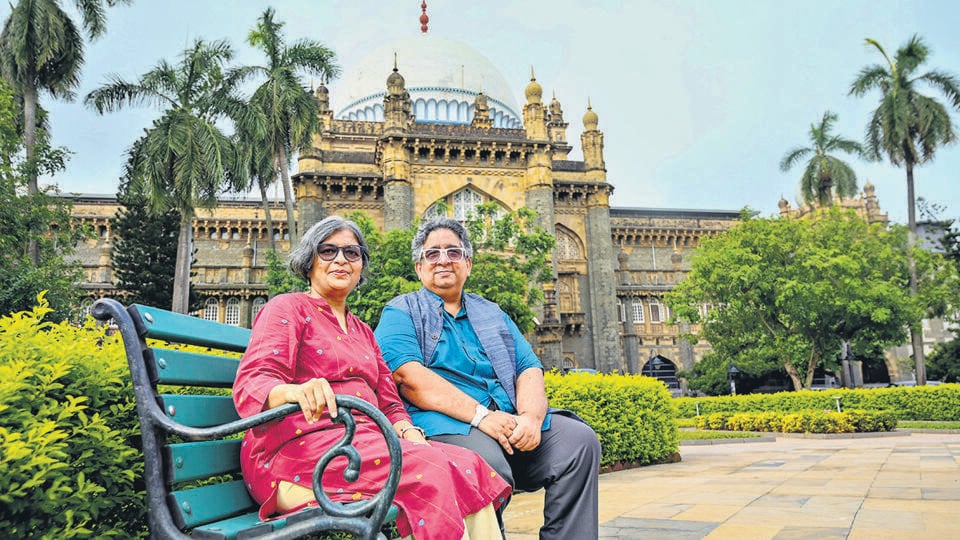
The idea for this book came from a need expressed by a few archaeologists who while well-versed in the history and background of buildings, sometimes lack the vocabulary to describe their architectural details and other technicalities. “We were asked if there was a possibility of getting something to carry along with them while visiting buildings and sites in the city, so that they could understand what type of structure they were looking at and identify its different parts,” says Mustansir, who has previously edited ‘20th Century Compulsions’, a collection of early writings on Indian modern architecture.
Mapping heritage
The suggestion led the Dalvis to consider creating a glossary that would, in effect, name the different parts of the variously styled buildings that dot Mumbai. Except that they didn’t want it to be a conventional glossary, comprising an alphabetically-ordered list. “We wanted to organize it thematically,” says Smita, an expert on Islamic architecture and aesthetics, and author of ‘Celebrating India in 75 Buildings’. “For this particular book, the natural choice was to look at the different styles of architecture that emerged in Bombay, and create a glossary for each.”
As the authors write in the book, Mumbai’s building types are “often contradictory, often oxymoronic” and yet stand shoulder to shoulder. Also fascinating is that some of these different architectural styles emerged simultaneously in the early 19th century: Domestic Vernacular, Neo-Classical and Neo-Gothic.
The construction of Neo-Classical (example, The Asiatic Society of Mumbai) and Neo-Gothic (CSMT, University of Mumbai) structures resulted from the British implementing the cut-paste approach, bringing everything happening in England to India. “At the time, England was witnessing the ‘Battle of Styles’. Architects were fighting amongst each other over whether Neo-Classical was the better style to use or Neo-Gothic. While no conclusions were made, both ended up being used. And, both had their phases in the city,” explains Mustansir.
Local style
The authors are, however, thrilled about highlighting the often overlooked “Domestic Vernacular” in their glossary. Though quite diverse in terms of material and design, it came to be used as an umbrella term for the architectural style embraced by ordinary people. “The citizens of the city were also building for themselves, and they were not necessarily building in the same style as their colonial masters. They brought their own techniques, styles, construction, methodologies and skills, from wherever they came from, to build houses, shops, temples and mosques. When a more rural kind of architectural knowledge comes to a city, it gets adapted in the most interesting way,” says Mustansir. The aangan (central open courtyard), jharoka (projected window with jalis) and mori (small wash area for utensil washing and bathing) among others were expressions of this style.
During the latter half of the 19th century, British India “became a vast laboratory of architectural experimentation,” and that’s when the Indo-Saracenic style, heavily influenced by Islamic architecture, took root. Decades later, in the early 1930s, a new visual language—Art Deco—was sweeping through cities all over the world, and Bombay’s architects immediately latched on to it.
Though the book broadly explores architectural styles, its language, the authors say, cannot be understood in isolation. “This formal language of architecture has a backbone of structure,” says Smita. “It is this structure, its structural systems and construction elements that actually define the formal aesthetics of a building or its type.”
The book, hence, examines the structural systems that governed the construction of these buildings—load-bearing masonry and framed structures. Load-bearing structures, where the loads of the building were transferred through their walls to the foundations, were found in the Domestic Vernacular style, Neo-Classical, Neo-Gothic, and Indo-Saracenic styles. Whereas, Art Deco was made possible by the “widespread adoption of reinforced concrete construction”.
The glossary also served as an opportunity to clear up several misunderstood ideas related to architecture. “One major misconception is that Islamic architecture is synonymous only with Mughal architecture,” says Smita, adding that several Sultanates all across India, before or contemporary to the Mughals, were equally prolific and had significant output in terms of their buildings. Islamic architecture also seems to be notably remembered for its arches and domes, which she says is too limited a way of seeing it. “Indian Islamic Architecture uses different systems of construction, as well as incorporates varied elements, which influenced a lot of traditional Indian architecture that followed. The glossary shows a lot of that diversity.”
The Dalvis hope that this illustrated book will not just be useful to architects, archaeologists, and students of art and design, but also anyone curious about Mumbai’s built history. “We don’t want readers to just identify an element, we want them to identify an element in the company of other elements, because that gives you an idea of the entire architectural system.” This knowledge, they say, doesn’t just make us better observers, but more discerning appreciators of our buildings.
(‘The Glossary of the Architecture of Bombay’ will be launched at the Nalanda Learning Centre, CSMVS, on August 29, 4 PM)


