Mumbai: An international team of scientists including the Tata Institute of Fundamental Research (TIFR), Navy Nagar, have developed a new methodology to detect light from the first stars and galaxies through hydrogen clouds that filled the universe about 3,78,000 years after the Big Bang.
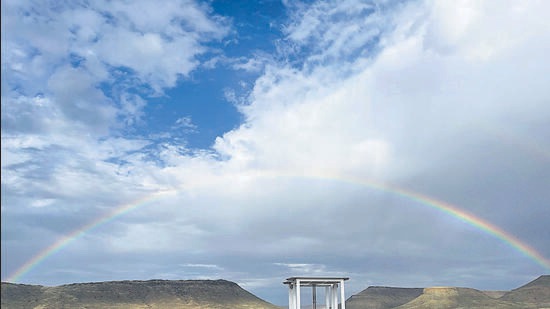
The Big Bang is the prevailing cosmological model for the universe from the earliest known periods through its subsequent large-scale evolution. It describes the rapid expansion of matter from a state of extremely high density and temperature.
Published in the international peer-reviewed journal Nature Astronomy on Thursday, this work – it comprises researchers from institutions across nine countries including India – is part of the Radio Experiment for the Analysis of Cosmic Hydrogen (REACH) project.
Researchers said observing the birth of the first stars and galaxies has been the goal of astronomers for decades because it will help explain how the universe evolved after the Big Bang to its current form with celestial objects, 13.8 billion years later.
However, the present radio telescopes make it difficult to detect signals from the earliest light from the stars through the thick hydrogen clouds for two reasons. Firstly, these signals are likely to be 1,000 times weaker than other radio signals that also emanate from the sky such as those originating in our own galaxy. Secondly, radio telescopes themselves introduce distortions to the signal received, which according to astronomers is “an extreme observational challenge and a major bottleneck in modern radio cosmology”.
“At the time when the first stars formed, the universe was mostly empty and composed mostly of hydrogen and helium,” said Eloy de Lera Acedo, principal investigator, Cavendish Laboratory at the University of Cambridge, and the paper‘s lead author, in a press statement. “Because of gravity, the elements eventually came together and the conditions were right for nuclear fusion, which is what formed the first stars. But they were surrounded by clouds of so-called neutral hydrogen, which absorb light really well, so it‘s hard to detect or observe the light behind the clouds directly.”
{{/usCountry}}“At the time when the first stars formed, the universe was mostly empty and composed mostly of hydrogen and helium,” said Eloy de Lera Acedo, principal investigator, Cavendish Laboratory at the University of Cambridge, and the paper‘s lead author, in a press statement. “Because of gravity, the elements eventually came together and the conditions were right for nuclear fusion, which is what formed the first stars. But they were surrounded by clouds of so-called neutral hydrogen, which absorb light really well, so it‘s hard to detect or observe the light behind the clouds directly.”
{{/usCountry}}To overcome the two difficulties, the REACH team has developed a methodology using Bayesian statistics that can not only see through the primordial hydrogen gas clouds and other sky noise signals but also avoid the detrimental effect of the distortions introduced by the radio telescope.
Researchers said their methodology will allow astronomers to observe the earliest stars through their interaction with the hydrogen clouds, in the same way, we would infer a landscape by looking at shadows in the fog. The method will improve the quality and reliability of observations from radio telescopes looking at this unexplored key time in the development of the Universe. The first observations from REACH are expected later this year.
While another research group in 2018 that was running the Experiment to Detect the Global Epoch of Reionization Signaturer (EDGES) had published a result that hinted at a possible detection of this earliest light, the team said astronomers have been unable to repeat the result which led them to believe that the original result may have been due to interference from the telescope being used.
“The EDGES result did not fit the expectations from our understanding of how the universe works. This is why it caused great excitement,” said Girish Kulkarni, faculty, department of theoretical physics, TIFR and added, “Our work told us that setting up a completely independent experiment to verify the EDGES result was necessary, but so was setting up a distinct and robust data analysis procedure.”
In fact, early this year, an experiment called SARAS 3 (Shaped Antenna Measurement of the Background Radio Spectrum 3) by Bengaluru-based Raman Research Institute publishing measurements that contradicted what EDGES found.
“ This makes it very compelling to work on REACH,” said Shikhar Mittal, PhD student, TIFR, who is also part of the REACH collaboration. “In fact, it is very timely that we are working on REACH while the new James Webb Space Telescope (JWST) is ready to look closer to the cosmic dawn than ever before. We have recently published work that highlights interesting connections between what projects like REACH and EDGES see and what JWST sees.”
Stay updated with all the Breaking News and Latest News from Mumbai. Click here for comprehensive coverage of top Cities including Bengaluru, Delhi, Hyderabad, and more across India along with Stay informed on the latest happenings in World News.
Stay updated with all the Breaking News and Latest News from Mumbai. Click here for comprehensive coverage of top Cities including Bengaluru, Delhi, Hyderabad, and more across India along with Stay informed on the latest happenings in World News.