
 E-Paper



Ghost town gets new lease of life
The National Company Law Tribunal has approved a proposal by Darwin Platform Infrastructure Limited to take over Lavasa, a private city in Pune district. The decision has revived hopes for thousands of home buyers and investors who have been affected by the uncertainties surrounding the project. Darwin Platform Infrastructure Limited has expressed eagerness to revitalize the project and prioritize the needs of stakeholders. However, the execution of the resolution plan is subject to environmental clearances.

 Prefer HTon Google


Pune: Once envisioned as a hilltop paradise for the rich, the private city of Lavasa in Pune district has over the years slid into the depths of uncertainty thanks to a plethora of impediments. The July 21 verdict by the National Company Law Tribunal (NCLT), which approved a proposal by Darwin Platform Infrastructure Limited (DPIL) to take it over, has rekindled the hopes of thousands of home buyers and investors.
Despite several conditions and a complex resolution plan approved by India’s bankruptcy court, which can only be executed subject to environmental clearances, those who have put their money into the hill city are daring to hope. “The NCLT decision will revive the project, as it promises fresh investment, which we believe will change the current course of events in Lavasa,” said Zal Eranee, 80, a businessman from Mumbai who booked four properties in 2011. Eranee is eagerly awaiting the turnaround.
Rohington Darukhanwala, 78, is also optimistic. The London-based businessman invested in a Lavasa home over a decade ago, hoping to spend his twilight years with other family members in his home country. “The NCLT order has raised our hopes,” he said. “We are sure the new entrant will give us the apartment at the earliest.”
The new entrant, as of now, is gung-ho about attending to the needs of the home buyers and investors whose money has been stuck for so many years. Ajay Harinath Singh, group chairman of DPIL, welcomed the NCLT verdict and said his company was “very eager to revitalise the ambitious project”. “The plight of homebuyers, along with the concerns of secured financial creditors, will not go unnoticed by DPIL,” he said. “The company promises to include the stakeholders in the revival process and prioritise their needs.”
Vineet Tulsyan of R3 Corporate Advisors, the strategic advisor to DPIL, said the NCLT order, though delayed, was better late than never. “The initial task will be to understand the ground situation, problems of the residents and other complexities,” he said. “Revival of the city and getting an environmental clearance should be the priority. We are very confident that the Darwin group will not only revive Lavasa but create a beautiful landmark destination.”
The story of Lavasa began as a gleam in the eye of NCP leader Sharad Pawar and Hindustan Construction Company (HCC) chairman and managing director (CMD) Ajit Gulabchand in the 1990s. Pawar, while flying by helicopter over a large tract of vacant land in the Mulshi valley, came up with the idea of developing the space into a privately built and managed city. To do his bidding, Gulabchand and a few other businessmen formed an entity called Lavasa Corporation.
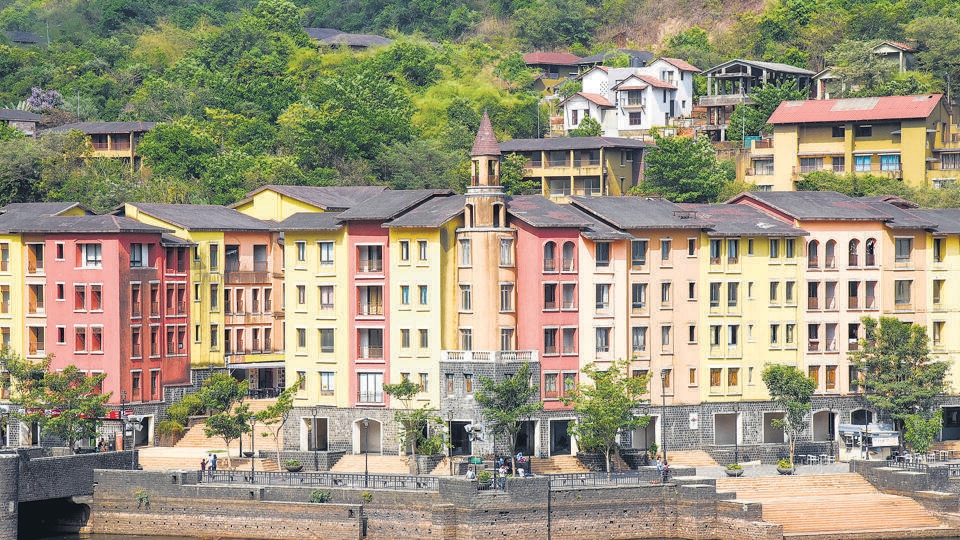
The township, a four-hour ride away from Mumbai, was modelled on the lines of the cotton-candy harbour of Italy’s Portofino. Originally planned across 25,000 acres covering 18 villages, its area was revised to 12,500 acres under the Mulshi tehsil when it took off in 2010. The first private project in Maharashtra to receive Special Planning Authority (SPA) status—which granted it the power to draw up land use plans, develop land in its jurisdiction and sanction construction—it was, all in all, an overarching and wildly ambitious project.
Buyers were instantly attracted to the concept of an idyllic private city. “We read about Lavasa in the newspapers,” said Darukhanwala, who put down roughly 80 % of the amount for his flat, imagining that it would be a quick and easy property buy. “We never imagined that the project would be a disaster.” Between 2010 and 2012, a one-bedroom apartment in Lavasa cost about ₹30 lakh, while the bungalows went for between ₹2 crore and ₹4 crore.
Darukhanwala’s sentiments resonate with around 2,000 property buyers still awaiting delivery of their homes. Mumbai-based Supreme Court advocate Jamshed Kama, 75, invested in two properties in the hill city in 2011 after being lured by advertisements promising world-class living standards for buyers. “Later, the project floundered and we were left in the lurch,” he said. Many buyers, who took hefty loans from banks or sank their life savings into a Lavasa property, were worse off than the wealthy buyers.
How and why did things go south so quickly?
As work began, the Lavasa project got embroiled in numerous controversies, ranging from allegations of forcible land acquisition to violation of environmental norms. By 2010, the project was dealt a massive blow, as the central environment ministry, then led by Congress leader Jairam Ramesh, issued a stop-work notice, citing destruction of the environment.
“In a way, the project was almost killed by that order. It was unjust in nature, as the ministry blocked the construction on unreasonable grounds,” said Vitthal Maniar, a long-time associate of Sharad Pawar and a stakeholder in Lavasa Corporation, with 6.5% shareholding.
The setback prompted promoters to postpone the initial public offering that would have allowed raising funds from the market. It took one year for the ministry to revoke the stop-work notice, although by this time a crucial period had lapsed, adding to the promoters’ financial woes.
A further blow was to come in 2017, when the then Devendra Fadnavis-led government revoked Lavasa’s SPA tag. It coincided with the Lavasa Corporation, a subsidiary of Hindustan Construction Company (HCC), filing for bankruptcy in 2018 due to the large sums of money it owed a consortium of banks. From then on, the township began to slowly slip into disrepair.
Today, the many unfinished buildings resemble a ghost town where, instead of the envisioned 400,000, only around 3,000 people, including native villagers, live. The buildings that were once a vibrant red and yellow have lost their Mediterranean lustre and their appeal, overshadowed as they are by concrete skeletons. The lakeside promenade, which tourists thronged till 2017, now wears a deserted look. The utter neglect of the hill city and zero monitoring has resulted in theft of construction material after the project was stalled in 2017 due to a financial crunch.
As marketed by its promoters, Lavasa was suitable for industries such as hospitality, tourism, health, education and IT & ITES. A few hotels, a hospital and educational institutions did set up their establishments. As things began to turn adverse and the flow of people waned, many of them shut shop. The villagers who originally owned the land had invested the money they got in businesses such as heavy vehicles and cabs, which were roped in by Lavasa Corporation during the construction phase. Many others set up small eateries to serve construction workers and tourists. All of them are now at a loose end.
While buyers waiting interminably for their houses have been suffering, life for the few living in Lavasa is no cakewalk either. Power cuts have become frequent, garbage collection is negligible, and maintenance of the common utilities is nearly non-existent. According to Minoo Wadia, president of the Apex Association of Lavasa Property Owners, things have come to a standstill for the past few years. “All the common amenities here have crumbled,” said Wadia, 80, a retired Air Force officer who bought two flats 12 years ago. “At times, those living here have to pitch in with their own funds to get some common utilities up and running.”
In September 2022, power supply to the hill city was disconnected after the Lavasa administration failed to pay its ₹22.78-crore dues to the power utility company of the state government. The power cut impacted the sewage and water treatment plants. Eventually, the supply was restored after payment of a partial sum, but it highlighted the deep financial mess Lavasa was in.
Rajgopal Nogja, who was CEO of Lavasa Corporation, declined to answer questions on how the Lavasa dream collapsed and why attempts to revive the project failed. Gulabchand could not be contacted.
Today after six years, when the resolution process has been concluded, rows of buildings with ready apartments are empty for want of new buyers. These apartments, along with under-construction structures, await proactive measures from DPIL, which won the ₹1,864-crore bid to acquire Lavasa Corporation.
However, it will not be that easy. DPIL’s resolution plan envisages the delivery of fully constructed properties to home buyers within five years of getting environmental clearance. At the same time, home buyers will be able to get delivery of their incomplete houses only when they pay the actual future cost. Those looking to exit the project will get only back 40% of the amount they had paid, within 24 months of the receipt of environment clearance for the first phase.
As of now, hopes are high on the part of house owners and investors. Whether their dissipated dreams can be resurrected remains to be seen.


