
 E-Paper



Six fishing hamlets in Mumbai to bear brunt of Bandra-Versova Sea Link
The Bandra-Versova Sea Link, scheduled to be completed by August 2027, will directly impact artisanal fishing activities at six locations in Mumbai western suburbs, including the prominent koliwadas at Khar Danda and Vesave, and other smaller settlements at Kadeshwari Mandir (near Bandra fort), Chimbai village off Hill Road, Juhi Koliwada (in Santacruz) and Mora Gaon in Juhu.

 Prefer HTon Google


The Bandra-Versova Sea Link (BVSL), now scheduled for completion by August 2027, will directly impact artisanal fishing activities at six locations in Mumbai western suburbs, including the prominent koliwadas at Khar Danda and Vesave, and other smaller settlements at Kadeshwari Mandir (near Bandra fort), Chimbai village off Hill Road, Juhi Koliwada (in Santacruz) and Mora Gaon in Juhu.
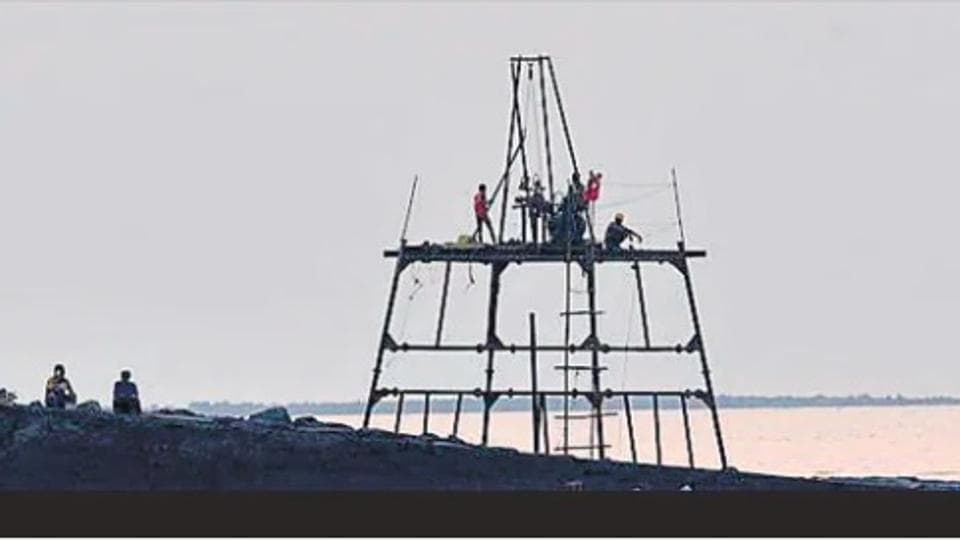
As on Sunday, 2.07% of BVSL’s works have been completed. The construction of piers and temporary gabion structures can be seen at Kadeshwari Mandir, Carter Road and Juhu Koliwada. The fisherfolk said that the work has been on hold for at least four months now, which Maharashtra State Road Development Corporation (MSRDC) officials attributed to the monsoon season.
A group of Kathiyawadi kolis, operating a small boat yard on Carter Road under the name Sarothiya Koli Samaj Matsyavyavsay Sahakari Sanstha, also said that they are vulnerable to the BVSL.
“The bridge will pass about a kilometre from the shore. That’s where most manually driven boats, like mine, find the best catch these days. If they drill into the ocean floor there, it’s over for us,” said Mohan Solanki, one of the members of the community.
Despite the anticipated impact, MSRDC officials and the state fisheries department said they either did not have, or were unable to provide, data on the total number of the project-affected persons (PAPs).
The fisheries department officials also declined to provide data on the number of the registered fisherfolk, boats and societies in the project area. Dr Samata Shitut, district fisheries officer, did not respond to requests for a comment.
Rough estimates given by environmentalists and members of the community suggest that there are between 600 and 800 boats (mechanised and non-mechanised) operating across these fishing hamlets that help sustain the livelihoods of 2,000 to 3,000 families.
An affidavit filed by environmentalists, fisherfolk and residents against BVSL in the National Green Tribunal (NGT), estimates that fishing around the larger Juhu coast sustains about 700 families. Vesave and Khar Danda are much larger colonies, for comparison.
Citing the example of the Bandra-Worli Sea Link, which has allegedly depleted fish reserves, changed navigation routes, increased the rate of erosion and made tidal action around Dadar and Mahim Koliwada more intense, fishworkers operating further up in the suburbs expect to face similar predicaments.
Bhimsen Kopte, a resident of Khar Danda and member of the Danda Koli Samaj, said, “If you ask anyone at Worli or Mahim Koliwada, they will tell you that boats have to go further into the sea to find fish ever since the sea link came up. Whenever a VVIP passes over the bridge, fishermen are told to stop their activities a full day in advance. The same will happen to us now.”
Many emphasised that the bridge will diminish access to their customary fishing grounds, forcing them to take precarious detours around the structure and burn more diesel while doing so, besides causing further disruption to ecology that is already under stress from pollution and overfishing.
The MSRDC’s own environment impact assessment report (EIA) reveals more in this regard. Page 34 of the EIA report reads, “Construction of offshore structure modifies the relationships of benthic communities, changing the existing biodiversity in the area and creating a new local ecosystem… The construction work phase would increase temporarily the water turbidity. This could affect marine flora (phytoplankton specially) because of a decrease in the possible received light. There may be temporary decrease or change in the faunal population due to disturbance caused by construction activities.”
Environmentalists and fisherfolk have criticised the EIA report for emphasising the project’s “temporary” impacts while paying little to no consideration toward permanent ramifications.
“The dredging will cause permanent damage after construction, not to mention the restrictions on fishing that will be imposed during the build phase. There will be a permanent loss also of other coastal commons, such as areas for fish drying, net mending, boat parking and so on,” pointed out Stalin D, director of Vanashakti NGO, which was one of the eight appellants currently litigating in NGT to overturn BVSL’s regulatory clearances.
The EIA report even pointed out that “there is a considerable amount of degradation of marine environment from the coast up to 2km due to discharge of untreated sewage, industrial waste etc”, and refers to the project area as a “polluted system” which has a “poor fishery potential”.
This claim has been made on the basis of secondary data, and despite the storied history of Mumbai’s fishing trade, Stalin pointed out.
Despite such concerns – which experts, environmentalists and various fishing societies have conveyed to the government from time to time – a socio-economic survey to assess the impact of BVSL on artisanal fishing, first commissioned by MSRDC in March 2019, has been delayed by at least a year.
This was after fisherfolk demanded that it be assigned to the Tata Institute of Social Sciences (TISS), instead of the NGO that was initially appointed.
Confirming this, a senior official with the MSRDC said, “People raised some issues because the first consultant organisation did not have prior experience engaging with members of the Koli community. Fishermen also said that they preferred speaking to male social workers, so TISS was engaged in February at the recommendation of leaders from registered fishing societies. Their final report will be ready in two months.”
The report, now being prepared by TISS’ Centre for Community Organisation and Development Practice (CODP), will be presented before a ‘consultative committee’ headed by MSRDC vice-chairman and managing director Radhesyam Mopalwar, along with two other officials from MSRDC, one from the department of fisheries and four representatives from affected fishing societies.
“The committee will decide if and how much compensation is to be paid, depending on the extent of damage to livelihood. We are not anticipating much as the sea link will be situated 900 metres from the coast. As for issues with navigation, we are providing three or four dedicated navigation channels that will be 100 metres wide, in Bandra, Juhu and Versova. Everywhere else, the piers will be 50 metres apart. That is enough room for the boats,” said the official quoted above.
The official also clarified that Vesave Koliwada, which is over 2km away from the end of the proposed BVSL alignment, has been excluded from the scope of TISS study, and will be considered under the subsequent the Versova-Virar Sea Link Project. Researchers at TISS declined to comment on the story, citing confidentiality.
For the most vulnerable of the groups in BVSL project area, adversities have already begun. At Kadeshwari Mandir, which is squeezed on a small patch of hillside between the Worli Sea Link and Bandra Fort, the construction of gabion structure by MSRDC has prevented water from entering the boat-yard at low tide. The fisherfolk are now struggling to get their vessels afloat when going out to fish.
“It’s a lot of hard work to carry the boat out with your hands, but there’s no other choice. They built this wall right in the middle of our navigation route. MRSDC gave us a small opening in the wall, but at high tide there’s too much water in it. At low tide, there isn’t any. So it’s essentially useless,” said resident Bonny Joseph, 51, pointing to the fibreglass remains of a mechanised boat which met with an accident there earlier this year.
“Where we used to take our boats out four, maybe even five times a day, we are now going only twice a day when the tide allows,” he said, fearing that this diminished routine has changed permanently.


