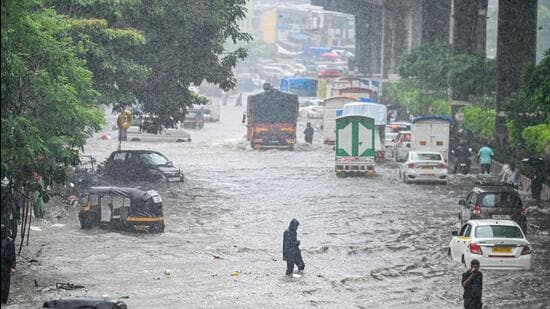
Mumbai: The Bombay High Court on Tuesday said that citizens should stop blaming the Brihanmumbai Municipal Corporation (BMC) alone for waterlogging and other monsoon-related issues in the city, observing that “rampant encroachments, clogged drains, and misuse of public infrastructure” was “our own creation”.
A division bench of acting chief justice Ravindra V Ghuge and justice Gautam Ankhad said, “We should stop blaming the corporation alone. It gave us drainage lines, and we filled them up. They put pavement blocks, and we started parking our cars on them. They gave us footpaths, and we started having pav bhaji, pav masala, sabudana vada stalls on them”.
The court made the remarks while hearing a petition filed by Atish Vaity, a resident of Mandala village in Raigad, highlighting the BMC’s inaction in widening the village road from 30 feet to 50 feet.
According to the petition, the Mumbai-based Department of Atomic Energy (DAE) had donated a piece of land to the BMC in 1992 for the development of a 50-foot-wide road. However, the road was eventually encroached upon, prompting the BMC to issue multiple notices in 2010 and 2011, it said.
Despite issuing notices, felling 192 trees to facilitate the project, and granting a no objection certificate (NOC) for the road-widening in 2016, only a 30-f00t-wide road was laid, the petition added.
{{/usCountry}}Despite issuing notices, felling 192 trees to facilitate the project, and granting a no objection certificate (NOC) for the road-widening in 2016, only a 30-f00t-wide road was laid, the petition added.
{{/usCountry}}During the hearing on Tuesday, senior advocate Milind Sathe, appearing for the BMC, submitted that it had already cleared encroachments from the 30-foot-wide road under its control. It added that the remaining land belongs to the DAE, which oversees the nearby Bhabha Atomic Research Centre (BARC). Stating that BARC does not seem interested in widening the road, Sathe argued that if the DAE and its authorities were willing to hand over the land, a decision could have been reached.
The court thereafter issued a notice to the DAE, seeking its response as to whether it was willing to offer the additional 20 feet of land required to widen the road.
Addressing the larger issue of monsoon flooding in Mumbai, the court remarked that the city “was destined to witness rainwater on the roads,” as people had encroached upon public lands, blocked drainage lines and converted footpaths into parking and hawking zones.
Referring to encroachment outside the high court building, the bench said that footpaths on the eastern side have been occupied by photocopy shops and tea and juice vendors, making it “impossible” for pedestrians to walk.
“Our habit is to rob our own motherland. We put all the dirt and material inside that, we block the gutters. We grab lands and then set up our shops illegally. You can’t walk. What will the corporation do?” the judges asked.
“When the corporation comes for demolition, you want seven days’ notice. And then, suddenly, the law books are opened. But when you grab the land, nobody reads the law. So that is how things are in Mumbai. We are destined to see rainwater on the road with everything clogged… Cannot help it,” the judges said, expressing helplessness.
Stay updated with all the Breaking News and Latest News from Mumbai. Click here for comprehensive coverage of top Cities including Bengaluru, Delhi, Hyderabad, and more across India along with Stay informed on the latest happenings in World News.
Stay updated with all the Breaking News and Latest News from Mumbai. Click here for comprehensive coverage of top Cities including Bengaluru, Delhi, Hyderabad, and more across India along with Stay informed on the latest happenings in World News.