Ghaziabad recorded the least polluted air across the national capital region on Tuesday, a day after Diwali, which was celebrated on Monday this year, with an Air Quality Index (AQI) reading of 266 in the “poor” category, despite residents bursting firecrackers until well after midnight.
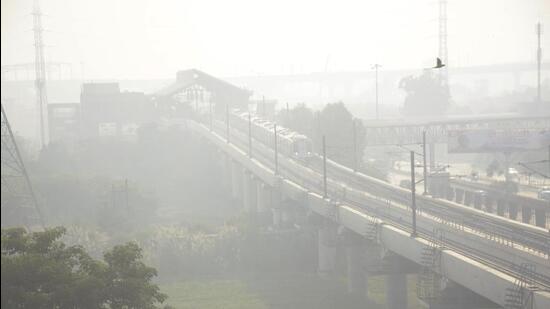
In comparison, while Delhi recorded an AQI reading of 303 (very poor) on Tuesday, other NCR cities such as Noida, Greater Noida, Gurugram, Faridabad and Manesar recorded AQI readings of 299 (poor), 272 (poor), 292 (poor), 289 (poor) and 261 (poor).
According to Central Pollution Control Board (CPCB), on the day of Diwali, the city’s AQI reading was also at its lowest compared to the last three years at 300 (poor), a substantial improvement over the last two years, when Ghaziabad recorded “severe” AQI levels on Diwali day with readings of 419 on November 4, 2021, 456 on November 14, 2020 and “very poor” AQI reading of 395 on October 27, 2019.
An AQI reading between zero and 50 is considered “good”, 51 and 100 “satisfactory”, 101 and 200 “moderate”, 201 and 300 “poor”, 301 and 400 “very poor”, and 401 and 500 “severe”.
To be sure, according to a Supreme Court order, the sale and use of traditional firecrackers is completely banned in the NCR. While the Uttar Pradesh government did not impose a blanket ban on green crackers like neighbouring Delhi, the Commission for Air Quality Management on September 13 this year ordered that the use of green crackers (certified by Petroleum & Explosive Safety Organisation) will be banned in NCR if the Air Quality Index reading of the region crosses 200 (poor).
{{/usCountry}}To be sure, according to a Supreme Court order, the sale and use of traditional firecrackers is completely banned in the NCR. While the Uttar Pradesh government did not impose a blanket ban on green crackers like neighbouring Delhi, the Commission for Air Quality Management on September 13 this year ordered that the use of green crackers (certified by Petroleum & Explosive Safety Organisation) will be banned in NCR if the Air Quality Index reading of the region crosses 200 (poor).
{{/usCountry}}Officials of the pollution department and environmentalists attributed the improved conditions on this year’s Diwali as well the weeks leading up to it to meteorological factors.
“On Diwali, Ghaziabad’s pollution levels spiked from 9pm to 1am (most likely due to the bursting of crackers), but meteorological conditions led to faster dispersal of pollutants and improved conditions thereafter,” said Utsav Sharma, regional officer of UPPCB.
“This is primarily due to higher day temperature and faster wind speed. Further, instances of stubble burning have not reached their peak this year due to intermittent spells of rain which continued till after Dussehra, which was celebrated on October 5 this year. Due to these factors, pollution levels during the one-month pre-Diwali period have been the lowest for the city since 2017,” said Utsav Sharma, regional officer of UPPCB.
Ghaziabad’s average AQI reading during 30 days of the pre-Diwali period was 161 (moderate) this year. Official records of the UPPCB indicate that the city’s average AQI reading during 30 days of the pre-Diwali period in 2021 was 230 (poor), in 2020 was 355 (very poor), in 2019 was 199 (moderate), in 2018 was 318 (very poor), and in 2017 was 261 (poor).
A closer look at the data reveals that Ghaziabad fared better than most previous years (with the exception of 2019) even during the week leading up to Diwali with an average AQI reading of 272 (poor) this year. Ghaziabad’s average AQI reading of the week leading up to Diwali in 2021 was 329 (very poor), in 2020 was 413 (severe), in 2019 was 261 (poor), in 2018 was 335 (very poor) and in 2017 was 369 (very poor).
During the 30-day pre-Diwali period this year, Ghaziabad did not experience any “severe” air days, according to UPPCB data. The city had witnessed no “severe” days during the 30-year pre-Diwali period in 2021 and 2019 as well.
However, while the city did experience NCR’s cleanest air on Tuesday, residents must gear up for the post-Diwali period, during which the pollution levels could spike to “severe”.
While, a forecast by System of Air Quality and Weather Forecasting and Research (Safar) on Tuesday said, “The fire counts/emissions over northwest region (share in PM2.5 – 5.6%) and Diwali fire cracker emission appear to have not affected much of Delhi’s air quality” , the forecast also indicated that surface winds were moderate with a speed of 8-16kmph, which was likely to remain about 6kmph on October 26 and 27, with a maximum temperature 31-32 degrees Celsius and a minimum of 15 degrees Celsius, that may cause moderate to weak dispersal of pollutants.
Historically too, statistics from the state pollution board show that the average AQI reading for the 30-day post-Diwali period is usually recorded in the higher range-- 376 (very poor) in 2021, 341 (very poor) in 2020, 381 (very poor) in 2019, 376 (very poor) in 2018 and 424 (severe) in 2017.
“The pre-Diwali period was better this year due to different meteorological conditions and spells of rain. But this betterment has no contribution from local authorities. The bursting of crackers continued well past midnight on Diwali. The post-Diwali period will be challenging like it has been for past several years now. It will test the ground-level work and enforcement of local authorities,” said Akash Vashishtha, a city-based environmentalist.
Ghaziabad is among the 16 “non-attainment” cities in Uttar Pradesh and its pollution levels generally remain on the higher side during the onset of winter. Cities are declared “non-attainment” if they do not meet the National Ambient Air Quality Standards for particulate matter (PM10) or nitrogen dioxide (NO2) over a period of five years.
In April this year, the city ranked as the second-most polluted city in the world after Bhiwadi in Rajasthan on the World Air Quality Report 2021. The annual report, prepared by Switzerland-based organisation IQAir, surveyed 6,475 cities across the world.
Stay updated with all the Breaking News and Latest News from Mumbai. Click here for comprehensive coverage of top Cities including Bengaluru, Delhi, Hyderabad, and more across India along with Stay informed on the latest happenings in World News.
Stay updated with all the Breaking News and Latest News from Mumbai. Click here for comprehensive coverage of top Cities including Bengaluru, Delhi, Hyderabad, and more across India along with Stay informed on the latest happenings in World News.