Ahmedabad: The Ahmedabad civic body is considering a ₹180 crore plan to redevelop the Sardar Vallabhbhai Patel (SVP) Cricket Stadium in Gujarat that hosted India’s first international cricket match in 1981, people familiar with the development said.
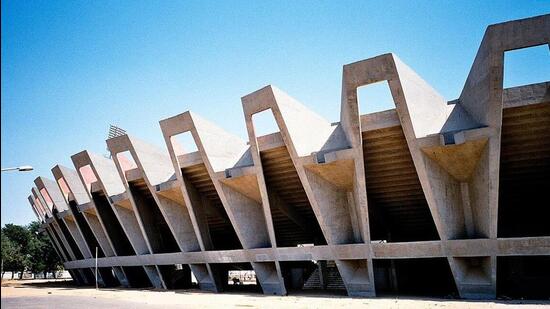
The plan is to transform the stadium, designed by famous architect Charles Correa, into a multi-sport facility that can be used to hold international events including the 2036 Olympic Games which India will bid for.
Amdavad Municipal Corporation (AMC) officials said the stadium remained underutilised for many years, and previous attempts to revive it have not succeeded. A formal decision on redeveloping the stadium is pending before the standing committee of the corporation which had sought a report from the conservation management plan.
“There is a huge maintenance cost involved in maintaining a big structure like this. The stadium was meant for sporting purposes and if it does not serve this purpose fully, we have no other option but to consider its redevelopment. It is not a national heritage,” said a top government official involved in the project.” said a top municipal official on condition of anonymity.
The stadium was originally built for international cricket but later was mostly used for domestic cricket after a stadium was constructed in 1982 at Motera. The Sardar Vallabhbhai Patel Cricket Stadium is centrally located in Ahmedabad’s Navrangpura area and is about 10 km from the Narendra Modi stadium in Motera.
{{/usCountry}}The stadium was originally built for international cricket but later was mostly used for domestic cricket after a stadium was constructed in 1982 at Motera. The Sardar Vallabhbhai Patel Cricket Stadium is centrally located in Ahmedabad’s Navrangpura area and is about 10 km from the Narendra Modi stadium in Motera.
{{/usCountry}}The stadium was the first of its kind in India and quickly achieved legendary status as the setting for local, national and international games.
Noted British architectural historian William JR Curtis, who has studied Indian architecture for decades, said: “From the sky, the SVP stadium resembles a wheel, not unlike that at the centre of the Indian national flag”.
“Cricket legends and major stars were born in this circle of fame. Designed entirely in reinforced concrete in a close collaboration between the architect Charles Correa and the engineer Mahendra Raj between 1959 and 1964, the building demonstrates a complete fusion of architectural thinking and structural expertise. Like a modern version of an ancient amphitheatre, the cricket stadium establishes a clear figure in the cityscape, both a public monument and a generous open-air space,” according to Curtis.
In India cricket is a passion for people of all social classes and the Patel Stadium even conveys a sense of ritual and assembly, he said.
In the 1950s and 1960s, Ahmedabad witnessed a surge in world-class modern architecture such as Le Corbusier’s four buildings – the Millowner’s Association Headquarters, the City Museum, the Shodan House, and the Sarabhai House; Louis Kahn’s Indian Institute of Management; Charles Correa’s Gandhi Ashram Museum, and Balkrishna Doshi’s Institute of Indology and School of Architecture.
“Where else on earth does one find a concentration of such architectural excellence? So, the cricket stadium fits into a larger picture of enlightened urban development, and the original project also included other sports facilities such as a badminton court and a skating rink, all exquisitely designed by Charles Correa. This was to be a key athletics centre for the general public,” he said.
The Sardar Vallabhbhai Patel Stadium was included on the 2020 World Monuments Fund’s (WMF) Watch List to draw attention to the complex challenges of preserving not only an iconic twentieth-century modern structure but an emblematic public space for the people of Ahmedabad. Inclusion on the watch also sought to encourage a conservation management plan including the communities who support and benefit from the building.
Despite being centrally located and utilised daily by a substantial number of people, the stadium has undergone considerable physical deterioration due to decades of inadequate maintenance and insufficient funding, according to WMF. Designating it as a cultural heritage site would guarantee its preservation and mitigate the risk of potential loss, it added.
In July 2020, the Getty Foundation said the Patel Stadium was one of 13 significant twentieth-century buildings that would receive a total of $2.2 million under its ‘Keeping It Modern’ grants. With Getty’s support, WMF specialists from both the U.S. and India have collaborated with a team of local experts to create a detailed plan to conserve the site and enhance its value as a green space for the local community to enjoy.
WMF also launched a project to create a Comprehensive Conservation Management Plan (CCMP) for Patel Stadium in partnership with the Amdavad Municipal Corporation (AMC) and the National Centre for Safety of Heritage Structures, Department of Civil Engineering at the Indian Institute of Technology Madras (IIT Madras).
The plan was designed to serve three objectives: provide the basis for the site’s successful conservation so that it can serve as a vibrant, valued, self-sustaining community hub; offer an exemplary model for good conservation practices and creative adaptive reuse ideas for other modernist concrete structures in Ahmedabad; and create a wider understanding and appreciation of the cultural, historical, architectural, engineering, and social significance of India’s modernist architecture, according to WMF website.
Curtis said it was important for people to acknowledge that ‘heritage’ applies to outstanding modern buildings also, and cited a WMF-supported study that underscores the viability of repurposing the stadium for various activities such as local cricket matches, athletics, jogging, and yoga. Additionally, the stadium could host Olympic events such as discus throwing events if the Games come to Ahmedabad, he added.
The areas around the stadium can be used for profitable retail purposes and the original idea of badminton courts, a skating rink and tennis areas can be realized. “It would be wasteful madness to demolish this great, world-class building with its generous open-air public space as it has already acquired so much meaning to the population of the city,” said Curtis.