
 E-Paper



Civic elections: Polling teams dispatched to 1,109 booths
Each polling team has a presiding officer, an assistant presiding officer, and two polling officers, at each booth. At polling stations with over 1,000 registered voters, an additional polling officer has been deployed to help voters

 Prefer HTon Google


Gurugram
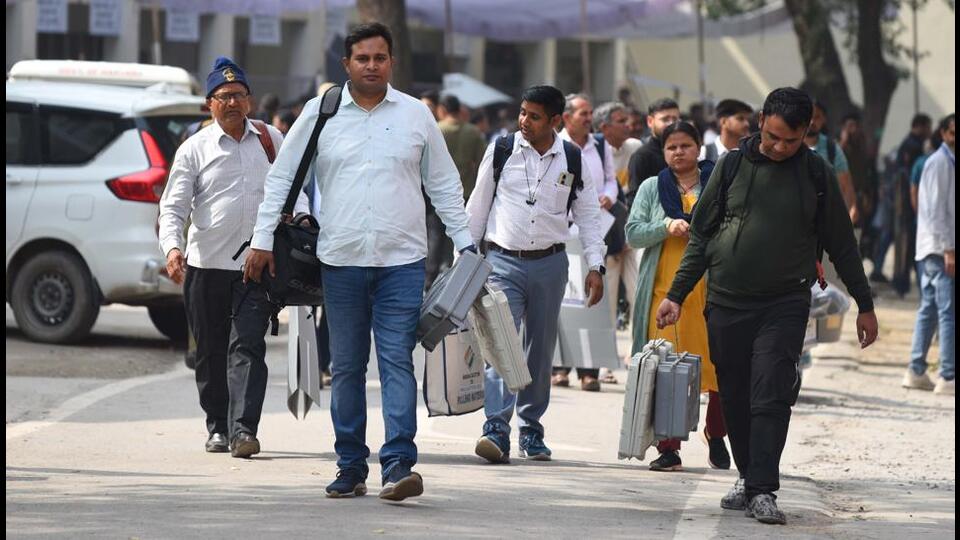
Municipal elections will be held across Haryana today, including the Municipal Corporation of Gurugram, with necessary preparations completed on Saturday. Polling teams were dispatched to 1,109 polling booths in Gurugram, Manesar, Sohna, Pataudi-Jatauli Mandi, and Farrukhnagar. Gurugram district election officer and deputy commissioner Ajay Kumar has directed all polling officials to ensure free and fair polls for the civic bodies, officials said.
Polling teams have reached their assigned booths, where voting is scheduled to begin at 8am and continue until 6pm. Officials have been instructed to conduct a polling drill at 7am in the presence of candidates or their polling agents, ensuring that the process runs smoothly before voting opens to public.
Each polling team has a presiding officer, an assistant presiding officer, and two polling officers, at each booth. At polling stations with over 1,000 registered voters, an additional polling officer has been deployed to help voters. The returning officers have been told to check that no polling personnel can leave their booths before voting is over for the day and all electronic voting machines (EVM) and election forms are returned to designated collection centres.
According to the state election commission’s guidelines, the use of mobile phones is prohibited inside polling stations and any violations will be met with legal action.
Voting through separate EVMs
In most municipal areas, except for the Sohna Municipal Council and Ward 22 of the Municipal Corporation of Gurugram (MCG), two separate EVMs have been installed at every booth — one for the election of the mayor/chairperson and another for selecting the ward member. The administration has urged voters to be aware of this system, so that they cast their votes in the correct manner.
In order to vote in the municipal polls, residents need to carry a valid voter ID or any other approved identification document. If a voter does not have a voter ID, he/she can use alternative identity documents such as a passport, driving licence, PAN card, Aadhaar card, government employee ID, pension payment orders, or a photo identification issued by a bank. Only registered voters, whose names appear on the official voter’s list will be allowed to vote.
To maintain law and order during polls, the Haryana Excise Act has put in place a complete ban on liquor sales in municipal areas and within a 3-km radius on March 1 (pre-election day), March 2 (voting day) and March 12 (counting day). All liquor shops, bars, hotels and establishments serving alcohol will remain closed during this period.
Polling arrangements
Voting will take place at 905 booths in the Municipal Corporation of Gurugram, 96 in Manesar, 47 in Sohna, 45 in Pataudi-Jatauli Mandi, and 16 in Farrukhnagar. To handle any unexpected situations, 333 reserve polling teams have also been deployed.


