
 E-Paper



CJI Surya Kant stresses need for procedural framework to regulate AI use at Delhi event
CJI Surya Kant calls for a procedural framework to regulate technology in arbitration, highlighting concerns over AI's impact on confidentiality and human judgment.

 Prefer HTon Google


New Delhi
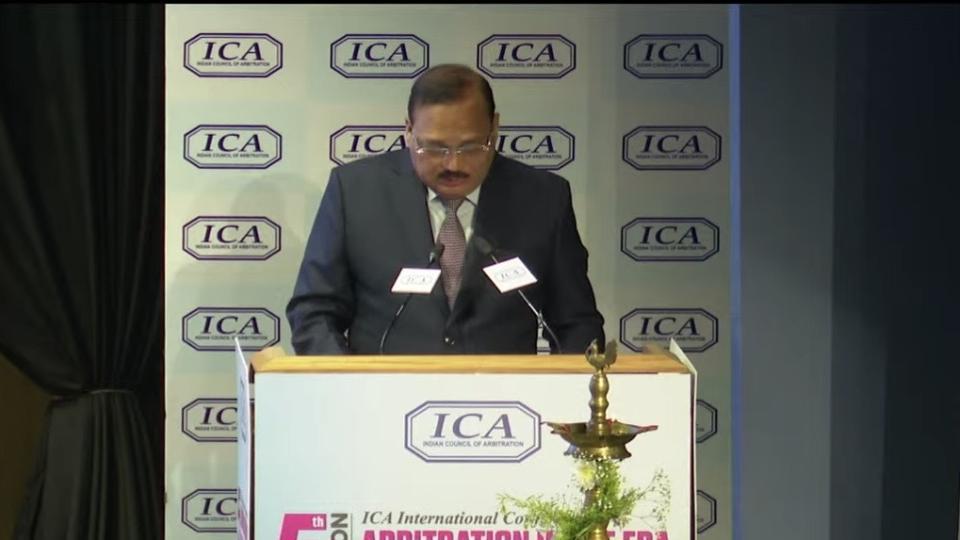
Chief Justice of India (CJI) Surya Kant on Friday stressed the need for a procedural framework to regulate the use of technology in arbitration, noting that while technological advancements have transformed proceedings, increasing reliance on artificial intelligence (AI) raises concerns over confidentiality and preservation of independent human judgment.
Speaking at the inauguration of the 5th Edition of the Indian Council of Arbitration International Conference on “Arbitration in the Era of Globalization: Legal Technology, Economic Development & Cross-Border Disputes”, the CJI said that the legitimacy of arbitration rests not only on efficiency but also on the assurance that decisions remain the product of impartial human expertise.
He said that the way forward lies not in rejecting technological progress, but in regulating its use through appropriate safeguards.
“Virtual hearings, digital case management platforms, and secure electronic transmission of documents have already revolutionised the conduct of such (arbitration) procedures. These developments have improved accessibility, and reduced logistical delays, practically, and particularly, in cases where geography, once posed serious constraints,” he said.
“At the same time, technological progress brings its new responsibilities. The increasing use of AI in decision support tools raises legitimate concerns relating to confidentiality, and the preservation of independent judgment. Arbitration drives its legitimacy, not only from efficiency, but from the confidence that decisions remain, the product of impartial human expertise,” the CJI said.
He said, “The solution, therefore, lies not in shunning technology altogether, but in regulating, it’s use, through procedural frameworks.”
“Arbitral tribunals must retain autonomy over the manner in which, such tools are incorporated into proceedings, so that protocols governing cyber security, and confidentiality, keep pace with technological adoption. When governed by such safeguards, technology becomes a powerful ally of arbitration in a fast paced world,” the CJI said.
The inaugural session of the two-day event, which will be held in the Delhi High Court, was also attended by Delhi lieutenant governor Taranjit Singh Sandhu, former Supreme Court judge AK Sikri and other high court and Supreme Court judges.
In his speech, the CJI further emphasised that to position India as a preferred forum for resolving complex cross-border disputes, it is essential to consciously develop an integrated alternative dispute resolution (ADR) ecosystem in which mediation and arbitration operate as complementary, rather than competing, mechanisms.
“Despite substantial progress in arbitration, mediation, and conciliation, two wings, mediation and conciliation, have not always evolved in the same way. As a result, their utilisation as dispute resolution pathways appears disjointed rather than complimentary. The response to this silence lies in consciously building on integrated ADR ecosystem, in which mediation and arbitration operate as mutually reinforcing instruments, rather than competing alternatives. Such a cultural transition, evolving pre-arbitration mediation frameworks, institutional referral mechanism, and hybrid procedure are vital to emerge as the preferred jurisdiction for resolving complex, cross- border disputes,” he said.
LG Sandhu said that arbitration was no longer merely an alternative dispute resolution mechanism but has emerged as a vital pillar of global commerce, deriving its strength from three core attributes: neutrality, predictability and enforceability.


