E-Paper



CM lays foundation for Delhi’s third automated testing station, flags off 50 new e-buses
The CM added that commercial vehicles continue to be among the biggest contributors to Delhi’s air pollution and a shift to technology-driven, fully automated fitness testing was crucial to curb pollution.

 Prefer HTon Google


New Delhi: Chief minister Rekha Gupta on Friday laid the foundation stone of a new Automated Testing Station (ATS) at the Delhi Transport Corporation’s (DTC) Tehkhand Depot and flagged off 50 new electric buses.
The government said the initiatives mark a decisive step in modernising vehicle fitness testing and strengthening Delhi’s electric mobility transition.
The CM said the last eight months had brought extraordinary progress in the city’s transport landscape, particularly in modernising systems that had remained neglected for decades. She added that commercial vehicles continue to be among the biggest contributors to Delhi’s air pollution and a shift to technology-driven, fully automated fitness testing was crucial to curb pollution.
“Previous governments allowed transport arrangements to fall into deep disarray. The new ATS infrastructure will bring historic improvement in transparency, efficiency and environmental impact,” said Gupta.
Delhi has around 1.53 crore registered vehicles, of which nearly 6.5 lakh are commercial vehicles that require an annual fitness certificate. Until recently, the capital had just one automatic centre at Jhuljhuli, with a limited capacity of around 48,000 tests per year, forcing vehicle owners to travel to neighbouring NCR cities for clearance.
The second ATS at Nand Nagri is nearing completion and can test around 72,000 vehicles annually. Designed to run without human intervention, it will offer a fully digital system for brake tests, suspension checks, axle assessments, underbody inspections and emissions evaluation.
The CM said that the third automated station at Tehkhand, having the same capacity of over 72,000 tests per year, including 20,000 two-wheelers, effectively tripling Delhi’s annual testing capability from the current situation.
Transport minister Pankaj Kumar Singh said, “The Tehkhand ATS, built at a cost of ₹10 crore, is expected to generate around ₹3 crore in annual revenue. Another manual testing centre at Burari is also being upgraded with modern equipment, and once fully revamped, Delhi’s automated testing capacity is expected to cross one lakh vehicles annually.”
Officials said that the Tehkhand centre will have a four-lane automated vehicle fitness testing system, including two lanes for heavy vehicles and one lane each for light vehicles and two-wheelers. The testing will include emission test, roller brake test, front and rear suspension test, underbody inspection and headlight test. The centre will have a 40m x 26m pre-engineered building with eight rooms, toilet block, pantry and panel room.
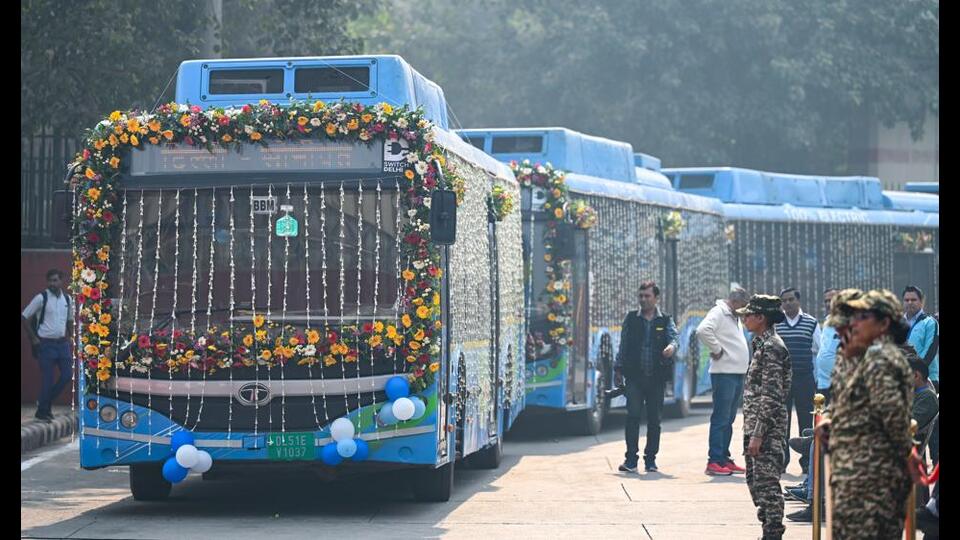
At the same event, the CM flagged off 50 new electric buses, including 30 twelve-metre and 20 nine-metre low-floor AC buses, each equipped with CCTV cameras, panic buttons, GPS and accessibility-friendly features.
Gupta said that while the previous government added only about 2,000 buses in 11 years, her administration has inducted 1,350 electric buses in eight months. She also highlighted the resumption of interstate and university special bus services, which had been discontinued earlier.