
Sign in

Ggm: Locals flag inaction despite data on waterlogging hotspots

The members pointed out that despite repeated submissions of field reports to the Municipal Corporation of Gurugram (MCG), the Gurugram Metropolitan Development Authority (GMDA) and even Haryana cabinet minister Rao Narbir Singh, no meaningful mitigation plan has been put in place

Published on: May 6, 2025, 06:40:06 IST
Share
Share via
  • facebook
  • twitter
  • linkedin
  • whatsapp
Copy link
  • copy link

Gurugram: With the monsoon season looming over Gurugram, members of the citizen-led initiative Making Model Gurugram (MMG) have expressed their dismay over the civic administration’s failure to act on detailed data that they had provided on the city’s chronic waterlogging hotspots, they said.
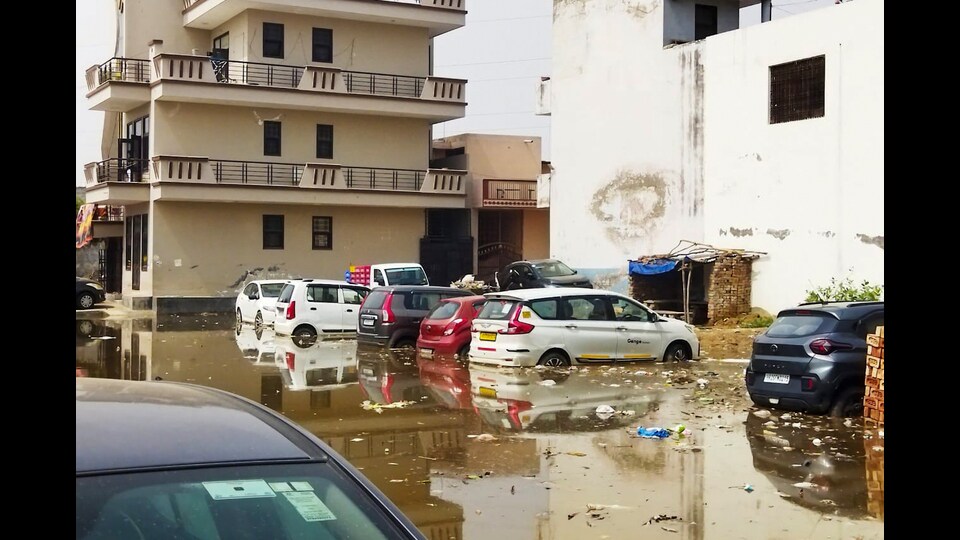
Vehicles parked in a waterlogged plot in Ashok Vihar in Gurugram. (HT PHOTO)

The members pointed out that despite repeated submissions of field reports to the Municipal Corporation of Gurugram (MCG), the Gurugram Metropolitan Development Authority (GMDA) and even Haryana cabinet minister Rao Narbir Singh, no meaningful mitigation plan has been put in place.

Gauri Sarin, founder of Making Model Gurugram, said residents have done the groundwork that authorities should have led. “There is now enough data on waterlogging spots shared with all relevant agencies and officials. The last four months should have been used to plan and implement preventive measures, but we’re still waiting. Local people have workable solutions—they should be included in the planning process,” she said.

Sarin emphasised the need for a multipronged approach involving the removal of flow barriers, cleaning of drains and sumps, construction of harvesting pits, and management of low-lying zones. She also urged the formation of a dedicated flood control task force to swiftly respond to citizen complaints and enforce drainage corrections before the rains hit.

Despite public statements from officials acknowledging waterlogging as a recurring challenge, MMG members insist that no ground-level consultation or action has been undertaken. “Residents understand the context of their neighbourhoods. Why not involve them meaningfully?” Sarin asked.

Chaitali Mandhotra, RWA member from Ardee City, echoed a similar concern. “Desilting is the key, and it should have been completed by now. Last year, desilting in our colony was abruptly halted and never resumed. We fear a repeat of the same chaos this year,” she said.

In Gurugram’s Sector 48, residents of Tatvam Villas have taken matters into their own hands. A colour-coded road marking system devised by resident Manjeev Aggarwal now helps commuters navigate safely through flooded roads. Green, yellow, and red markers denote safe, cautious, and avoid zones respectively. “This simple system eliminated vehicle stranding incidents last year for the first time,” said Priyansha Aggarwal, another resident, who added that blocked drains near V Club continue to cause damage and pose health risks.

MMG members now urge authorities to shift to a proactive, citizen-inclusive planning—warning that without institutional accountability, Gurugram’s flood-prone streets may once again be submerged in chaos this monsoon.

  • Leena Dhankhar
    ABOUT THE AUTHOR
    Leena Dhankhar

    Leena Dhankhar is Senior Editor and Bureau Chief, Gurugram, at Hindustan Times, where she has spent over 17 years chronicling the transformation of one of India's fastest-growing urban regions. From starting her career as a crime reporter to leading the Gurugram bureau, her journalism has been defined by investigative reporting, in-depth storytelling and an unwavering focus on public interest. Over nearly two decades, she has reported extensively across crime, politics, civic governance, elections, real estate, environment, courts, sports, education and entertainment, covering Gurugram, Faridabad, Nuh and Palwal. Her reporting has exposed several major scams and systemic failures, including insurance frauds, waste management irregularities, illegal arms manufacturing units in Nuh, illegal mining in the Aravallis, organised crime networks and governance lapses affecting millions of residents. Known for her investigative work and exclusive stories, Leena has reported on high-impact national issues, including the Nicaragua charter flight carrying Indian migrants that was turned back amid allegations of human trafficking, exposing the growing network of illegal immigration rackets. Her work has also focused on gang wars, prison administration, juvenile crime, women and child protection systems, the functioning of the Juvenile Justice Board and Child Welfare Committee, and environmental challenges such as pollution, waterlogging and deteriorating civic infrastructure. Beyond hard news, Leena has extensively documented Haryana's rich heritage, forests and wildlife, bringing attention to the state's historical landmarks, biodiversity, conservation efforts and ecological challenges through immersive reportage and feature writing. Her journalism has consistently gone beyond breaking news. She has documented Gurugram's rapid urbanisation through long-form narratives and enterprise reporting on issues ranging from pothole-ridden roads, flooding and waste management to the changing social fabric of India's Millennium City. She also writes widely read feature columns, including The Outsider, Changemaker, and Concern for Gurugram, profiling people, places and ideas shaping the city's identity. Leena is the author of Gurugram School Murder, published by Juggernaut Books, a deeply reported account of one of India's most high-profile school murder investigations. She is currently working on her second book, an investigative work exploring some of India's most significant scams and fraud investigations. Beyond print journalism, she has expanded her storytelling through public speaking and digital media. She is a TEDx speaker and has produced podcasts exploring Gurugram's transformation, civic challenges and untold stories. Her work reflects a commitment to narrative journalism that combines rigorous reporting with compelling storytelling. A law graduate with an MBA in Human Resources, Leena brings a multidisciplinary perspective to her reporting, particularly on governance, public policy and legal affairs. She has travelled extensively across India to pursue investigative assignments, often reporting from remote locations and conflict-prone areas in search of stories that matter.Read More