The city’s air quality continued to remain in the ‘very poor’ zone on Saturday for the fourth consecutive day, even as the air quality index (AQI) improved marginally to 362 from 379 recorded a day earlier, according to the 4pm bulletin of the Central Pollution Control Board.
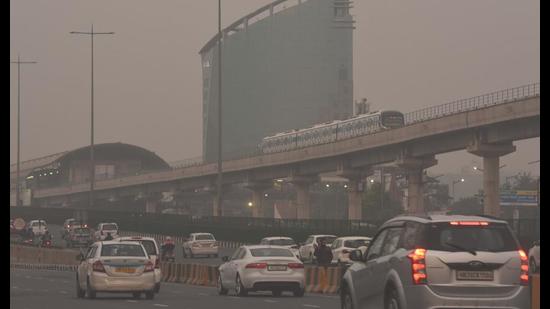
The India Meteorological Department (IMD) on Saturday said that the air quality over Delhi-NCR is likely to improve marginally in the next three days, but will remain in the ‘very poor’ category as mostly calm or slow winds during night are unfavourable for effective dispersion of pollutants. “Winds are likely to be relatively strong on Monday and Tuesday. The air quality is likely to remain in very poor category on both days,” the IMD said.
According to the data shared by the air monitoring stations in Gurugram, an AQI of 380 was recorded at Vikas Sadan, Sector 51 station recorded an AQI of 349, while AQI readings at Teri Gram and Gwal Pahari were 367 and 338, respectively.
An AQI between zero and 50 is considered ‘good’, 51 and 100 ‘satisfactory’, 101 and 200 ‘moderate’, 201 and 300 ‘poor’, 301 and 400 ‘very poor’, and 401 and 500 ‘severe’.
On Saturday, the IMD recorded maximum and minimum temperatures for the city at 24.7°C and 10.8°C. A day earlier, the maximum temperature was 26°C while minimum was 10°C.
{{/usCountry}}On Saturday, the IMD recorded maximum and minimum temperatures for the city at 24.7°C and 10.8°C. A day earlier, the maximum temperature was 26°C while minimum was 10°C.
{{/usCountry}}Experts said that a dip in temperature complicates the situation in urban areas as high-rises in cities like Gurugram not only restrict the passage of air but the concrete also gets cold, which has a negative impact on dispersal of pollutants.
Sachin Panwar, a city-based air quality expert, said, “There is strong thermal inversion and since concrete takes a lot of time to get warm, the dispersal of pollutants gets delayed in comparison to dispersion in open areas of rural belts. Smog formation will make it worse.”.
Meanwhile, officials of the Haryana State Pollution Control Board (HSPCB) said that they are keeping a close watch on the situation and their teams are checking construction sites and industrial areas regularly. “Following strict actions in the last two days, there was better compliance to the pollution norms at construction sites and industrial areas today,” said Kuldip Singh, regional officer (north), HSPCB.
Sandeep Singh, another HSPCB officer, said that they are working in close coordination with other government agencies in Gurugram to check violations.
The town and country planning department said that its teams are also visiting private colonies and sensitising the contractors and plot owners to follow norms. “Enforcement is strict and people are taking precautions due to regular checks,” said RS Bhath, district town planner (enforcement).