The Left Democratic Front’s (LDF) campaign slogan — ‘LDF 3.0 loading’ — remained unrealised on Monday as election results in Kerala signalled a decisive shift in power, pushing the ruling coalition into the opposition after a decade in office and paving the way for a Congress-led United Democratic Front (UDF) government.
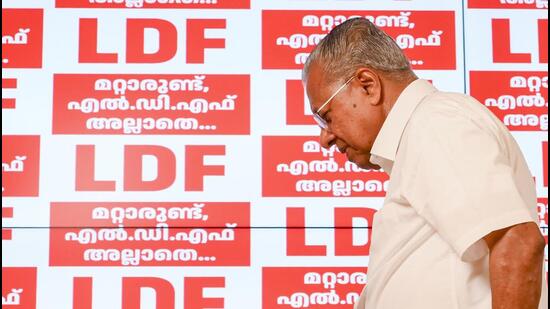
The LDF’s campaign had been centred almost entirely around Pinarayi Vijayan, the outgoing chief minister, and his governance record. Despite being 80 and dealing with health challenges, Vijayan ran an intense campaign — giving over two dozen interviews to newspapers and television networks over three days before hitting the campaign trail, where he addressed four rallies a day for over two weeks.
In an interview ahead of polling, Vijayan had spoken of a “pro-incumbency wave”, citing the government’s delivery on social welfare schemes, infrastructure projects and crisis management. However, the results indicated that voters did not share the Communist veteran’s assessment.
Hours after the results began to show a clear setback for the LDF, Vijayan appeared subdued.
Born on May 24, 1945, in Pinarayi village in present-day Kannur district, Vijayan’s political journey is deeply intertwined with Kerala’s Left movement. The same region had witnessed a historic meeting in 1939 that led to the formation of the undivided Communist Party of India in the state.
Raised in poverty in a family engaged in toddy tapping and farming, Vijayan was influenced early by peasant movements and labour struggles. His formal entry into politics came during his pre-university years at Brennen College in Thalassery, where he joined the Students Federation of India (SFI), the student wing of the Communist movement.
{{/usCountry}}Raised in poverty in a family engaged in toddy tapping and farming, Vijayan was influenced early by peasant movements and labour struggles. His formal entry into politics came during his pre-university years at Brennen College in Thalassery, where he joined the Students Federation of India (SFI), the student wing of the Communist movement.
{{/usCountry}}His rise through the ranks was swift. He became Kannur district secretary of the SFI, later its state president, and at just 24, entered the CPI(M) district committee following the party’s split from the CPI. A year later, he contested the assembly elections from Kuthuparamba.
During the Emergency (1975–77), Vijayan was imprisoned and allegedly tortured, further cementing his political credentials. In 1996, he became power and co-operatives minister in the EK Nayanar government but stepped down in 1998 to take over as CPI(M) state secretary, a position he held until 2016 — the longest tenure in the party’s history in Kerala.
His years as party chief were marked by intense factional rivalry, particularly with his mentor-turned-rival VS Achuthanandan. While Achuthanandan cultivated a mass appeal, Vijayan adopted a more rigid, organisational approach. Their public clashes led to both being removed from the Politburo in 2007, though Vijayan was later reinstated.
In 2016, the CPI(M) chose Vijayan over Achuthanandan as chief minister, citing the latter’s age. Vijayan went on to consolidate power within both the government and the party.
NP Chekutty, a veteran journalist and political analyst, said Vijayan’s leadership style was evident early on. “Within the party, as the state secretary, Vijayan had adopted the Leninist approach of consolidation of power while ignoring the proletariat. He completely misinterpreted Communist and Leninist principles. The party should have ideally resisted him and questioned his approach. But it failed to do so,” he said.
Pinarayi Vijayan’s journey
Vijayan’s first term as chief minister (2016–2021) was dominated by crisis management — from Cyclone Ockhi in 2017 to the devastating floods of 2018, landslides in 2019 and the Covid-19 pandemic in 2020. His handling of these crises drew widespread praise.
His daily press briefings during the pandemic, coupled with welfare measures such as advance pension payments, community kitchens and free ration distribution, were widely credited with cushioning vulnerable populations.
A retired senior bureaucrat described Vijayan as “a thoroughly professional politician”.
“During a crisis, he helps bring down the temperature in the room. I have worked closely with him as chief minister and he was always a patient listener. He’s extremely business-like and respects the time of bureaucrats like us. You can see him take notes even when a junior officer is speaking in the room,” the officer said.
The official added that Vijayan maintained tight control over governance. “He is his own spokesperson. He doesn’t permit anyone to speak on his behalf.”
The LDF’s re-election in 2021 was widely attributed to this governance record, along with expansive welfare programmes.
Vijayan’s tenure also saw a strong push for infrastructure, including land acquisition for the ₹6,000-crore expansion of National Highway 66, the Edamon-Kochi power highway, the GAIL Kochi-Mangaluru gas pipeline, the Vizhinjam transshipment port in partnership with the Adani Group, and phases of the Kochi Metro. Work on a tunnel road to Wayanad is also underway.
These projects were largely funded through the Kerala Infrastructure Investment Fund Board (KIIFB), which raised resources via masala bonds listed in London and Singapore. While this enabled large-scale investments, critics flagged concerns over rising debt. By 2024-25, Kerala’s outstanding liabilities were estimated at over ₹3 trillion, with a debt-to-GSDP ratio of 34–35%.
Senior Congress leader Ramesh Chennithala had earlier criticised the model. “KIIFB model is out-of-budget borrowing. The only revenue for KIIFB is the issue of masala bonds. It’s a big folly because the interest rate is 9.75%...the public exchequer is empty today and there is high over-expenditure. There is no proper collection of taxes,” he said.
CPI(M)’s governance model
Despite administrative successes, critics argue that Vijayan’s governance deviated from traditional Left principles and weakened internal democratic processes within the CPI(M).
Controversial projects such as the proposed Silver Line semi high-speed rail corridor and the Wayanad tunnel road drew criticism over environmental concerns. While SilverLine was shelved amid protests, work on the tunnel project continues.
J Prabhash, a former political science professor at Kerala University, said Vijayan’s decisiveness came at the cost of dialogue.
“(In controversial projects), he simply did not want a dialogue on it or have a democratic discussion. He could not take the opposition along unlike previous Communist chief ministers. His decisions also indicate a clear deviation from Left-aligned values,” he said.
Chekutty added that Vijayan’s economic policies fostered cronyism. “A lot of money has been spent through PR to build this image of Vijayan. Even their tagline — “Who else but us?” — is fundamentally wrong. It portrays an arrogant mindset. Under him, the government has only made decisions in favour of the upper and middle classes. The tribals and other marginalised groups have not been empowered,” he said.
What now?
With the LDF voted out after 10 years in power, questions now loom over Vijayan’s political future — will he step back from active politics or take on a leadership role in the opposition, as Achuthanandan once did?