
 E-Paper



Maharashtra’s tiger zones under threat over plan to cut over 2.5 lakh trees
Bajrang’s is the 42nd tiger death in the state since January, the highest figure in the last 11 years

 Prefer HTon Google


On Tuesday afternoon, Bajrang, a majestic tiger and the chief attraction for tourists in Maharashtra’s famous Tadoba Andhari tiger reserve, died in a fierce territorial battle with another tiger at Wahangaon village under the Chimur forest range. The 10-year-old Bajrang, who had reportedly sired at least 50 cubs during his lifetime, met with his tragic end at the hands of another formidable big cat called Chhota Matka.
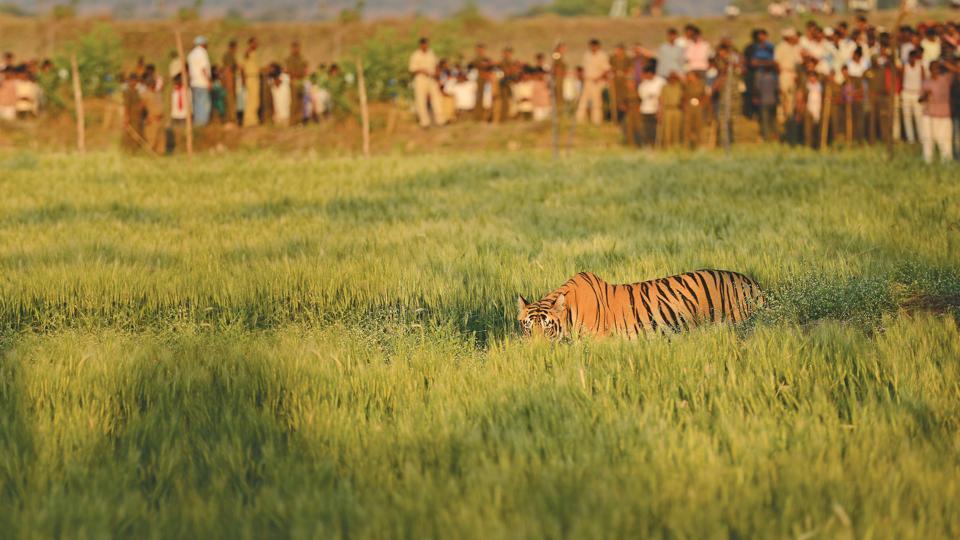
Bajrang’s is the 42nd tiger death in the state since January, the highest figure in the last 11 years. According to wildlife experts, there are three prime reasons for the tiger deaths: poaching, territorial fights and accidents. The last two have to do with the shrinking tiger habitat: the reduction of tiger areas can result in fights over territory and the widening of highways in tiger areas lead to accidents.
The forests of Vidarbha are part of central India’s famed tiger corridor, which is spread between Madhya Pradesh, Maharashtra and Chhattisgarh. The Vidarbha region has Tadoba-Andhari, Melghat, Pench, Navegaon-Nagzira, Umred and Tipeshwar tiger sanctuaries and a few smaller forests. Tadoba, one of the country’s oldest national parks spanning 1,727 square km, boasts a rich biodiversity and is home to over 125 tigers. Hundreds of tourists throng to this reserve in Chandrapur to catch a glimpse of the majestic beasts.
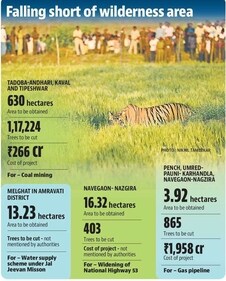
The question, however, is: for how long? Wildlife experts are worried about the future of the tiger habitat in Maharashtra, as large-scale cutting of trees in tiger zones has been proposed—at least 2.5 lakh at last count—for various infrastructure projects. The State Wildlife Board (SWB), in its meeting held in October, cleared proposals that will lead to the cutting of thousands of trees in tiger reserves, their buffer zone and tiger corridors (see graphic). The meeting was chaired by forest minister Sudhir Mungantiwar who, ironically, hails from Chandrapur.
Some of the projects are as follows. Around 630 hectares of the tiger corridor of Tadoba Andhari, Kaval and Tipeshwar tiger reserves are proposed to be diverted and 1,17,224 trees stand in danger of being chopped. In another case, the diversion of 146.99 hectares of forest land has been planned, and 192 hectares of non-forest land will be given for the Yavatmal Marki Mangli coal mining block in the tiger corridor of Tadoba Reserve, Painganga Sanctuary, Tipeshwar and Kaval tiger belts. Approximately 1,13,425 trees are under threat here.
Eight hundred and sixty-five trees will be sacrificed for an 18-inch natural gas pipeline from Nagpur to Jharsaguda passing through the Pench, Umred-Pauni-Karhandla, Navegaon-Nagzira tiger areas, using 3.92 hectares of forest land.
In another case, the tiger corridor of Umred Pavni-Karhandla reserves and Tadoba Andhari is likely to be given for mining to a Nagpur-based company and is 25 km from the core reserve area. This will entail cutting 18,024 trees.
The Melghat tiger reserve in Amravati district of Vidarbha is one of the largest tiger reserves. The state has now given 13.23 hectares of land in its buffer areas for water supply schemes under the Jal Jeevan Mission but the quantum of damage to tree cover has not been mentioned by the state authorities yet.
The widening of National Highway 53 between Navegaon and Nagzira will cost 403 trees. According to the Wildlife Board, 16.26 hectares of eco-sensitive zone and tiger corridor will be diverted for the widening. An electricity transmission line from Umred to Nagbhid will cost 386 trees and 179 hectares of tiger corridor of Navegaon Nagzira and Tadoba reserves, while the Kamleshwar-Warud electric line passing through the tiger corridor of Bor-Pench will cost 380 trees and will use 30 hectares of land.
There is another proposal to chop 2,48,673 trees for an irrigation project and two coal blocks as well although it has been put on hold temporarily and a committee under retired IAS officer Praveen Pardeshi has been appointed to study how the damage can be minimised.
When questioned, forest minister Mungantiwar said, “I have not allowed mass destruction of trees. I have not cleared the Asolamendha irrigation project and have asked Praveen Pardeshi to gauge what is necessary and submit a report. People who don’t help in the protection of forests must not preach to those who have conserved forests. The Centre has already rejected an airport in Chandrapur area.’’
Pardeshi, a part of the SWB, also heads the Bombay Natural History Society (BNHS). “I have visited the spot and am finalising my report,” he said. “We will try to save some trees.”
Wildlife experts are unhappy about the unfettered chopping. “The Asolamendha irrigation project and the Lohardongari mine proposals in Vidarbha will involve huge tree-felling in the tiger corridor, and hence need serious scrutiny though site inspection,” said Kishor Rithe, director of BNHS. “I hope the SBWL expert committee will ensure safety measures for the tiger corridor.”
“The biggest threat to tigers is the fragmentation of forests and forest degradation,” said Aneesh Andheria of the Wildlife Conservation Trust. “While the tiger population has been increasing in the last 15 years, one must not forget that the quality of forests outside tiger reserves has gone down. The best way to protect tigers is to have good corridors so that tigers can move freely. Indiscriminate diversion of forest land for non-forest purposes is emerging as a threat to the connectivity of tigers and is detrimental to their long-term survival.”
Bandu Dhotre, president of the environmental NGO Eco-Pro and a former member of the SWB, said the clearing of projects in the tiger corridor and tiger areas was dangerous. “The man-animal conflict in Chandrapur district is at its highest,” he said. “The tiger population is increasing and we need to protect the corridors. But instead of protecting these, the space for the tiger is being taken over for projects.”
It is not just the state authorities—the national wildlife board too is clearing proposals that could damage the tiger habitat. In August, the National Board for Wildlife (NBWL) diverted many areas in the tiger corridor in the Tadoba-Pench and Melghat tiger reserves (see graphic).
Around 14.7 hectares of forest land is proposed to be acquired in the Pench-Bor-Melghat tiger corridor for the upgradation of the Nagpur-Katol national highway NH 353 J. The NBWL is also considering allowing 39.63 hectares of the Kanha-Pench tiger corridor and the Kanha-Navegaon-Nagzira tiger corridors to be used for laying the Madhya Pradesh Power Transmission Package Limited’s 14-kilometre-long and 27-metre-wide Nainpur-Mandla electric power line.
The proposed four-laning of National Highway 930 D from Bamni to the Telangana border will cost 37.63 hectares of forest land from the tiger corridor connecting Tadoba, Kanhargaon Sanctuary, Indravati Tiger Reserve and Kawal Tiger Reserve. Diversions of over 20 hectares of land from the core and buffer areas of the Melghat Tiger Reserve have been allowed by NBWL for the upgradation of existing roads from Makhala to Madizadap, Jarida to Khandukheda, Hatru to Marita and the Chilati Kuhi Road.
To be sure, the ministry has proclaimed that studies will be done and measures taken before the projects are begun. It has requested the director of the Wildlife Institute of India (WII) and the state forest department to carry out site inspection and submit a report; it has also declared that all animal passage plans and mitigation measures suggested by WII will have to be followed. All the proposals have reportedly been cleared with many conditions, but how many of such conditions are fulfilled is not known.


