
 E-Paper



Quest to regain movement, one robot at a time
Dr Riener’s lab, the Sensory-Motor Systems at Eidgenössische Technische Hochschule (ETH) in Zurich is at the frontier of this research globally

 Prefer HTon Google


At first glance, Dr Robert Riener’s exoskeleton looks like Armor from the Marvel franchise Iron Man. In the Hollywood franchise, a quirky scientist Tony Stark creates an exosuit to enhance his human ability. While Stark wears a hardened armour to fight baddies, Dr Reiner’s exosuit, called a Myosuit, is made of a soft, flexible lightweight material and helps paralyzed patients stand and walk.
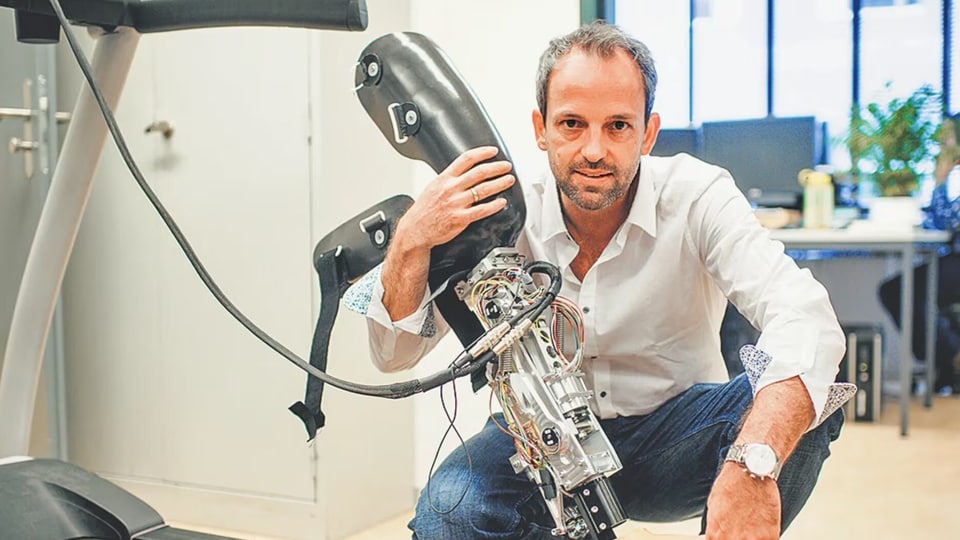
Musculoskeletal apparatus or assistive robotics, which is what Riener builds, are machines to restore, support and augment physical function for people with disabilities or age-related impairments. This includes wearable robotic frames such as the Myosuit he wears and other therapy devices that help patients move their limbs.
Dr Riener is a professor at Eidgenössische Technische Hochschule (ETH) in Zurich and his lab there, the Sensory-Motor Systems, is at the frontier of this research globally. Dr Riener’s lab, the Sensory-Motor Systems at Eidgenössische Technische Hochschule (ETH) in Zurich is at the frontier of this research globally. The lab has a machine shop to reconstruct prototypes of wearable robotics, an electronics room to develop mechatronic devices like sensors, actuators and controllers from scratch, and a massive computer lab to run machine learning simulations for these prototypes.
Since 2010 when he got into the field, Riener has published over 500 scientific papers on the subject, has 26 patents in rehabilitation robotics and currently, 40 researchers work at his lab. In 2016, Dr Riener founded Cybathlon, an international Olympic-style competition where people with disabilities team up with developers from startups and companies and academic labs (like his) to test and showcase cutting-edge assistive robotics technologies. In 2024, 80 countries participated in the challenge, and brought the community together to bring out the best in assistive robotics.
HT talked to Dr Riener at his lab on the future of assistive robotics and when will could see paralysed patients using robots to stand, walk and run. Edited excerpts.
What level of impairment can a person have and still benefit from your technology?
Though the robotic devices can work for almost any level of impairment, they need to be operated using either a remote, joystick or a computer. How does a patient with no limb mobility do that? Some devices are autonomous and can be switched on by a caretaker. Others require mechanical controllers like joysticks. In case of complete paralysis, we need to create a brain-computer interface, but that is not easy to apply or reliable.
There’s a unique challenge in building robotics for the disabled. You’ve to reliably understand a disabled patient’s desire, and translate that into safe, comfortable machine motion. What’s the hardest technical problem in reading nerve or muscle signals?
Assistive robotics is about understanding the intention of a disabled person than raw mechanical engineering. How do we know if a person wants to run or take steps down to the ground floor, and create a machine that follows that intention?
To do that, we need to make the patient wear an electrodes cap that can get a signal of intention directly from the brain. But it’s not aesthetic or comfortable for patients to wear for long. In some cases, you also need to implant electrodes inside the brain, which makes it unethical or a safety problem.
The other challenge is to convince engineers and technicians to spend time with people with impairments and the clinical staff who work with them. There are challenges and limitations that exist even in the best prostheses, orthoses and wheelchairs in the world. Engineers must understand the patients to build a technology that works for them.
The assistive robotics market is set to grow from $ 5.30 billion to $ 24.28 billion by 2031, at a CAGR of 28.88% according to a report by Mordor Intelligence. But we don’t see many exoskeletons like MyoSuit in our daily life. Is there a technical roadblock?
Batteries. Currently, the device battery lasts for two hours and then needs a charge. That’s not enough if you’re developing an exoskeleton for a patient who wants to wear it for a whole day. Weight is another challenge. Our exoskeleton is about five kilograms in weight. That’s not feasible to wear all day long. Batteries and motors are the heaviest part of an exoskeleton which need to become lighter and last longer.
How long before we see exoskeletons in our daily life? How much will they cost?
The large and bulky exoskeletons that came out 10-15 years ago were heavy, slow and expensive. New devices such as MoGo or Hypershell came out that are very lightweight, agile, and affordable for individuals. But it will take many years till you see any adoption by the market and society.
More than that exosuit itself, your focus is on how humans change their behaviour when they suddenly walk using your wearable robot. What’s the most memorable thing that a patient has said to you?
Many people are so emotional when the first time they can stand up from a wheelchair wearing an exosuit. They hadn’t stood up for years. “I can see my children eye-to-eye level,” one told me. It is amazing to see their happiness at the fact that they can stand from the wheelchair.
Will exoskeletons and prosthetics eventually outperform normal human ability? If yes, what happens then?
Sure, this will happen. But it will take longer than most people think. It would be not the first time that technology outperforms the human: see the steam engine, the automobile, the calculator, the personal computer, etc.
As you said, a technology can also be used for riskier propositions. Like in Iron Man, an exosuit can be used in soldier augmentation systems where able-bodied people enhance their powers. Is this a potential future use case of your technology?
So far, most prosthetic, and orthotic technologies are still too bulky, too heavy, and too slow to work for soldier augmentation, but yes, there’s always a possibility. With every new technology, we need to assess the risks for the individual and the society and work with through regulations.
What’s the thing that surprises you the most about assistive technology as a field of robotics?
The polarization in our society: Many people are anxious about the technology. It can enhance, make patients lose control or be used in the military. These fears need to be addressed by engineers and researchers like us. Others believe that the technology will solve everything, which again is an extreme thought.
Realistically, what will we see in this technology in the next five years?
Power density of motors and batteries will continue to improve. Materials are getting better and thanks to AI, user interfaces will get more intelligent and easier to be used by patients. Ergonomics will also improve, but we are still away from mass adoption of this technology till health insurance includes wearable robotics as allowable medical devices.


