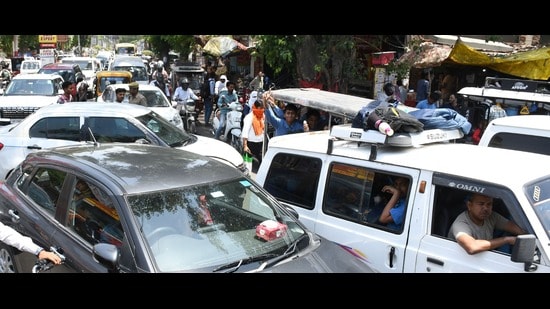
The rising number of vehicles on Sangam city roads with each passing year is posing a major challenge for the staff-starved traffic department, which struggles daily to manage the worsening vehicular congestion.
Between 2016 and 2024, a significant 8,61,422 new vehicles hit city roads, bringing the annual average to 95,713 vehicles. Currently, around 17.58 lakh vehicles are registered with the regional transport office (RTO) under 32 categories of vehicles.
Of the total number of new vehicles added between 2016 and 2024, over 97% (8,37,180) are two-wheelers and cars.
According to records from the RTO, Prayagraj, a total of 1,00,313 new vehicles were registered in 2016, followed by 1,17,349 in 2017, 1,20,520 in 2018, 1,18,832 in 2019, 87,832 in 2020, 93,344 in 2021, 1,00,976 in 2022, 1,10,520 in 2023, and 1,19,736 in 2024.
Of the total number of new vehicles, a significant 97.18% or 8,37,180 comprised two-wheelers and cars, including 7,27,370 bikes and scooters and 1,10,810 cars. The third-highest number of new vehicles includes e-rickshaws, amounting to 32,264 (3.74%), translating to an average of 3,586 e-rickshaws hitting city roads per year.
Additional regional transport officer (administration), Rajeev Chaturvedi, said that the annual increase in vehicle registrations in Prayagraj shows an upward trend, which will further worsen traffic congestion on the existing road infrastructure unless alternative measures are implemented before the 2031 Kumbh Mela to ease road pressure.
{{/usCountry}}Additional regional transport officer (administration), Rajeev Chaturvedi, said that the annual increase in vehicle registrations in Prayagraj shows an upward trend, which will further worsen traffic congestion on the existing road infrastructure unless alternative measures are implemented before the 2031 Kumbh Mela to ease road pressure.
{{/usCountry}}Official data from the public works department (PWD) reveals that the district has a total of 4,162 roads measuring 9,545.016 kilometers. Of this, 210 roads measuring 467 kilometers crisscross city limits, while 179 kilometers fall under the National Highways Authority of India (NHAI) and 150 kilometres under National Highways (NH).
According to executive engineer, PWD Prayagraj, PK Rai, the existing road infrastructure comprises roads under various categories including NHAI, NH, city roads (CR), village roads (VR) and other district roads (ODR).
On average, Prayagraj has a vehicle density of over 184 vehicles per kilometer, given the total vehicle count of approximately 17.58 lakh registered with the RTO against the existing road length of 9,545.016 kilometers.
To ease congestion on city roads, traffic department officials have identified seven critical choke points that urgently require flyovers to provide relief from traffic snarls. These flyovers would also help ensure smoother traffic movement during the forthcoming 2031 Kumbh Mela.
According to traffic inspector Amit Kumar, a flyover from the PAC Gate in Dhoomanganj to Nehru Park would help ease congestion on the busy GT Road, also known as Kanpur Road. Other suggestions include a flyover from Khuldabad Police Station to Buddha Tazia on Noorullah Road, a parallel bridge to the existing Phaphamau Bridge, a flyover from Swaroop Rani Nehru Hospital crossing to CMP Degree College crossing, a single-lane flyover from the FCI godown in Naini to the Arail crossing, a flyover near the ADA railway crossing, and one from Chota Baghada to the Rahimapur area on the outskirts of the city.
According to traffic department officials, during religious gatherings like the recently concluded Mahakumbh 2025, the construction of additional flyovers would significantly help ease traffic congestion across city roads.