E-Paper



Political arithmetic, social chemistry signal BJP’s recalibration in UP
The party is expected to use the upcoming organisational reshuffle and appointments to vacant posts in boards and corporations as an opportunity to address gaps in caste, regional and gender representation that may have remained unaddressed in the ministry expansion

 Prefer HTon Google


The long-awaited expansion of the council of ministers by chief minister Yogi Adityanath on Sunday is a significant exercise aimed at recalibrating caste, regional, gender and organisational equations ahead of the crucial 2027 Uttar Pradesh assembly elections.
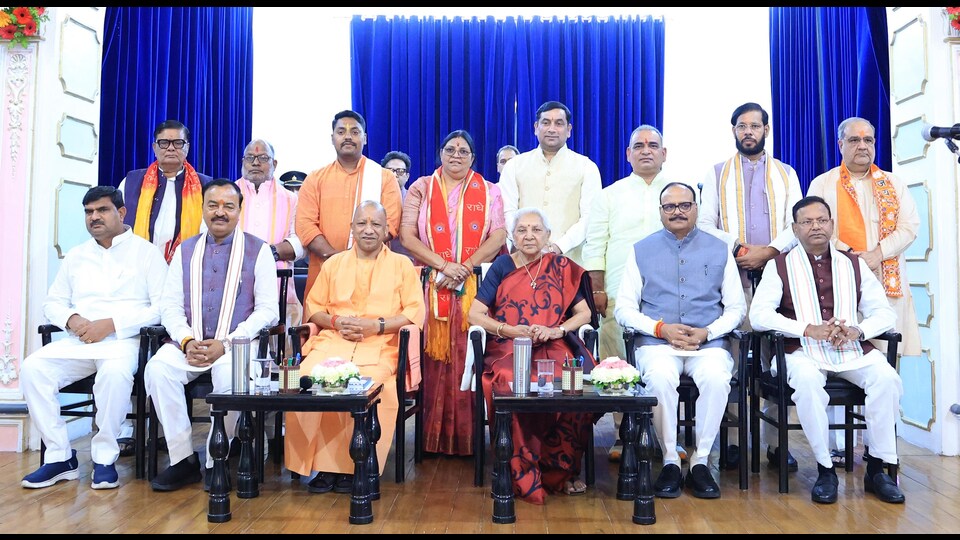
The expansion was carried out without dropping any minister from the existing council, indicating the BJP leadership’s effort to accommodate new social and political groups without disturbing the existing settings and triggering an avoidable discontent.
The Sunday’s exercise, which was being talked about for months, is being viewed as a calculated move to work out political arithmetic and social chemistry at a time when the BJP is all set to intensify preparations for the 2027 assembly elections after the historic victory in West Bengal. The induction of leaders from OBC, Dalit and non-Yadav backward communities is aimed at consolidating the BJP’s broader social coalition, while also addressing regional representation.
The move is also being viewed as the BJP’s attempt to politically counter the Samajwadi Party’s PDA (Pichhda, Dalit, Alpsankhyak) narrative, which gained considerable traction during the 2024 Lok Sabha elections and was seen as one of the key factors behind the SP’s unprecedented performance in proportion to the BJP’s shrinkage in the state..
The party is expected to use the upcoming organisational reshuffle and appointments to vacant posts in boards and corporations as an opportunity to address gaps in caste, regional and gender representation that may have remained unaddressed in Sunday’s expansion of the council of ministers.
At the formation of the Yogi 2.0 government in March 2022, the ministry included 20 OBC, eight Dalit, seven Brahmin, six Rajput, four Vaishya, and two Bhumihar ministers. After the first expansion in 2024, OBC representation rose to 22 and Dalit to nine, while the Brahmin count remained at seven despite Sunil Sharma’s induction as Jitin Prasada moved to the Centre.
The latest expansion continues this balancing act, inducting six new ministers—one Brahmin, three OBCs, and two Dalits—alongside the elevation of two ministers of state to independent charge.
Bhupendra Singh Chaudhary: BJP’s key Jat face from West UP returns to cabinet
The induction of Bhupendra Singh Chaudhary, 57, is politically significant as he is considered a prominent Jat face from western Uttar Pradesh. He hails from the Moradabad region.
A former state BJP chief, his return to the cabinet assumes importance amid the party’s efforts to maintain its hold over western UP, where caste equations and farmer politics continue to influence electoral outcomes. Chaudhary, who currently comes from the Upper House of the state legislature, was minister of Panchayati Raj, before he moved to the organisation, taking over as the state president of the party in August 2022.
Manoj Pandey: Rewarded for rebelling against SP
The inclusion of Manoj Kumar Pandey, 58, is also politically notable. The Unchahar MLA had rebelled against the Samajwadi Party during the February 2024 Rajya Sabha elections and later moved closer to the BJP. His elevation being considered as a reward for the rebellion against the SP is expected to help the BJP strengthen its outreach among upper-caste and politically influential sections in central Uttar Pradesh. He is vocal when it comes to issues concerning the Brahmin community. He was a prominent Brahmin face in the Samajwadi Party and served as a cabinet minister in the Akhilesh Yadav government. He was also the SP’s chief whip in the assembly.
Pandey is believed to have influence in areas like Rae Bareli and Amethi, which have traditionally been strongholds of the Gandhi family.
Political observers say BJP is using Pandey to make inroads into SP’s traditional Brahmin vote base in Awadh and Purvanchal.
Krishna Paswan: Accent on Dalit representation
Krishna Paswan, BJP MLA from Khaga in Fatehpur, is a prominent Dalit leader of the Paswan community who began her journey as an anganwadi worker. She is a four-time legislator and two-time district panchayat member. Her induction is being seen as a symbolic outreach to women as well as Scheduled Caste voters.
Surendra Diler: Political legacy of his family spans three generations
Surendra Diler, 33, the BJP MLA from Khair in Aligarh, is a prominent young Dalit leader and the son of former MP Rajveer Singh Diler. His induction marks the continuation of a political legacy spanning three generations. His grandfather, Baba Kishan Lal Diler, was a six-time MLA and four-time MP, while his father, Rajveer Singh Diler, served as BJP MP from Hathras and earlier as MLA from Iglas.
He comes from the Valmiki community that is believed to be a staunch BJP loyalist caste in UP. Induction of Surendra Diler may help the BJP make its hold over non-Jatav castes even stronger.
Hansraj Vishwakarma: From grassroots worker to minister
Hansraj Vishwakarma, 57, an MLC and BJP district president of Varanasi for the last 10 years, is an OBC leader who is believed to be instrumental in implementing the party’s strategy to make inroads amongst non-Yadav OBCs in eastern UP. His induction may help the party shape its electoral narrative in the region in 2027 and also send a message to the party cadre that the BJP took care of its loyal and grounded workers.
Kailash Singh Rajput: Wields influence among Lodh voters
Kailash Singh Rajput, 63, is an MLA from Tirwa constituency in Kannauj district actively involved in local development campaigns, He comes from the dominant Lodh caste under the OBC. Lodhs have been strong BJP supporters since the emergence of Kalyan Singh as their leader. Induction of Rajput, a law graduate and experienced BJP leader in the region may help the party continue to win their support and strengthen the party in Kannauj that is believed to be the SP’s stronghold. .
Tomar, Pal elevated as MoS (independent charge)
The promotion of Ajit Singh Pal (47) and Somendra Tomar ( 45) as ministers of state (independent charge) is being viewed as recognition of their organisational and electoral performance as well as an attempt to reward loyal leaders before the next assembly elections. A two-time MLA from Sikandra constituency in Kanpur Dehat, Pal belongs to the Baghel community under the OBC, while Tomar who represents Meerut South constituency is a Gurjar by caste and his elevation may keep the community in good humour.
Analysts say the latest expansion reflects the BJP’s continuing strategy of broad social engineering, which has remained central to its electoral success in Uttar Pradesh since 2014 when it strategically courted non-Yadav OBCs an non-Jatav SCs to its remarkable political gain that somehow looked to fritter away in 2024, alerting the BJP top leadership and forcing it to start taking course corrections.
BJP’S LEGISLATIVE STRENGTH
Assembly: 258 MLAs — 45 Rajputs, 42 Brahmins, 84 OBCs, 59 SCs, 28 other upper castes.
Legislative Council: 79 of 100 members – 23 Rajputs, 14 Brahmins, 26 OBCs, 2 Muslims, 12 other upper castes, 2 SCs.