E-Paper



Rain improves Delhi air, Grap 4 revoked
The Safdarjung weather station—considered representative of Delhi weather—recorded 3.9mm of rainfall in the 24 hours preceding 8.30am on Thursday

 Prefer HTon Google


New Delhi
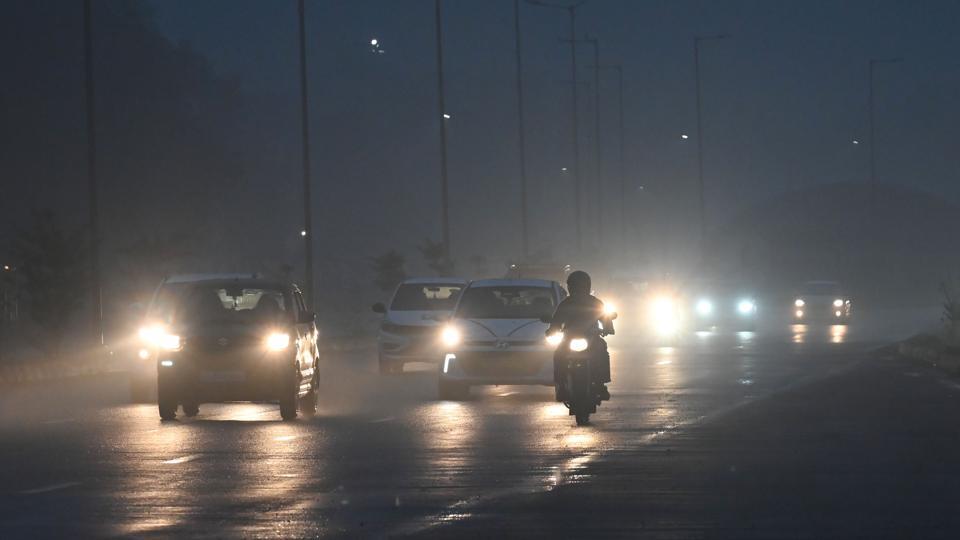
Stage 4 of the Graded Response Action Plan (Grap) was revoked on Thursday as a spell of light rainfall from late Wednesday to Thursday morning—caused due to a western disturbance—and strong surface winds dramatically improved the air quality in Delhi and NCR cities. The move comes a day after the Commission for Air Quality Management (CAQM) in NCR and adjoining areas imposed stages 3 and 4 of Grap due to a sudden decline in air quality due to meteorological factors.
On Thursday, Delhi’s air quality index (AQI) improved to 302 (“very poor”) at 4pm from 386 (“very poor”) recorded at the same time a day before. The AQI had crossed the 400 (“severe”) mark by 8pm on Wednesday, but rainfall and winds in the intervening night dispersed pollutants. At 8pm on Thursday, the AQI improved to 288 (“poor”).
The Safdarjung weather station—considered representative of Delhi weather—recorded 3.9mm of rainfall in the 24 hours preceding 8.30am on Thursday. The highest rainfall, 10.1mm, was recorded at the Palam station, followed by 9.7mm at the north Ridge station.
The India Meteorological Department (IMD) forecast another western disturbance to start impacting northwest India from January 18, with chances of another spell of light rainfall on January 21. It has, meanwhile, issued an orange alert for dense to very dense fog on both Friday and Saturday.
“We saw overnight rainfall across most of Delhi due to a western disturbance, the impact of which is now over. A second western disturbance will start to influence northwest India from January 18, meaning cold northwesterly winds are unlikely to persist for too long,” an IMD official said.
According to IMD, Delhi has now logged 6.1mm of rainfall this month, against the long-period average (LPA) of 19.1mm for January.
Due to overnight rain, Delhi recorded shallow fog on Thursday, with the lowest visibility at the Safdarjung weather station at 500 metres.
The overcast skies also led to a rise in minimum temperature, from 6°C a day earlier to 10.3°C on Thursday, which was three degrees above normal. The maximum was 19.6°C on Thursday, up from 18.1°C recorded a day earlier.
“Fresh snowfall has been recorded and the impact of this rain spell will lead to minimum dipping again. It may drop to 6°C by January 19, before the next western disturbance once again changes the wind direction and causes the minimum to rise again. The maximum, meanwhile, will hover between 19°C and 21°C,” the IMD official said.
Stage 3 of Grap remains in force
CAQM officials said only Stage 4 of Grap has been revoked as the AQI may fluctuate again and that measures under Stage 3 will remain in place till further notice.
The Supreme Court, on December 5, 2024, asked CAQM to invoke Stage 3 measures when the AQI reaches 350, instead of the previous threshold of 400 and Stage 4 measures when the AQI reaches 400, instead of the previous threshold of 450.
“Owing to much favourable meteorological factors and rain in the region since the night of January 15, the CAQM sub-committee in its meeting on January 16 further reviewed the air quality scenario in the region,” CAQM said in a statement, adding forecasts showed Delhi’s AQI was likely to be in the lower-end of “very poor” for the next few days.
“However, only as a matter of precaution, considering the uncertainties in the model predictions and abrupt fluctuations in the meteorological factors, it was opined that Stage 3 of Grap may be continued with and the situation be reviewed subsequently,” it added.
Stage 4 measures lifted include the restrictions on entry of trucks into Delhi, and the ban on BS-4 and lower heavy goods vehicles (HGVs), unless they are involved in essential or emergency services. Construction and demolition activities on linear projects, such as highways or pipeline works, are allowed once more, while classes 6 and higher need not function in hybrid mode any longer.
IMD has forecast strong surface winds on Friday, after a spell of dense to very dense fog in the early hours. Forecasts by the Centre’s Early Warning System (EWS) for Delhi predicted “very poor” AQI until Sunday.