
 E-Paper



Relief in Prayagraj as Ganga, Yamuna further recede
While Ganga was receding at a rate of around 5 cm on an hourly basis, water in the Yamuna was receding at around 6cm per hour, official said.

 Prefer HTon Google


Water levels in the Ganga and the Yamuna continued to recede at all three measuring points in Prayagraj on Wednesday.
Flood control unit officials said as of Tuesday 4 pm, water level in the Ganga had come below the danger mark of 84.734 at Chhatnag. A similar receding trend of Yamuna was witnessed at the Naini. Ganga was however still flowing above the danger mark at 84.79metre as on 4pm at Phaphamau on Wednesday, officials added.
While Ganga was receding at a rate of around 5 cm on an hourly basis, water in the Yamuna was receding at around 6cm per hour, official said.
Compared to the last 24 hours (as per reading on 4pm of Tuesday and that of same time on Wednesday), flood water in the Ganga had come down by around a metre (98cm) at Phaphamau and over one metre (1.04 metre) at Chhatnag. The water level in the Yamuna had come down by over one metre (1.11metre) in the past 24 hours, the officials said.
“As the water level would come down at Phaphamau, it will provide relief directly to Ashok Nagar and Rajapur localities. The flood affected areas of Salori, Chota Baghara and Bada Baghara would also get relief,”said executive engineer, flood control department, Brijesh Kumar Verma.
Flood water has also receded in rural areas giving relief to thousands of villagers and cattle who had taken refuge in a relief camp. The receding trend of flood water was also witnessed in many city areas including Chota Baghara, Bara Baghara, Bakshi Khurd, Sadiabad, Shivkuti, Guas Nagar, Salori, Karelabagh, Daraganj, Nagvasuki temple area, Harshvardhan Nagar.
“In our locality, while the families had shifted to relief camps, it was the responsibility of youngsters like me to guard the belongings. But now that the water is receding, many people are coming back”, said Pankaj Mishra, a student at Chota Baghara locality.
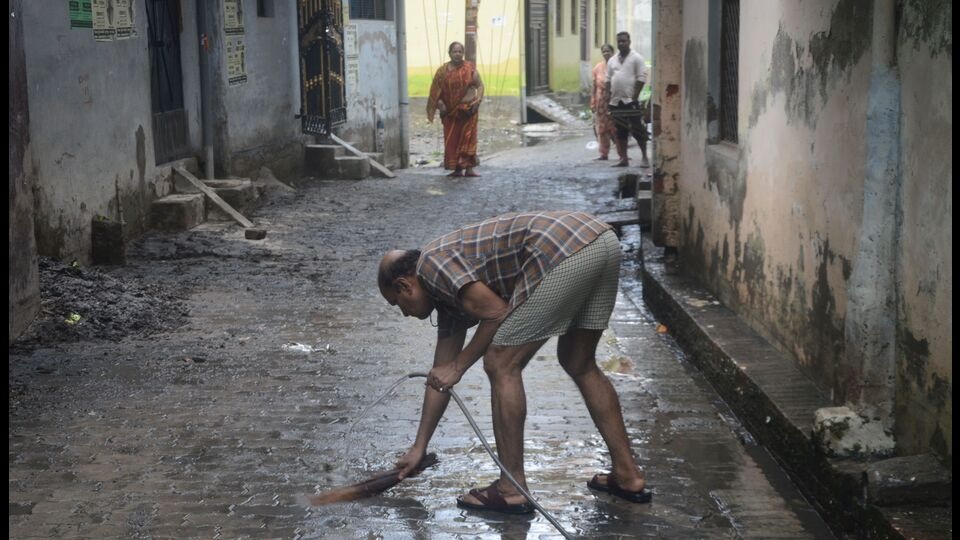
The receding flood water has however caused another problem. It has left piles of garbage, silt, thick rotten vegetation, filth, plastic wastes etc lying on the roads and areas from where the flood water has receded.
“Now that the floods are receding and leaving behind piles of garbage, we have begun to clean up these localities,” said ADM (finance and revenue) Jagdamba Singh. He is also the district nodal officer in charge of all affairs related to natural disasters.


