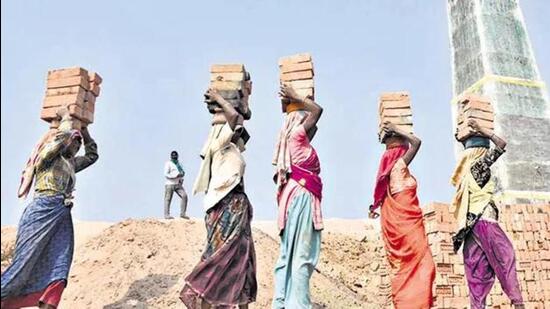
Satyaban Gahir, a bonded labourer from Odisha’s Nuapada district was rescued from a brick kiln in Tamil Nadu in 2016 under the Bonded Labour System (Abolition) Act, 1976. However, he and several other people in his village, who were rescued similarly, did not get any financial assistance from the government that they were entitled to. In December 2020, they came together to fight for their right and the group under the banner of ‘Shramavahini’ has now become a network of 4,000 members, who reach out to labourers working in brick kilns or construction sites so that their distress calls are heard by the government agencies.
“The informal network began in December 2020 to fight for the quick release of ₹20,000-assistance that the bonded labourers were entitled, but soon transformed into a forum for helping distressed labourers,” said Gahir, 33, who is the secretary of Shramavahini.
“As the distress calls of migrant labourers suffering in other states either go unheard or taken note in a belated stage by the local administration, we decided to start the informal network that alerts the district administration and labour department,” he said.
They post videos or photos of the distressed labourers on Facebook, Twitter and WhasApp while acting as a bridge between source state and destination state. Last month, a tweet on the distressing conditions of 10 Odia labourers in Telangana led to their rescue in less than 24 hours.
Santoshini Chinda, president of Shramavahini, said Odisha officers rushed to the labourers’ rescue after their network tweeted about them. “We have seen the worst days while working as bonded labourers. Coming together like this provides us with a sense of strength and security. It gives us the confidence of walking into a government office and follow up on entitlements and welfare schemes. We wish to support the government wherever possible in rescues and rehabilitation,” said Ranjita, one of the board members.
{{/usCountry}}Santoshini Chinda, president of Shramavahini, said Odisha officers rushed to the labourers’ rescue after their network tweeted about them. “We have seen the worst days while working as bonded labourers. Coming together like this provides us with a sense of strength and security. It gives us the confidence of walking into a government office and follow up on entitlements and welfare schemes. We wish to support the government wherever possible in rescues and rehabilitation,” said Ranjita, one of the board members.
{{/usCountry}}In 2020, a survey of migrant workers in Odisha by the state labour department and the National Law University of Odisha found that every year Andhra Pradesh and Telangana employed migrant labourers from Odisha who faced abuse and exploitation with meagre wages and non-protective living conditions. The survey found that the workers, especially from Western Odisha, migrate at a young age, without acquiring skills and education. They get employed in the lowest niches of the informal and unorganised labour market where they engage in heavy physical labour at lower wages and a limited scope of further advancement.
“The work arrangements are highly exploitative; more so in sectors such as brick kilns where the workers raise advances against labour, and often end up in bondage. Several families, both from the western and the coastal regions, report cases of the sudden disappearance of their young sons and husbands; often difficult to trace. The conditions are made worse due to the absence of accessible, worker-friendly, and efficient mechanisms for redress,” the survey said.
As the migrant labourers often face challenges in language in other states, the Shramavahini team acts as a bridge-builder between the source and destination states, providing assistance with any language-related challenges that may arise. It also collaborates with government and non-governmental organisations in other states to aid in the safe transportation of victims to their homes and connect survivors with various government welfare schemes.