
 E-Paper



Silencing The Bang: Firecracker sales take a tumble as young eco-warriors push climate consciousness
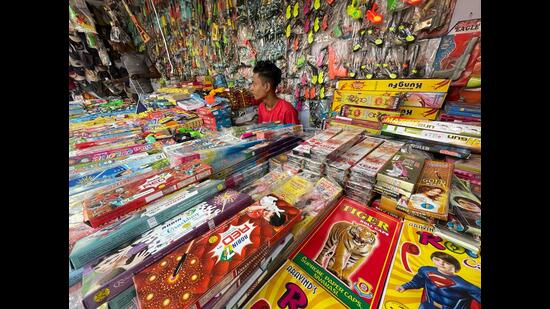
The number of firecracker shops in Yahiaganj, Aishbagh, and Alambagh has significantly dwindled as consumer preferences have evolved over the years.


LUCKNOW A stroll through the smattering of firecracker shops that emerge in the week leading up to Diwali reveals a significant decline in enthusiasm for ‘patakhas’ over the past four years. Retailers and suppliers have reported a substantial blow to their business due to the increasing preference for eco-friendly branded firecrackers.
Dwindling demand for firecrackers
The number of firecracker shops in Yahiaganj, Aishbagh, and Alambagh has significantly dwindled as consumer preferences have evolved over the years. “Most people now prefer crackers that make less noise and are less explosive. We have child-safe fireless crackers and Diwali guns that seem to be in high demand these days, but the traditional firecrackers are no longer attracting the crowds,” said Adnan Akhtar, a shopkeeper at Alambagh.
Girish Sharma, a shopkeeper in Aishbagh, echoes a similar sentiment. “All the crackers we offer are certified as eco-friendly by CSIR-NEERI (National Environmental Engineering Research Institute),” he said. “We set up shop every festival season and sell firecrackers annually. However, sales have declined recently, prompting us to reduce our inventory of the louder, high-decibel crackers this time.”
Umar, a first-time seller and supplier in Alambagh, expressed his concerns as he has not made a single sale despite stocking a room full of firecrackers for sale. “We haven’t earned a single rupee yet from firecrackers,” he lamented. “Although we’ve supplied to a few retailers, no buyers have visited our shop. We anticipate post-Diwali losses as we doubt we’ll be able to sell enough to cover our investments.”
Youthful climate activists take the lead
Sarah, a 21-year-old climate change activist and founding member of “The Conscious Humans,” underlined the observable impact of climate change on low-income communities in the city. “Since I was young, burning firecrackers always seemed like burning money. Not only do we spend thousands on firecrackers, but they also contribute to noise and air pollution, with the enjoyment being short-lived,” she said.
Sarah and her family ceased burning Diwali crackers around 2016 when she began researching the negative impacts of firecrackers. Members of “The Conscious Humans,” a group of environmentally conscious young bloggers, distribute secret letters to households the night before Diwali, urging them to abandon firecracker burning.
“We, the youth, are the architects of the world, and we cannot afford to be complacent. We must take action and be resolute in our pursuit of climate action,” said Sarah, who also serves as the operations coordinator of Fridays for Future in India -- an international movement initiated by environmental activist Greta Thunberg.
Jatin Khannaa, a Class 12 student at CMS Kanpur Road, stopped bursting crackers at the age of 15. “While Diwali is the festival of lights, the harm caused by firecrackers now outweighs the good, evident in the post-festival aftermath. Air and noise pollution levels rise, and explosive firecrackers pose a significant safety hazard to humans and animals,” he remarked. While the prospect of Lucknow residents going completely firecracker-free seems far-fetched, he hopes that people will at least reduce their purchases and use firecrackers responsibly.
Aishbagh cracker market loses sheen
Despite ongoing preparations for the popular firecracker market, which is believed to be over 100 years old in the Aishbagh area of old Lucknow, organizers believe the market has declined in recent years. The market will be open from November 10-12.
Gulsher Azad, in charge of the Firework Association responsible for setting up the three-day Diwali market, explained that the market has gone down from over 50 stalls to just 14. The shift is primarily attributed to the preference for green crackers, which yield little to no profit margins. He added that increasing environmental and noise pollution awareness among the public is a significant contributing factor.
Adhere to cracker ban in quiet zones; inspire kids for green celebration: UPPCB
In the run-up to Diwali, the Uttar Pradesh Pollution Control Board (UPPCB) has made a plea to the public, urging them to abide by pollution regulations and embrace a greener celebration.
The UPPCB has specified that firecrackers with noise levels exceeding 125 decibels (dB) should not be used. Additionally, there should be a minimum distance of 4 metres from the point of bursting. Furthermore, the manufacture, sale, or use of firecrackers that produce noise levels exceeding 100,000 dB is strictly prohibited.
The Central Pollution Control Board (CPCB) has also imposed a ban on firecrackers in areas designated as “quiet zones.” These include regions near hospitals, educational institutions, courts, religious places, and other areas declared as such by competent authorities.
In an effort to encourage a pollution-free Diwali, the UPPCB has called upon schools and educational institutions to play a vital role. The order specifies that school managers and principals in the state should educate students about the adverse effects of both air and noise pollution.
The UPPCB has further highlighted that only eco-friendly “green” firecrackers, devoid of barium salt, are permitted for use within the designated time limits. The board has issued these guidelines in the interest of the public and the environment, underscoring their commitment to promoting a cleaner and quieter Diwali.


