
 E-Paper



Tripura health workers cross hurdles to vaccinate people in remote areas
Sanjay Urang, a multipurpose worker, covers long distances every day on foot, including crossing a rivulet, to reach the remote areas in Tripura carrying vaccines to vaccinate the people who are still unaware of the necessity of the vaccination

 Prefer HTon Google


Sanjay Urang, a multipurpose worker, covers long distances every day on foot, including crossing a rivulet, to reach the remote areas in Tripura carrying vaccines to vaccinate the people who are still unaware of the necessity of the vaccination.
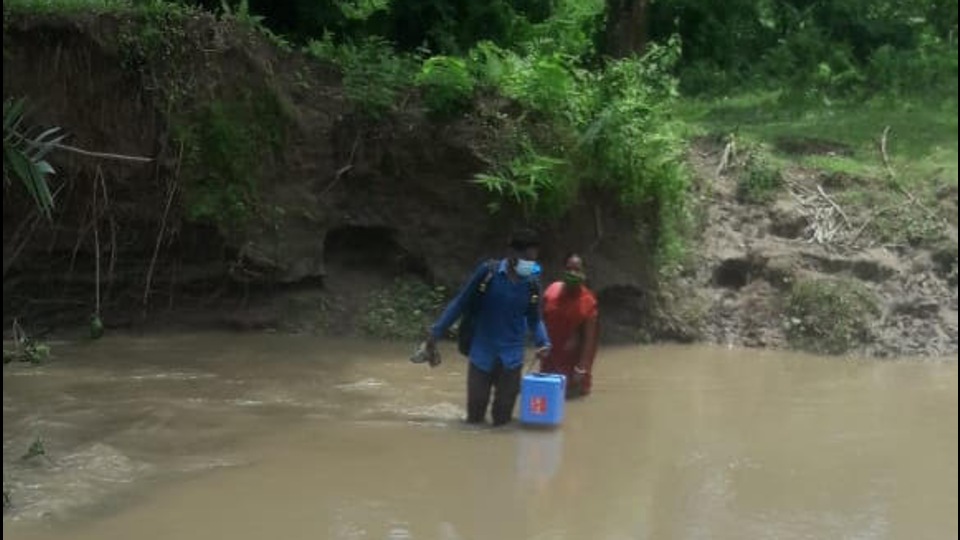
Like him, many health workers, ASHA employees, including doctors, are always on the front lines to deliver vaccines to some of the hardest-to-reach places in different parts of the state.
Mulyarampara, Nandirampara, Nabajoypara, Bikramjoypara in North district are some of remotest places where vehicle ride is still a dream. Most of Tripura’s indigenous hamlets are in hilly areas and are poorly connected.
“It’s our everyday part of life. All the centres are located in hilly areas. Distance of these centres from our health centre varies and are within 7-12 kilometres. After covering few kilometres on a vehicle, we walk on foot and also cross a rivulet without any boat,” said Dr Dwaipayan Roy, medical officer-in-charge of Laljuri primary health centre in the north district.
Nearly 200-300 people are residing in these villages and of them, 50-60 are eligible for Covid-19 vaccination.
“We have administered vaccines to almost all of them. Like in other areas, we also have to convince most of them about the importance of vaccination with the assistance of the higher administrative officials including additional district magistrate, sub-divisional magistrate, block development officer etc,” said Dr Roy.
Along with him, the multipurpose workers, ASHA employees are moving to these remotest villages crossing the rivulet, only to educate the villagers and administer Covid-19 vaccines. Dr Roy could name a few health workers, Sanjay Orang, Archana Sharma, Rahul Deb, whose tireless work in the pandemic has attracted attention.
Nanda Rani Nath, an ASHA facilitator of Laljuri primary health centre walks for 3-4 kilometres every day to visit rural places, like North Laljuri, Ujan Machmara, Nandirampara. She said that the road is not smooth enough but her determination and job never make her feel tired. “Not only me, we all are experiencing the same. Our job is to bring all people for vaccination. We also face objections from people, but it is our duty to convince them,” she said.
After her household works, she starts her day at 9 am that continues till the evening.
The health activists engaged in Jampui primary health centre in the district, close to the Mizoram border, are experiencing similar things.
Bamboobari, located near the Mamit district of Mizoram, is nearly 22 kilometres from Jampui hospital. It’s a non-motorable place where walking on foot is the only option left to the health workers to reach there.
“Bamboobari is one of the extremely hard areas to reach in North Tripura and has witnessed strong vaccine refusal area as well,” said Dr Bimal Das, medical officer of Jampui primary health centre.
Sharing his one-day vaccination programme experience in the village, Dr Das said that they started for the village at 4 am by foot and reached there at around 11:30 am. After their hectic programme ended in the evening, they had to spend the whole night in the village as they claimed it is not possible to return in the dark.
Misconception about the vaccine is prevalent in these areas, especially in Bamboobari.
“The locals have some false assumption regarding the Covid-19 vaccination. We conducted awareness programmes involving the village head, community leaders apart from the villagers and tried to clear their doubts as much as possible. After spending hours with them, we got one or two persons who came willingly for vaccination. Later, our team conducted a house-to-house visit programme. Now, a change in their mindset is visible to us. That’s our achievement,” said the medical officer.
Dr Dipankar Debbarma, medical officer-in-charge of Damcherra primary health centre said that there are some places where one cannot move only with vehicles, be it Gangajoypara, Handuraipra or Khagendrapara.
“Khagendrapara is one of those remotest villages in the area. We have some remote areas where we need to reach mostly by walking,” said Dr Debbarma.
Chief Medical Officer of North district Dr Arunabha Chakraborty said,” Our vaccination programmes in different parts of the district are going on in a full-fledged manner. There are many places where road connectivity is not so good, still, our health workers, crossing all hurdles, actively take part in reaching the vaccines to people’s doorstep.”
Apart from these villages, health workers and doctors are working to meet the target of vaccination in other rural parts of the state such as Nabachandrapara, Rambhaktapara in the West district.
According to the latest health department’s record, the state has a total of 516,180 doses in stock. The state is expected to receive additional 404,210 doses in August and another 8,650 in September.
“We have been promised to deliver 3.92 lakhs doses in July and we got total 9.55 lakh doses,” informed National Health Mission director Dr Siddhartha Shiv Jaiswal.
He also informed that a total of 24 oxygen plants are supposed to be set up in the state of which three have been completed. The rest of the plants are expected to be set up by August 15.


