
Sign in

Under Majhi govt, Odisha journalists allowed entry into state secretariat after 4 years

Apart from stopping the entry of journalists, the Naveen Patnaik government in July 2022 had banned the entry of journalists in schools

Published on: Jun 13, 2024, 10:00:16 IST
By
Share
Share via
  • facebook
  • twitter
  • linkedin
  • whatsapp
Copy link
  • copy link

Over four years after the Naveen Patnaik government stopped the entry of journalists into the Lok Seva Bhawan, the Odisha secretariat in Bhubaneswar, the BJP government led by chief minister Mohan Majhi on Wednesday threw open the gates to media persons on the first day in office.
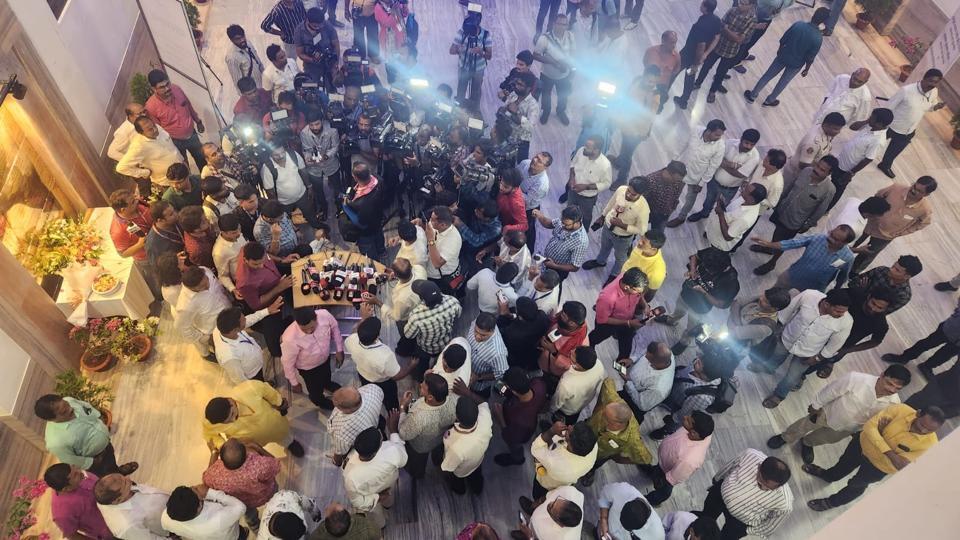
Odisha journalists at the Lok Seva Bhawan on Wednesday (HT Photo)

Entry of journalists into Lok Seva Bhawan premises was restricted by the BJD government in March 2020 following the Covid-19 pandemic. Two years later, the ban was partially lifted for accredited journalists. However, most journalists from TV news channels and newspapers who did not have accreditation could not enter the Secretariat as the Patnaik government refused to lift the ban on their entry despite demand by opposition leaders and journalists’ associations.

The BJP had promised to lift the ban once they came to power.

Journalist Ramachandi Ranasingh said it was a draconian decision on part of the Patnaik government. “The Fourth Estate is supposed to draw Laxman Rekha for the government. But in Odisha, the government drew Laxman Rekha, curbing its freedom in more ways than one can imagine. Today, we feel unencumbered. I am glad that the BJP kept its promise,” he said.

Apart from stopping the entry of journalists, the Naveen Patnaik government in July 2022 had banned the entry of journalists in schools in some areas after news channels showed how poor students were in mathematics, triggering a political row.

In Dhenkanal, the district education officer asked block education officers and school headmasters to not allow unauthorised entry of journalists into schools and classrooms, and to report such matters to the police. A similar directive was issued in Kendrapara as well.

  • Debabrata Mohanty
    ABOUT THE AUTHOR
    Debabrata Mohanty

    Debabrata Mohanty is a senior assistant editor of Hindustan Times who works as state correspondent from Odisha covering the state's politics, governance, public policy, natural disasters, environment and its society for close to three decades. With his long years of reporting from the state capital of Bhubaneswar, Mohanty has been known as one of the most experienced and credible journalists covering Odisha for the national English dailies. His reporting combines on-ground detail with deep institutional knowledge detailing the state's changing politics, governance issues, administrative reforms and the functioning of its public institutions. He has regularly reported on issues ranging from legislative developments and public policy implementation. Politics is his core areas of expertise as he closely tracks Odisha's political landscape, including the rise and transformation of the Bharatiya Janata Party (BJP), the Biju Janata Dal (BJD), the two principal political parties in Odisha. His long association with the state's political establishment enables him to write on contemporary developments in a larger political context. Mohanty takes a deep interest in writing human interest stories, environmental issues and documenting the impact of cyclones, floods, heatwaves, and other climate-related events in one of the most disaster-prone states. His coverage extends to public health, governance reforms and stories on accountability of government institutions. Before joining Hindustan Times, Mohanty worked with The Indian Express, Mail Today, and The Telegraph, where he covered at least six general elections and as many assembly elections. In 2007, he was selected for the prestigious Chevening Young Indian Print Journalist Programme at the University of Lincoln, United Kingdom, where he received advanced training in print journalism. In 2009 he won the Press Institute of India-International Committee of Red Cross award on conflict reporting for his on-ground reportage of 2008 Kandhamal riots.Read More