The huge rain deficiency in Bihar this year has taken a heavy toll on the state’s reservoirs, which have very little to offer to farmers staring at a serious agriculture crisis.
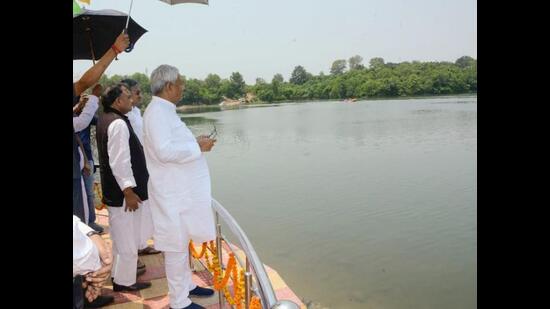
Of the 23 reservoirs in the state, barely three have over 40% water, while some are almost dry or have less than 10% water, as per the statistics of the water resources department (WRD).
The reason, said a senior official, is that the reservoirs are also rain fed and lack of rainfall has affected not only the rivers, but also the reservoirs.
“In July, rivers are usually in spate, with majority of them flowing above the danger mark. But this year, the situation is just the opposite. No river, except Kosi at one place, is anywhere near the danger mark, as Nepal has also received deficient rainfall, directly impacting Gandak, Budhi Gandak, Bagmati, Kosi, Kamla and Mahananda in north Bihar and Seemanchal areas. Last year, by this time, most of reservoirs had over 50% water and so dry spells during the sowing season were taken care of,” the official said.
As per WRD statistics, except the four dams in the Banka and Bhagalpur region, the situation is serious at most other places. Though the four dams — Badua, Orhni, Chandan and Bilasi — have over 40% water despite scanty rainfall, which has reached 75% deficiency in July, it is much lower compared to last year when they had 100% water during this time.
{{/usCountry}}As per WRD statistics, except the four dams in the Banka and Bhagalpur region, the situation is serious at most other places. Though the four dams — Badua, Orhni, Chandan and Bilasi — have over 40% water despite scanty rainfall, which has reached 75% deficiency in July, it is much lower compared to last year when they had 100% water during this time.
{{/usCountry}}In Jamui, Munger, Nawada and Lakhisarai districts, the situation has turned serious, with water in many dams reaching below the Dead Storage Level (DSL), which means below the level where there are no outlets to drain water in the reservoir by gravity due to silt accumulation. The volume of water stored below the minimum pool level of the reservoir is known as dead storage. Below pool level, water cannot be withdrawn from the reservoir.
In Kaimur district, Durgawati reservoir also has just 22% water, just half of the volume it had last year, while Batane and Kohira dams in Rohtas and Aurangabad districts, respectively, are virtually dry.
“Almost all reservoirs have water up to their pond levels, which means discharge into their respective canals can only be ensured when there’s more water in the feeding rivers (which unfortunately is missing this year),” said an official.
According to the official, however, water released from dams outside Bihar, like Rihand in Uttar Pradesh and Vansagar dam in Madhya Pradesh, is being diverted into canals as per the instructions issued by WRD minister last fortnight.
As per WRD statistics, there is significantly higher discharge in the Gandak, Kosi and Sone canals this year despite similar or lower reservoir levels. “In the case of rain-fed canal system, this is the best one can do to make water available for irrigation. Another important aspect, particularly to ensure water in the tail end canals, is that the department this year is intently following the system of managing selective/by turns discharge into sub-canals so that farmers relying on tail-end canals get their due share,” the official said.
He said that discharge from the reservoirs is usually released against requisition received from downstream canals. “The minister has insisted that officials, especially those managing tail end canals, make sufficient demand (raise requisition) for water in their respective canals. They are often tentative about raising sufficient demand, fearing it might end up damaging their canal pathways,” the official said.
Though the total length of canal distribution system is roughly 36,000 kms in Bihar, several canals, in particular at tail end, warrant repair, clearing of vegetation growth or compaction, the official said.
WRD minister Sanjay Jha said the problem due to lack of rain was unprecedented this year and chief minister Nitish Kumar was himself monitoring and reviewing the situation regularly. “On his directive, the department is trying its level best to ensure water to the farms up to the tail-end of canals. The situation in the Sone canal system, which caters to south Bihar farmers, has been improving. It is a big challenge because rain has eluded most parts of the state, but we still hope in the second leg of monsoon Bihar should get adequate rain and with diesel subsidy, the farmers will be able to make optimum use of the available resources,” he said.
The minister said the Bihar government was already working on the ambitious river-interlinking project. “This will not only augment irrigation protection but also save farmers from vagaries of nature and floods by transferring surplus water to arid zones. This is part of Nitish Kumar’s plan to ensure water to every farm by 2025,” Jha said.
With almost 80% rain deficiency in South Bihar and nearly 55% overall so far since June 1, Bihar is faced with a serious challenge, shifting its focus from flood protection to water flow in canal system.
Bihar’s dry run
State of reservoirs
Of the 23 reservoirs in the state, barely three have over 40% water, while some are almost dry or have less than 10% water because of rain deficiency this year.
Canals still well fed
Water released from dams outside Bihar, like Rihand in Uttar Pradesh and Vansagar dam in Madhya Pradesh, is being diverted into canals to supply water to farms.
The canal network
The total length of canal distribution system is roughly 36,000 kms in Bihar, but several canals, in particular at tail end, warrant repair, clearing of vegetation growth or compaction.
River-linking project
Bihar is already working on a inter-linking its rivers to augment irrigation and save farmers from vagaries of nature and floods by transferring surplus water to arid zones.
Stay updated Bihar Lok Sabha Result and with all the Breaking News and Latest News from Bengaluru. Click here for comprehensive coverage of top cities including Delhi, Mumbai, Hyderabad, and more across India . Stay informed on the latest happenings in World News.
Stay updated Bihar Lok Sabha Result and with all the Breaking News and Latest News from Bengaluru. Click here for comprehensive coverage of top cities including Delhi, Mumbai, Hyderabad, and more across India . Stay informed on the latest happenings in World News.